Blogpregnancy · traditional eating · meats and organ meats · Weston A. Price
Eating to Get Pregnant: The Ancestral Wisdom of Sacred Foods
When preparing for pregnancy, traditional peoples revered fish eggs, liver, bone marrow and small whole fish. Learn why these sacred foods mattered and how to bring them to your table.
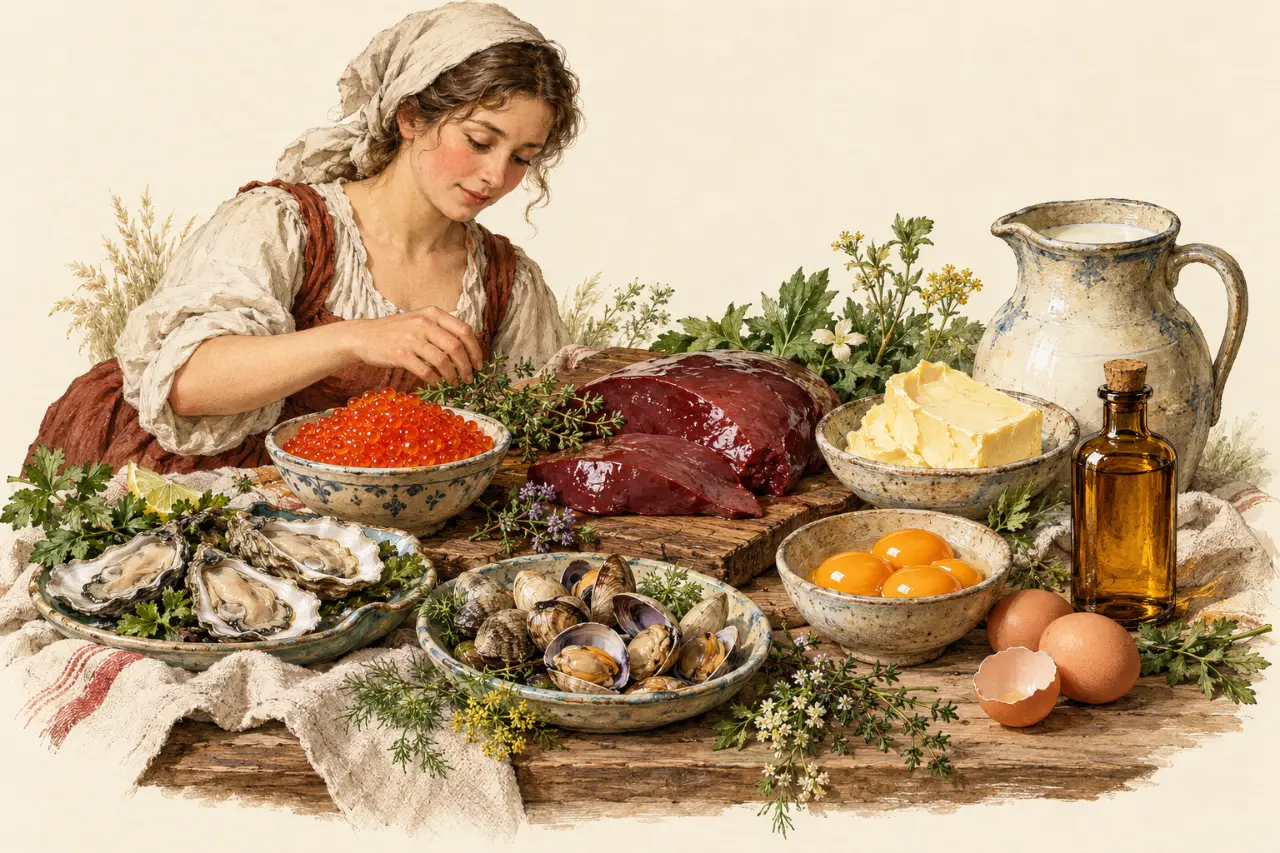
Fish roe, liver and bone marrow are some of the sacred foods that traditional peoples around the world set aside to nourish babies, growing children and, before anyone else, those preparing to have children. In these cultures, eating to get pregnant was a serious matter, guided by the elders. The travels of the dentist Weston A. Price showed why: these foods offer abundant minerals and high doses of what he called fat-soluble activators, essential for full development.
In adults, the benefits are similar: better use of nutrients and protection against disease. It's true that sacred foods are not part of the everyday menu in urban homes today, and not everyone falls in love with them at the first bite. But with a few kitchen tricks and an open mind, they can be better received than you might imagine. In nutritional value, they are unbeatable.
This article is an adaptation of a text by Jen Allbritton published in the magazine of the Weston A. Price Foundation.
What Are Sacred Foods
The dictionary defines sacred as something dedicated to a purpose and treated with reverence. Imagine an indigenous group that lives off its own land and thrives on native foods. The elders pass their wisdom on to young people about to marry, to couples, to pregnant women and to mothers raising babies and small children. They talk about specific foods, needed to nourish the body well during these critical periods.
This advice is not questioned or treated as a mere suggestion: it is a revered truth.
Minerals and Fat-Soluble Activators
When analyzing these revered foods, Weston Price discovered that they were rich in minerals and extremely rich in what he called "fat-soluble activators." Minerals are the nutrients almost everyone knows, such as calcium, magnesium, phosphorus, iron and iodine. They play many roles in building a beautiful, fully developed body and in keeping it working throughout life.
The fat-soluble activators, on the other hand, are less well understood and were a mystery even to Price himself at the beginning of his work. Science eventually showed that these "activators" are the animal forms of vitamins A (the retinol isomers), D (vitamin D3 and its isomers) and K2.
The role of these activators was described by Price himself in the book Nutrition and Physical Degeneration:
"The question arises as to the efficiency of the human body in extracting all the minerals from the foods eaten. Numerous laboratory analyses have shown that most people cannot absorb more than half of the calcium and phosphorus in their food. The amount used depends directly on the presence of other substances, especially the fat-soluble vitamins. This is probably where the greatest failing of the modern diet lies: in the intake and use of adequate amounts of the special activating substances, among them vitamins [A, D and K2], needed to make the minerals in food available to the body. It is possible to starve for minerals that are abundant in the foods eaten, because they cannot be used without an adequate amount of the fat-soluble activators."
Bricks and Mortar
Think of the body as a house built of masonry: minerals are the bricks, and the fat-soluble activators are the mortar. In other words, we can follow a diet full of extraordinarily nutritious foods, but its value depends on what is actually absorbed. Without the activators, vitamins A, D3 and K2, the effort of eating the "right" foods is in vain.
A few generations ago, sacred foods were revered: they were a required, non-negotiable part of the diet. Today, it is up to each of us to restore these truths in a culture that is confused about nutrition. Only with this effort will sacred foods once again become a common presence on the table, passed on to the next generations for the health of their families, communities and nations.
Eating to Get Pregnant: The Elders' Advice
Let's go back to the wise counsel of the elders. They would say something like this: at least six months before trying to conceive, the future father and mother should ideally start eating sacred foods in good amounts (see the list further below).
Those who grew up on the standard American diet, known as the SAD (Standard American Diet), would need more time to correct nutritional deficiencies: at least two years before trying to conceive. This diet is full of foods that work against the arrival of healthy babies:
- damaged fats, overheated and extracted with solvents;
- industrially raised meats (when there is meat at all, since many people fall into what the author calls the deception of vegetarianism);
- a load of pesticides and chemicals that comes through conventionally farmed foods, fast food, processed ingredients, personal care and cleaning products, and tap water.
Once the miracle of life begins, sacred foods should continue throughout the whole pregnancy. The mother should keep the same diet during breastfeeding, which, according to the author, should last at least a year.
Yolk and Liver: The Baby's First Foods
Between four and six months, according to the author, the baby can start complementing breast milk with first foods, ideally pasture-raised egg yolk and liver. The foundation covers this stage in Nourishing a Growing Baby, and Nu&Cru covers it in the Guide to Ancestral Introduction of Solid Foods and in the article Baby's First Foods.
Yolks provide choline, for brain development, and cholesterol, which nourishes the brain and helps build the intestinal system. Liver provides iron, whose stores drop sharply around six months of age, along with vitamins B12, B6, A and C and almost all the minerals a baby needs. It is no coincidence that yolk and liver are sacred foods.
The Sacred Foods of the West
In the Western world, the best-known sacred foods are raw dairy from pasture-raised cows, egg yolks from free-range hens and cod liver oil.
In a Western diet where sacred foods have all but disappeared, cod liver oil works as a vital insurance policy. Until World War II, parents and health professionals knew it helped ensure children's ideal growth and development. A 1930s ad, reproduced in the original article, promised that the oil gave babies the help they needed to build "a well-shaped head, a strong straight back, a firm, full chest and healthy, well-aligned teeth".
How Much Cod Liver Oil, According to the Foundation
The doses below are the ones the Foundation recommends in the article Cod Liver Oil Basics and Recommendations:
- Children from 3 months to 12 years: a dose providing about 5,000 IU of vitamin A and 500 IU of vitamin D per day, which is roughly 1 teaspoon of regular cod liver oil or ½ teaspoon of high-vitamin oil. For the little ones, use a dropper or a syringe.
- Children over 12 and adults: a maintenance dose of about 10,000 IU of vitamin A and 1,000 IU of vitamin D per day, or 2 teaspoons of regular oil or 1 teaspoon of high-vitamin oil.
- Pregnant and breastfeeding women: about 20,000 IU of vitamin A and 2,000 IU of vitamin D per day, or 4 teaspoons of regular oil or 2 teaspoons of high-vitamin oil.
The Sacred Foods of Native Peoples
- Seafood: whole small fish, fish livers, fish liver oil, fish heads and shellfish.
- Raw dairy: whole milk, fermented milk, cream and butter from pasture-raised animals.
- Eggs: from birds, especially the yolks, as well as insect and fish eggs.
- Organ meats: liver, brain, tongue, bone marrow, kidneys, lungs, tripe, intestines and reproductive organs.
- Animal fat: from beef, lamb, game, pork, poultry and marine mammals.
- Insects and the like: worms, caterpillars, larvae, grasshoppers.
Four lesser-known sacred foods deserve special attention: small fish, fish roe, bone marrow and liver. With a little creativity, they fit into a Western diet in many delicious ways.
Small Fish: Sardines, Anchovies and Company
Small, oily fish, fresh or dried, are exceptionally nutritious because they are eaten whole, with the bones and, sometimes (even better), the head and organs. There's no need to remove the skin or the bones: you eat the whole little fish. Once dried, certain details stand out even more, especially the eyes, which many kids think is awesome. Price described several societies that dried fresh fish to preserve its high nutritional value.
Anchovies, sardines and whitebait are great additions to the family's fish menu. They are rich in calcium and other minerals, and in vitamins A, D and B12. They also contain less mercury and other contaminants than large fish such as shark (known in Brazil as cação) and tuna, because they sit at the base of the aquatic food chain and feed mainly on plankton. The American organization Environmental Defense Fund keeps information on contaminants in fish and seafood.
Anchovies
Anchovies are small, salty, greenish fish, abundant in the Atlantic, Indian and Pacific oceans. Slender and strongly flavored, they are usually cleaned, cured in brine and preserved in oil. In Brazil, that jarred or tinned version is what we call aliche.
Gentleman's relish, a salty paste of anchovies, butter, herbs and spices, became popular in England in the early 19th century for spreading on sandwiches and flavoring fish cakes and croquettes. Throughout Europe, fresh marinated anchovies still appear often on menus. In the United States, they are known as a pizza topping and as an ingredient in Caesar salad dressing and Worcestershire sauce.
Sardines
The name sardine covers more than twenty varieties of small, oily, silvery saltwater fish, relatives of the herring. The word comes from the Italian island of Sardinia, where they were among the first fish to be preserved in oil. Today they are caught in the Atlantic, the Pacific and the Mediterranean, and they usually swim in large schools near the surface.
They are sold fresh (hard to find in the United States), canned in oil (olive oil is the best choice) or in sauce, salted, smoked or dried. Most commercial sardines are cleaned, beheaded and steamed before going into the can. You can make your own version with our recipe for homemade canned-style sardines.
In Asia, dried baby sardines, called niboshi (sometimes translated as anchovies), are eaten as a snack and traditionally used in niboshi dashi, the broth that is the base of miso soup. In Japan, sweet-and-sour fried sardines, known as tazukuri, are part of New Year celebrations. In Korea, fried sardines are seasoned with ginger, garlic and chili paste.
How to use little fish in the kitchen
Dried anchovies are delicious sprinkled over a green salad or blended into a chili or sauce, and they make a fun replacement for fish-shaped savory crackers. Stir a handful into tomato sauce before spreading it over a naturally fermented sourdough pizza base: no one will notice there are little fish swimming in there.
Sardines can top pizzas, go into salad dressings and spreads (like the creamy green dressing in the recipes below, or our sardine pâté), flavor soups, or be mixed into a salmon salad without changing the taste much. For the more adventurous, try a sardine wrap or sandwich with a spread such as hummus or olive tapenade, sliced hard-boiled egg, tomato and avocado, all on a bed of arugula or watercress.
Whitebait: little fish eaten whole
Whitebait is the name given to the young of several fish species, 2.5 cm long or less, eaten whole, with head, fins and guts. In New Zealand, they usually go into omelets or are breaded and fried. In Britain, these little fish (usually young herring) are sprinkled with lemon juice and served with bread and butter.
One of the images in the original article shows British whitebait, breaded and fried in hot tallow, which the author calls "a truly healthy fast food". Anyone who knows the fried manjubinha (tiny fried fish) served in Brazilian bars will understand the idea. To fry the old-fashioned way, see how to make lard and tallow at home.
Fish Roe: The Treasure Carried to the Andes
Fish roe has been a sacred food all over the world since antiquity. Price recorded the enormous effort the native peoples of the Andes made to carry dried fish roe from sea level up to their villages high in the mountains, sometimes hundreds of kilometers away. The goal was to give people of childbearing age the nutrients needed to have the healthiest babies.
This roe is rich in vitamins A, D and K2 (Price's Activator X), as well as zinc, iodine and DHA, the fatty acid that builds the brain. That makes it a powerful superfood for babies and adults alike. According to an analysis by UBE Laboratories funded by the Foundation, fish roe contains 17,000 IU of vitamin D per tablespoon.
The Inuit ate salmon roe and the roe of other fish in large quantities, often every day. In the warm season, salmon roe was dried in the sun so it would last all year, especially for pregnant women.
Caviar, ikura and tobiko
There are many kinds of roe to choose from. Most people think of caviar first, but technically only the roe of the prehistoric beluga sturgeon deserves that name. All the others are simply roe, although they are usually prepared the same way: the roe is separated from the membrane over a sieve, the liquid is pressed out, and the little eggs are lightly salted and packed fresh in small tins, or canned and heat-treated.
Salmon roe is among the most affordable and, generally, the tastiest. In Japan it is called ikura, a word borrowed from the Russian ikra, and it goes into sushi, just like tobiko, the sweetish, bright reddish-orange roe of the flying fish, which often decorates the California roll. One caveat: most California rolls are made with kani, an imitation crab full of additives. Ask for real crab.
How to Serve Fish Roe
Salted, processed "caviar," fresh or canned, is delicious with finely chopped onion and sour cream. Spoon some crème fraîche or sour cream onto a good cracker or a crisp pancake, then top with the roe and the minced onion. It will disappear in no time.
Unprocessed roe is harder to eat and to prepare. It is sold fresh, frozen, smoked or dried. If you fish and find roe in your catch, make the most of it: eat it right there, or take it home and serve it with toast and butter. Your fishmonger may also have fresh roe. Dried and frozen roe tends to be sticky and takes a bit more work.
Frozen roe can be thawed little by little, as needed. Scatter a few on the baby's high chair tray: most of the time, they will love your "salty peas," as Nina Planck, author of Real Food, calls them.
Another easy way to use fresh or dried roe is to add a spoonful to the family's scrambled eggs or to the baby's egg yolk pancake. Put one or two yolks from pasture-raised eggs in a bowl, mix in cooked vegetables, meat or fish, the roe and seasonings, and brown it in a hot skillet like a pancake.
You can also try whisking a spoonful into your next salmon salad with mayonnaise and pesto, or mixing it into a sun-dried tomato spread, smoked salmon pâté (recipe below) or a raw ketchup to boost the nutrients.
In Greece and other European countries, salted and smoked or dried roe is the main ingredient of a delicious spread, taramosalata, which has a version here at Nu&Cru: the roe pâté.
Liver: Rich in Iron From the First Bite
Liver from poultry (goose, duck, turkey or chicken), fish, beef, lamb, game and pork is recognized around the world as a superfood, and Nu&Cru has already devoted an article to it: Liver: The Most Nutritious Food There Is. All liver is rich in iron and other minerals, in choline and in B vitamins, especially the all-important B6 and B12. But each type has its own strong point:
- liver from ruminants (beef, lamb and game) is our best food source of vitamin A;
- pork liver is loaded with vitamin D;
- poultry liver has about half the vitamin A of beef or lamb liver, but it may be the best of all for its good balance between vitamins A, D and K2.
Because breast milk is low in iron, liver is a valuable first food for babies: at around six months, the iron stores of a full-term baby begin to run down. In many traditional cultures, pre-chewed liver is a common first food, as the physician Naomi Baumslag notes in the article Tricks of the Infant Food Industry. It is no wonder that it is a revered food: in concentration of vitamins and minerals, it outdoes almost every other.
Liver Compared With Other Foods
Values per 100 grams, according to the table published with the original article:
- Phosphorus: apple 6 mg; carrot 31 mg; red meat 140 mg; liver 476 mg.
- Iron: apple 0.1 mg; carrot 0.6 mg; red meat 3.3 mg; liver 8.8 mg.
- Zinc: apple 0.05 mg; carrot 0.3 mg; red meat 4.4 mg; liver 4.0 mg.
- Copper: apple 0.04 mg; carrot 0.08 mg; red meat 0.2 mg; liver 12 mg.
- Vitamin B2: apple 0.02 mg; carrot 0.05 mg; red meat 0.2 mg; liver 4.2 mg.
- Vitamin A: apple 0; carrot 0; red meat 40 IU; liver 53,400 IU.
- Vitamin C: apple 7 mg; carrot 6 mg; red meat 0; liver 27 mg.
- Vitamin B6: apple 0.03 mg; carrot 0.1 mg; red meat 0.07 mg; liver 0.73 mg.
- Vitamin B12: apple 0; carrot 0; red meat 1.84 mcg; liver 111.3 mcg.
How to Choose Liver
The ideal is to buy liver from animals that lived on chemical-free pasture. The second-best choice is organic chicken, beef or calf liver. The third is non-organic calf liver, since these young animals usually spend the first months of their lives on pasture. The time spent on pasture varies from farm to farm, so it is worth asking. Avoid liver from confined chickens, pigs and cattle. The Nu&Cru producers map can help you find people who raise animals on pasture.
As for flavor, calf liver is considered the best of all, for its delicate taste and tenderness. Lamb liver comes right behind, and chicken liver is on the same level, with its milder flavor and texture. Beef liver is firmer and has a stronger taste than calf liver, but if you don't overcook it, it is delicious too. Pork liver has the most intense flavor and works best in well-seasoned sausages and pâtés, such as German liverwurst.
Whatever the type, soaking or marinating the liver softens the strong flavor or the bitterness that some people find off-putting, and also makes it more tender. Milk, buttermilk, soured milk, lemon juice or vinegar all work well. More techniques are in How to Prepare Liver for People Who Don't Like It.
How to Prepare Liver
Because liver is low in fat, it's worth cooking it with plenty of lard, goose fat, bacon fat or coconut oil. Lard and bacon fat, which are rich in vitamin D, pair perfectly with beef or lamb liver, which is high in vitamin A and has little or no vitamin D.
Liver can be fried, grilled, served with bacon, or turned into sausage, pâté and charcuterie. Remember: cooked past medium-rare, liver turns tough. The inside should be pink but firm. And onions, especially caramelized ones, are liver's perfect companion, as in the classic fígado acebolado (liver and onions).
Liver also hides easily in meat dishes: meatballs, burgers, meatloaf, taco filling and stews. And poultry liver makes delicious spreads and pâtés.
A few practical tips from the author:
- Grate partially frozen liver and freeze it again in small portions or in ice cube trays, so you always have a little on hand to add to these dishes.
- Dehydrated liver, in powder or capsules, is an option for families who aren't ready to accept liver yet. The powder can be mixed into meat dishes without changing the flavor.
- Canned cod liver is surprisingly mild. Mix it into other meat or seafood dishes, or make the spread suggested in the book Eat Fat, Lose Fat, by Sally Fallon Morell and Mary Enig: blend one can of smoked cod liver with three tablespoons of mayonnaise, salt and pepper. Serve with crackers or in sandwiches and wraps.
Bone Marrow: The "Brain of the Bones"
"Traditional peoples who consumed large animals did not overlook the marrow hidden inside the bones; on the contrary, they valued it as an extremely nutritious food," explains Sally Fallon Morell in the article Bone Marrow.
Examples can be found all over the world. Native Alaskans regularly eat the marrow of caribou and moose. In India, people enjoy nalli nihari, a traditional dish of slow-cooked bone marrow. In Mexico, beef marrow (tuétano) fills tacos and tostadas. In the Philippines, it is the main ingredient of a soup called bulalo. Interestingly, in Russian the literal translation of marrow is "brain of the bones," a sign that its value was recognized long ago, as recorded in the classic cookbook by Elena Molokhovets.
In Nutrition and Physical Degeneration, Price wrote about the Native Americans of North America: "An important part of children's diet consisted of various preparations of bone marrow, both as a substitute for milk and as a special supplementary food."
When planning the menu for an orphanage, Price also included bone marrow. The children "were given a bowl of about half a liter of a very rich stew of vegetables and meat, made mainly with bone marrow and tender cuts of meat: the meat was usually grilled separately to keep the juices, then chopped very fine and added to the marrow soup, which always contained finely chopped vegetables and plenty of deep-yellow carrots."
What's in bone marrow
Lab analyses show that 100 grams of bone marrow (about six and a half tablespoons) contain 677 IU of vitamin A and 29 micrograms of vitamin K2, along with plenty of nourishing fat (up to 45% saturated). Bone marrow is rich in sphingolipids, specialized fats that protect cell membranes from environmental damage and are essential components of the brain and nervous system.
When buying bones with marrow (usually shank bones), always look for those from pasture-raised animals: lamb, beef, buffalo. More on the topic in Bone marrow: benefits and how to prepare it.
How to prepare bone marrow
The easiest way to bring bone marrow to the table is to melt it straight from the bone into a slow-cooked sauce or stew. The bones can also be roasted or boiled.
For roasting, the English chef Fergus Henderson, author of The Whole Beast: Nose to Tail Eating, has a simple explanation: stand the pieces of bone (about 7.5 cm long) upright in an ovenproof frying pan and roast at 230 °C for about 20 minutes. "What you are looking for is marrow that is loose and soft, but not melted away, which is what happens if you leave it too long," he says. The ends turn slightly crisp. To eat, scoop the marrow out with a small fork or a marrow spoon, spread it on toasted sourdough bread, sprinkle with sea salt and top with a parsley salad. Our version is the roasted bone marrow.
For a pinker, less grayish marrow, soak bones 5 to 7.5 cm long in cold water for 12 to 24 hours, changing the water several times. This step makes no difference nutritionally, but the lighter color can make the marrow look more appetizing. Then cover the bones with cold water, bring to a gentle simmer and cook over low heat for 20 minutes to 1 hour, depending on the size of the bones.
Once cooked, hold the hot bones with a dish towel and scoop out the marrow with the handle of a spoon or a marrow spoon. Spread it like butter on crackers, stir it into a paste or sauce for vegetables, or add a spoonful to a bowl of soup or stew (see the recipe below), without much ceremony. Another idea: spread a thin layer of marrow on a tortilla (preferably sprouted grain), top with salsa, lime and a pinch of sea salt.
A cultural imperative
Following the revered practices around the sacred foods of the past is not just sensible: it is essential. Whether to conceive a baby, to give children the best possible physical and brain development, or to make better use of nutrients in adult life, sacred foods need to be on the table often.
For the author, it is imperative to pursue ancient food wisdom with passion, for the good of our families, and to make sacred foods a common presence in today's culinary traditions.
Recipes with sacred foods
Creamy Green Sauce
Ingredients
- 1 avocado, peeled and pitted
- ½ cup mayonnaise, preferably homemade
- ½ cup sour cream or plain yogurt
- 5 or 6 anchovy fillets, chopped
- 2 tablespoons chopped chives
- 2 tablespoons chopped cilantro
- 1 tablespoon lime juice
- 1 garlic clove, minced
- salt and pepper to taste
Directions
Blend all the ingredients in a food processor or blender until creamy, and store in the fridge in a tightly closed jar for up to 24 hours. Use it in salads, as a dip for raw or steamed vegetables, or stir it into a cauliflower or potato purée.
Smoked Salmon Pâté with Fish Roe
Ingredients
- ½ cup chopped smoked salmon
- 2 tablespoons freshly squeezed lemon juice
- 115 g cream cheese, preferably organic or homemade
- 2 tablespoons finely chopped red onion or chives
- 1 to 2 tablespoons dried fish roe
- salt and pepper to taste
Directions
Blend everything in a food processor until smooth. Store in the fridge in a tightly closed jar for up to 24 hours. One tablespoon of roe provides 17,000 IU of vitamin D. According to Sally Fallon Morell, combining roe with sour cream, crème fraîche or cream cheese brings together vitamins A, D and K2 all at once: a powerful combination of sacred foods.
Sautéed Liver with Figs
Ingredients
- 2 onions, chopped
- 1 red bell pepper, cut into small pieces
- 5 dried figs, finely chopped
- ½ cup orange juice, preferably freshly squeezed
- ½ cup homemade beef or chicken broth
- 1 cup sliced beef, bison or chicken liver, organic and from grass-fed or pasture-raised animals
- salt to taste (about ½ teaspoon)
- 1 tablespoon lard or bacon fat
Directions
- If you like, let the liver marinate for a few hours in sour milk or in water with a little vinegar.
- Sauté the onion in the fat of your choice until translucent.
- Add the bell pepper and figs and cook until soft.
- Add the broth and orange juice and cook until the liquid thickens to a sauce consistency.
- Add the liver and cook just until done, still pink in the middle.
- Serve with toasted whole-grain bread or natural sourdough bread.
The recipe comes from nutritionist Dianne Koehler. For the broth, see Bone Broth: Benefits and How to Make It.
Beef Soup with Bone Marrow
Chef John Umlauf prepared this recipe at the 2004 Wise Traditions conference, to great success. It makes about 5.7 liters.
Ingredients
- 4 pieces of bone-in shank, cut into 5 cm rounds (the same cut used for ossobuco)
- 6 tablespoons olive oil
- 3.8 liters filtered water
- 900 g carrots, peeled
- 900 g potatoes, washed
- 450 g shallots or onions, peeled
- 2 large cans crushed peeled tomatoes
- 1 cup balsamic vinegar
- 3 to 4 bay leaves
- 4 tablespoons green peppercorns
- 1 tablespoon coarsely ground black pepper
- 3 tablespoons chopped fresh garlic
- 1 cup chopped fresh parsley
- sea salt to taste
Directions
- Dry the meat well and sprinkle with the black pepper.
- In a large, heavy-bottomed pot that is not aluminum, heat half of the olive oil and brown the meat on both sides.
- Add the water, vinegar, tomatoes, bay leaves and green peppercorns. Simmer over low heat for 4 hours, or until the meat falls apart.
- Remove the meat and bones from the broth and let them cool. Return the broth to low heat and skim off the foam and impurities from the surface.
- Separate the meat from the bones and cartilage.
- Cut the potatoes and carrots into small pieces and add them to the broth along with the garlic.
- Quarter the shallots or onions, toss them in the remaining olive oil, roast or sauté until golden, and add to the broth.
- When the vegetables are tender, return the meat to the pot, add the parsley and adjust the salt.
Easy Chicken Liver Pâté
Chicken livers have less vitamin A than beef or lamb liver, but according to the author they can be even more nutritious, because they bring together vitamins A, D and K2, Weston Price's three fat-soluble activators, in one delicious package.
Ingredients
- 450 g pasture-raised chicken livers
- 2 tablespoons butter, lard or bacon fat
- ½ cup brandy
- ½ cup homemade beef or chicken broth
- 1 clove garlic, crushed
- 1 teaspoon dried green peppercorns, crushed
- ¼ teaspoon dried rosemary, crushed
- ½ teaspoon mustard powder
- ½ teaspoon dried dill
- 3 to 4 tablespoons softened butter
- unrefined salt to taste
Method
- Pat the livers dry and brown them well in the butter, lard or bacon fat.
- Add the brandy and the broth to the skillet and scrape the bottom to loosen the browned bits.
- Add the garlic, peppercorns, rosemary, mustard and dill.
- Simmer until the liquid reduces to a thick paste.
- Let the livers cool slightly, then blend in a food processor with the softened butter until smooth.
- Adjust the salt and serve with toasted natural sourdough bread or on endive leaves.
Nu&Cru also has its own version of liver pâté.
Bone Marrow Flan
Serves 4.
Ingredients
- about 6 marrow bones, 5 to 7.5 cm long
- 1 cup fresh cream
- 2 egg yolks
- 1 whole egg
- unrefined salt and pepper to taste
Method
- Soak the bones in cold water for 12 to 24 hours, changing the water several times.
- Cover the bones with cold water, bring slowly to a boil and cook over the lowest heat for about 20 minutes.
- Push the cylinder of marrow out using the handle of a small spoon.
- Blend the cream with the marrow and the eggs, and season to taste.
- Pour into four individual ramekins greased with butter, place them in a baking dish with hot water and bake in a water bath at 150 °C for about 20 minutes, until set.
- Let cool and unmold. Serve as a side dish with meat.
Read also
On Nu&Cru
- Postpartum eating: the art of the resguardo
- Baby's first foods: what to offer
- Liver: the most nutritious food there is
- Bone marrow: benefits and how to prepare it
- Backyard chickens: free-range eggs at home
- Recipes with sacred foods: liver pâté, roe pâté, roasted bone marrow, creamy egg yolks and homemade sardines, canned-style
- Guide to Introducing Solid Foods the Ancestral Way, with egg yolk and liver from the first months
- Producers map for buying liver, bones and eggs from pasture-raised animals
At the Weston A. Price Foundation (in English)
- Diet for Pregnant and Nursing Mothers
- Vitamins for Fetal Development: Conception to Birth
- Nourishing a Growing Baby
- The Liver Files
- Cod Liver Oil Basics and Recommendations
- Princípios Atemporais de Dietas Tradicionais Saudáveis (in Portuguese)
References
- Price, Weston A. Nutrition and Physical Degeneration, 6th edition, p. 269.
- Mateljan, George. The World's Healthiest Foods: Essential Guide for the Healthiest Way of Eating. Entry "Sardines", 2007, pp. 490-491.
- Ibid.
- Gordon, Meredith. Such Stuff as Dreams are Made On: The Story of Caviar, from Prehistory to the Present. Harvard Law School.
- Forristal, Linda Joyce. The Roe of Health, In the Kitchen with Mother Linda column. Wise Traditions, Spring 2002.
- Morell, Sally Fallon. Honoring the Sacred Foods, talk at the Wise Traditions conference, November 14, 2009.
- Baumslag, Naomi. Tricks of the Infant Food Industry. Wise Traditions, Fall 2001.
- Razaitis, Lynn. The Liver Files. Wise Traditions, Spring 2005.
- Fallon, Sally. Bone Marrow. Wise Traditions, Summer 2007.
- Molokhovets, Elena. A Gift to Young Housewives (Russia, 1861), cited in an email from Katherine Czapp, July 28, 2009.
- Price, Weston A. Nutrition and Physical Degeneration, 6th edition, p. 260.
- Ibid., p. 295.
- Sphingolipid. Wikipedia (in English).
- Morell, Sally Fallon. Honoring the Sacred Foods, talk at the Wise Traditions conference, November 14, 2009.
- Fallon, Sally. Bone Marrow. Wise Traditions, Summer 2007.
- Fallon, Sally, and Enig, Mary. Cod Liver Oil Basics and Recommendations. February 2009.
- Razaitis, Lynn. The Liver Files. Wise Traditions, Spring 2005.
- Morell, Sally Fallon. Honoring the Sacred Foods, talk at the Wise Traditions conference, November 14, 2009.
This article is an adaptation of "Sacred Foods for Exceptionally Healthy Babies… and Parents, Too!" by Jen Allbritton, published in Wise Traditions in Food, Farming and the Healing Arts, the magazine of the Weston A. Price Foundation, in Fall 2010. Read the original in English.
As informações têm caráter educativo e não substituem avaliação individual de profissional de saúde habilitado.