Blogbabies and children · introducing solid foods · real food
Starting Solids at 6 Months: What to Feed Your Baby First and How to Begin
When to start, what goes on the first plate and how to plan the first few weeks, bringing ancestral cooking together with the Brazilian Ministry of Health's safety guidelines.
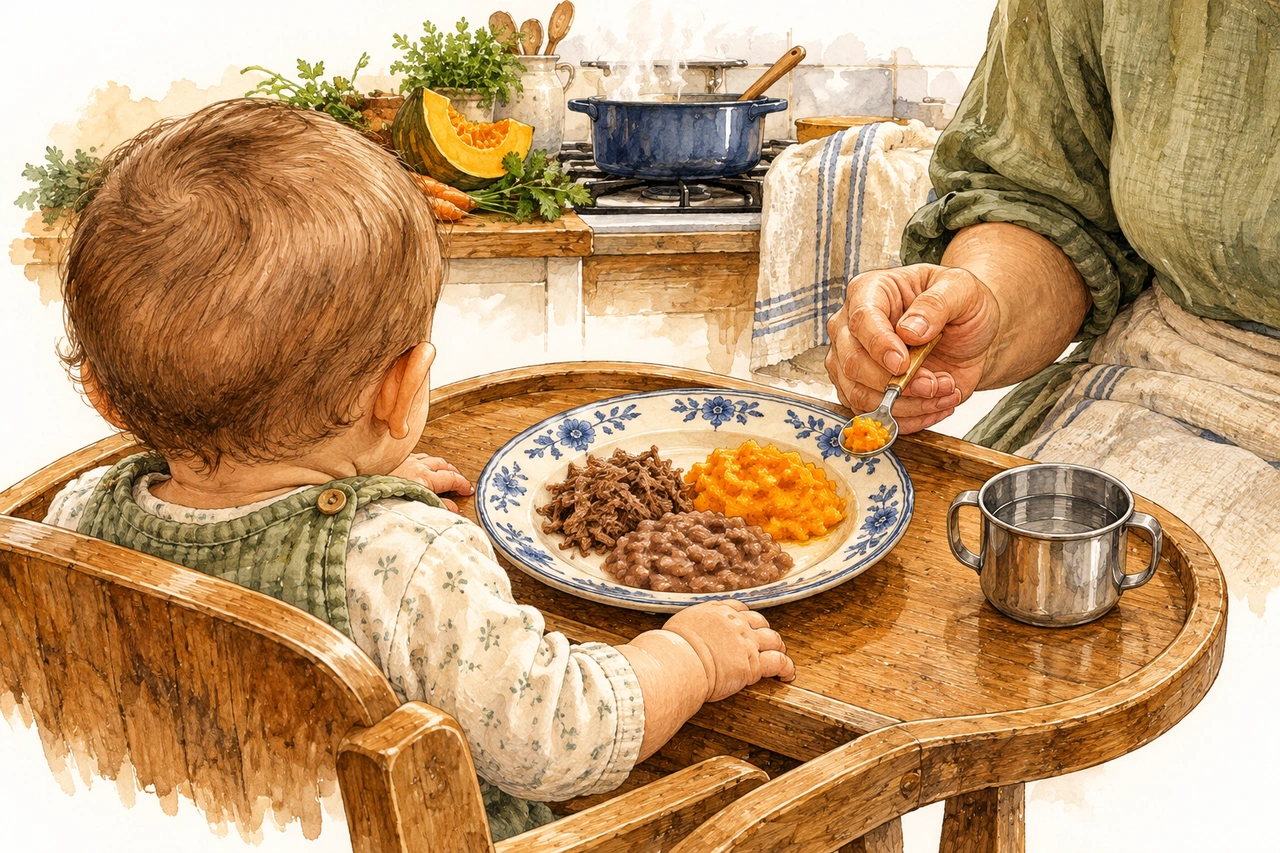
Starting solids begins around 6 months, when your baby can sit with little support, brings things to their mouth and no longer pushes everything out with their tongue. Breast milk continues, and food comes in to complement it, not to replace it. The first plate is already real food: well-cooked meat and, over the following weeks, a vegetable and a fat from a good source, all mashed with a fork, with no added salt, no sugar and no honey.
On this point, ancestral cooking and the Ministry of Health's Guia Alimentar para Crianças Brasileiras Menores de 2 Anos (Dietary Guidelines for Brazilian Children Under 2) agree more than it might seem. Both put meat on the plate from the start and keep out sugar and ultra-processed foods. They differ on other things, such as the order in which some foods are introduced, and this article shows where, so you can decide with clarity.
When to Start: Age and Signs of Readiness
The Ministry of Health, the World Health Organization and the Brazilian Society of Pediatrics all point to the same reference: exclusive breastfeeding until 6 months and, from then on, other foods alongside breastfeeding, which can continue until age 2 or beyond. The WHO's 2023 complementary feeding guideline keeps 6 months as the starting point.
Age alone, however, is not enough. The Ministry's guide describes the 6-month-old who is ready: sits with little or no support, pushes food out with the tongue less and already makes chewing movements (p. 114). The Ancestral Introduction to Solids Guide, written by nutritionists Laura Valentim and Dalyla Peçanha, sums up the same criterion in one sentence: starting solids doesn't begin on the calendar, it begins with the baby.
Teeth are not a requirement. Hardened gums can mash food to the right consistency (Ministry guide, p. 107). There is also no need to give water, tea or any other food before 6 months, because breast milk hydrates in just the right amount (p. 89).
If your baby was born prematurely, has a health condition, drinks formula or doesn't show these signs near 6 months, the decision about when to start belongs to your pediatrician.
What Goes on the First Plate
The question that comes up most is where to begin: fruit, vegetable purée, cereal? In the ancestral approach, the answer is meat. The Ancestral Introduction to Solids Guide builds the first month around bone and meat broth, the meat that cooked in it, a mild-flavored vegetable (squash, chuchu (chayote) or zucchini) and a fat (beef fat, lard or olive oil).
This choice is not an eccentricity. The Ministry's guide allows all meats and organ meats from 6 months, always well cooked (p. 86), and points out that animal-source iron is easily absorbed, at a time when the baby starts to need more iron than milk provides (p. 90). The WHO's 2023 guideline goes in the same direction and recommends meat, fish or eggs every day between 6 and 23 months, according to the summary published by ENN. The ancestral guide gives this point the central place: meat comes first, and fruit is a complement.
Texture: Mashed, Never Blended
Here is the safety rule that matters more than the order of the foods. The Ministry advises offering food mashed with a fork, with the foods kept separate on the plate, not blended and not strained (p. 100 and p. 116). The right consistency is one that doesn't run off the spoon. Liquid food has more water and fewer nutrients, and a baby who stays on liquids for too long tends to find pieces strange later on, with more gagging and choking.
That is why broth comes in as a base and for moistening, not as a meal. The ancestral guide starts the first days with broth and soon adds the meat from the broth; among the consistencies it accepts ("blended, mashed or finely chopped"), choose mashed. Meat cooked until it falls apart, shredded very fine and moistened with a little broth, already has the texture of a first meal.
The First Four Weeks, One Step at a Time
The plan below follows the ancestral guide's progression, with the texture the Ministry recommends. It is a reference, not a protocol: the pace is the baby's.
- Week 1. One meal a day, at lunch. Meat cooked in meat and bone broth, shredded very fine and moistened with the broth itself. Start with just a few spoonfuls.
- Week 2. Still one meal a day. A mild-flavored vegetable (pumpkin, chuchu (chayote) or zucchini) is introduced, cooked and mashed with a fork, served next to the meat, not mixed in.
- Week 3. Two meals a day. A fat is introduced: a drizzle of olive oil or a little melted beef fat or lard over the vegetable.
- Week 4. Two meals a day, with the same base. This is where the ancestral guide adds drops of the liquid from a homemade ferment, such as sauerkraut or fermented carrot. That liquid is brine, which contains salt, and there is no official guidance on homemade ferments for babies. For that reason, we treat this step as optional and as something to talk over with whoever is following your baby's care; leaving it for later costs nothing.
As for quantity, the Ministry suggests starting with about one dessert spoon of each food, working up to three tablespoons in total, without rigidity (p. 116). The ancestral guide mentions 2 to 4 tablespoons per meal between 6 and 7 months. Both references say the same thing: a little at the start, and the baby decides how much to eat.
After the fourth week, the ancestral guide continues stage by stage, with menus from the 7th month onward.
The rhythm of meals is one point where the sources differ. The ancestral guide builds up slowly: one meal a day for the first two weeks, two in the following ones. The Ministry proposes that the baby reach 7 months eating three meals of food a day, among lunch, dinner and snacks (p. 114). Neither path is a safety issue. What matters is watching for hunger and fullness and increasing as the baby accepts.
Where the Ancestral Guide and the Ministry Agree, and Where They Don't
This is the comparison that was missing for anyone who wants to cook the ancestral way without losing sight of the official rules.
Where they agree
- Start at around 6 months, once the baby shows signs of readiness, while continuing breast milk.
- Meat from the start and organ meats early (the Ministry of Health allows them at 6 months; the ancestral guide introduces liver from the 7th month), always well cooked.
- No sugar before age 2: sweetness comes from the fruit itself.
- No honey before age 1, because of the risk of botulism (the Ministry recommends avoiding it until age 2).
- No ultra-processed foods, ready-made seasonings, bouillon cubes or cured and processed meats.
- No juice in the first year, not even fresh-squeezed: fruit is offered as a food, not as a drink (p. 85).
- Don't force, don't distract, respect the baby's fullness cues.
Where they differ
- When to introduce egg. The Ministry allows the whole egg, white included, from 6 months, well cooked (p. 86). The ancestral guide introduces the yolk at around 10 months and the whole egg after age 1.
- Beans and grains. The Ministry offers beans, rice and other grains from 6 months (p. 77). The ancestral guide holds off on grains, legumes and nuts until after 18 months, always soaked and well cooked.
- Fruit. The Ministry accepts raw fruit, scraped or mashed, from 6 months. The ancestral guide prefers cooked fruit, served with fat, in the first year.
- Dairy. The Ministry points out that a breastfed baby doesn't need cow's milk or formula (p. 114). The ancestral guide leaves all dairy until after age 1.
- Salt. The ancestral guide accepts a small amount of unrefined salt in the family's food once the baby starts sharing it. The Ministry speaks of a minimal amount (p. 103), and the Brazilian Society of Pediatrics (SBP) advises avoiding salt and ready-made seasonings from the very beginning, according to the summary of the SBP practical guide published by the Afya portal.
How to decide
On safety points, always follow the stricter recommendation: a mashed texture, no salt added to the baby's plate, no sugar or honey, careful food storage. On the order in which foods are introduced, the ancestral guide proposes a more gradual sequence, and it is Nu&Cru's reference. There is one exception worth discussing with your pediatrician: if there is food allergy in the family. The same SBP summary advises not delaying foods such as egg and fish, even in babies prone to allergy. In that case, the order and timing of each food is an individual decision.
What stays off the plate at first
- Honey before age 1. It may contain spores of the botulism bacterium, and a baby's gut can't yet stop it from multiplying (Federal Council of Medicine, with guidance from Anvisa). The Ministry recommends avoiding it until age 2, since it is also a form of sugar (p. 104).
- Sugar of any kind before age 2, including cakes, cookies and jams (p. 104).
- Added salt and ready-made seasonings. Onion, garlic and herbs season the meat and the broth.
- Raw foods of animal origin. Meat, liver, fish and egg are served well cooked, never rare or runny (p. 86).
- Raw milk. The ancestral guide leaves cow's milk until after the first year. When it does come in, it is pasteurized or boiled, never raw; the Ministry, when it addresses cow's milk prepared at home for a child, also says to boil it (p. 145).
- Juices, even fresh-squeezed.
- Hard, round or small whole foods, such as grapes, cherry tomatoes, nuts and popcorn. Grapes and other small fruits are cut into very small pieces and seeded (p. 84), nuts are served only finely ground (p. 88), and popcorn stays off the menu until age 2 (p. 78).
Liver and Fat: The Ancestral Foods, in Measure
Liver is the food that most sets ancestral cooking apart from the usual baby purée. The Ministry of Health guide includes it among the foods for babies and notes that it is rich in vitamin A (p. 86). That is exactly why the amount matters: in the ancestral guide, liver comes in from the 7th month, after the adaptation month, in a small portion, cooked in broth or as a well-cooked pâté. Raw liver never goes on a baby's plate. For the technique, see how to prepare liver so it tastes good; how often to serve it and how big the portion should be for your baby are questions for the guide or for a health professional.
Fat is the other hallmark of ancestral cooking. The ancestral guide uses beef tallow (rendered beef fat), lard (rendered pork fat), olive oil and, later, butter. The Ministry also uses oil or olive oil in preparation, in small amounts, and advises against fried foods for children (p. 180). In practice, the two references meet in the same gesture: a thin drizzle of fat over mashed vegetables, with no frying.
Breast Milk Stays at the Center
In the first months of starting solids, food is still a learning experience, and breast milk remains the main food. The Ministry suggests offering food after nursing at first, without worrying about how much the baby eats (p. 99). The ancestral guide observes that a baby who has just nursed is not hungry for a meal and recommends an interval of about 3 hours. Both point to the same care: the meal arrives when there is hunger.
Organizing the Week Without Living in the Kitchen
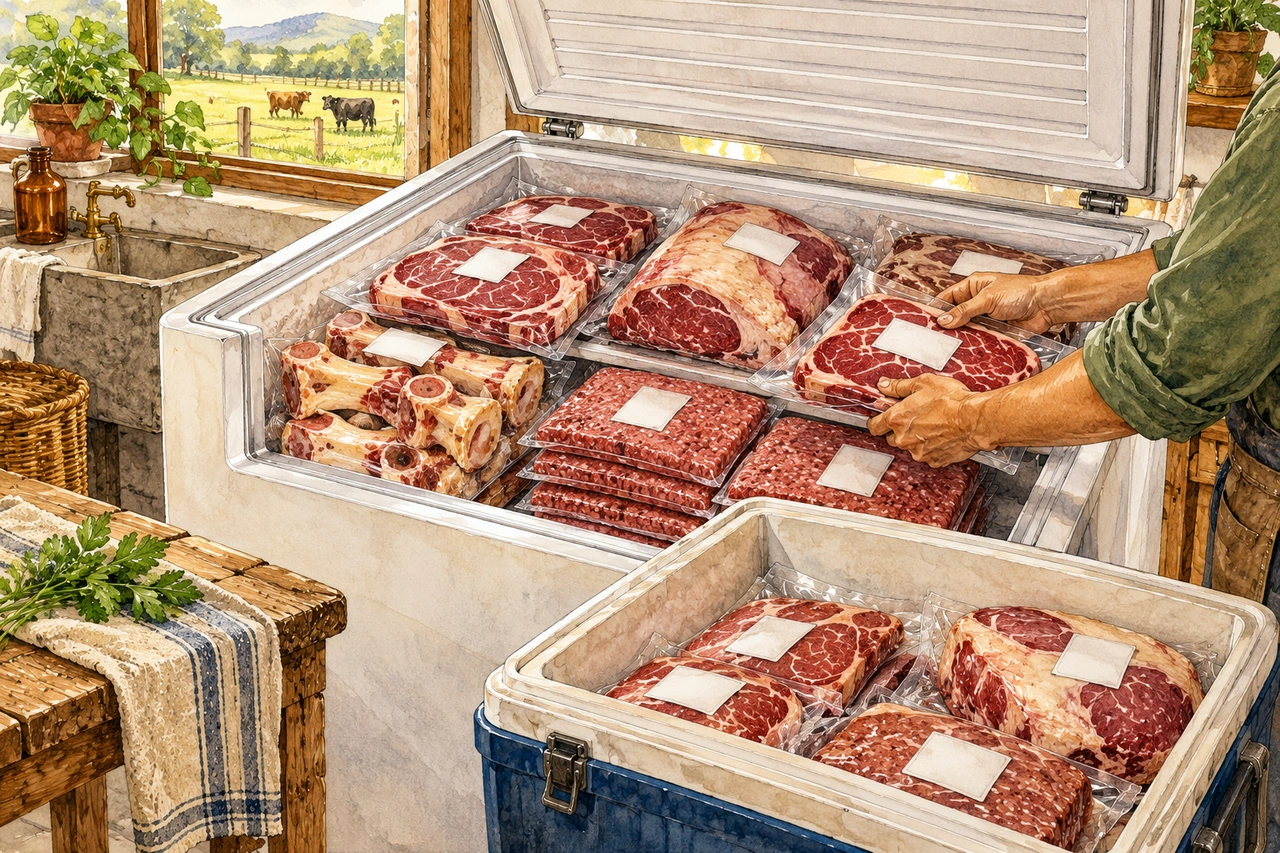
The routine of the first weeks fits into a single day of prep: a meat and bone broth, the meat cooked in it, one or two vegetables, all portioned into small containers. Fridge and freezer storage times, and the safe way to thaw, are in how to prepare and freeze baby food. For the broth itself, the step-by-step is in bone broth.
As for gear, your baby needs less than the lists suggest: a chair where they can sit upright, a small spoon, an open cup and a fork for mashing. The annotated list is in utensils for starting solids. And once the family is eating real food, the same pot serves everyone, with the baby's portion set aside before the salt goes in: that is the plan in baby at the family table.
Keep your baby away from processed food for as long as possible, without the illusion that you will manage it forever. One day they will try a cookie at a party, and that is fine. What protects them is the foundation they get at home, repeated every day.
When to Ask for Help
Some signs call for an individual evaluation, not more reading:
- frequent choking, persistent gagging or difficulty swallowing;
- refusal that drags on for weeks, or weight gain below what is expected on the pediatrician's growth chart;
- skin rashes, vomiting or diarrhea that appear after a new food;
- prematurity, an already diagnosed allergy or food allergy in the family.
Swelling of the lips or eyelids, difficulty breathing or choking that does not resolve are emergencies: call SAMU (Brazil's emergency medical service) at 192. For other cases, talk to your pediatrician. If you want ancestral eating adjusted to your baby's history and routine, Nu&Cru's complementary feeding consultation is an individual online session with nutritionists Laura Valentim and Dalyla Peçanha, with a personalized meal plan. If your baby has not started eating yet and you have questions about them, you can also talk to us beforehand.
The Day Before You Start
Pick the day you are going to begin and, the day before, make the first meat and bone broth. Set the meat aside, shred it very fine, keep the next day's portion in the fridge and freeze the rest in small containers. The first meal will be ready before your baby wakes up.
For the complete sequence, stage by stage, the Guia da Introdução Alimentar Ancestral (Ancestral Complementary Feeding Guide) brings together the signs of readiness, the progression by age, five-week menus and more than 80 recipes, in a digital book that also works for those who have already started.
Educational content; it does not replace an individual assessment by a health professional.
Part of this text is based on an article by Sally Fallon and Mary G. Enig ("Feeding Babies", from the book Nourishing Traditions) published by the Weston A. Price Foundation.
As informações têm caráter educativo e não substituem avaliação individual de profissional de saúde habilitado.