Blogmeats and organ meats · traditional eating · recipes · Weston A. Price
Bone Marrow: Benefits, History and How to Prepare It
Traditional peoples cracked open bones to get to the marrow. Learn the history and benefits of bone marrow, plus recipes for marrow pudding, soup, steak tartare and sweet pastries.
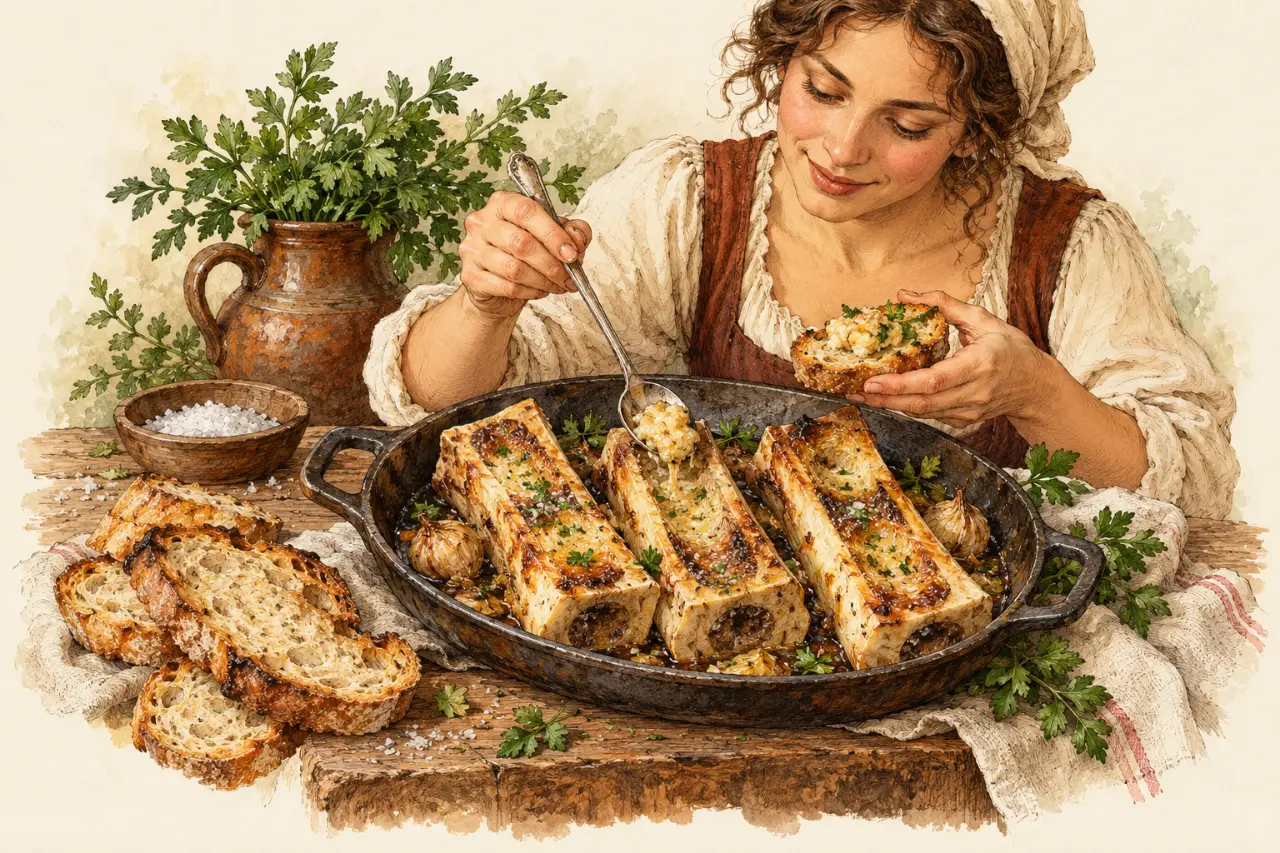
Traditional peoples who hunted and ate large animals did not overlook the bone marrow hidden inside the bones. Quite the opposite: they prized marrow as an extremely nutritious food, and the benefits of bone marrow were known long before any laboratory analysis.
In this article, adapted from a text published by the Weston A. Price Foundation in the journal Wise Traditions, you will learn about the place of bone marrow in traditional diets, the little that science knows about its nutrients, a curious story involving children with leukemia and, at the end, how to prepare bone marrow in recipes ranging from snacks to dessert.
Bone Marrow in the Diets of Traditional Peoples
Weston Price himself gives a good example. In his main work, Nutrition and Physical Degeneration, he describes the Indigenous peoples who lived in the Rocky Mountains of the far north of Canada. For nine months of the year, their diet depended almost entirely on game, mainly moose and caribou. In summer there were plants; in winter, a little bark and tree shoots.
Price noticed that these peoples placed enormous importance on the animals' organs, including the walls of the digestive tract, while much of the muscle meat went to the dogs. And he made a revealing observation:
"It is important to note that skeletons are rarely found where the Northern Indians have killed large animals. The remains appear as heaps of finely broken bone splinters, cracked open to obtain as much as possible of the marrow and the nutritive qualities of the bones."
According to Price, these Indigenous peoples got their fat-soluble vitamins and most of their minerals from the organs. And an important part of the children's diet was made up of bone marrow preparations, used both as a milk substitute and as a special food (6th edition, page 260).
The Menu Price Designed for Children
When Price drew up a meal plan for an orphanage, bone marrow was on the menu too (page 295). The meal went like this:
- To start: about 120 ml of tomato or orange juice and one teaspoon of a mixture, in equal parts, of a natural, vitamin-rich cod liver oil and a butter especially rich in vitamins, the combination the foundation calls Dr. Price's remedy.
- Main dish: a bowl of almost half a liter of a very rich vegetable and meat stew, made largely with bone marrow and tender cuts. The meat was grilled separately to keep the juices in, chopped very fine and added to the bone marrow soup, which always included chopped vegetables and plenty of deep yellow carrots.
- Afterward: stewed fruit with very little sugar, and whole wheat rolls made every day with wheat freshly ground in an electric coffee mill, spread with the same vitamin-rich butter.
- To drink: two glasses of fresh whole milk for each child.
The menu varied from one day to the next: in place of the meat stew, there was creamy fish soup or organ meats. The foundation analyzes this program in the article The Scientific Approach of Weston Price, and Nu&Cru explains the value of butter in Is Butter Bad for You? Why It's Better.
Bone Marrow Around the World
A quick internet search turns up bone marrow recipes described with great affection by gourmets in France, Ireland, the Philippines and Korea. Peoples such as Native Americans and the Mongols may have eaten marrow raw (the foundation describes how the Mongols prize marrow in its account Diet of Mongolia). With one well-placed blow to a femur, you can pull the marrow out in a single long, whole cylinder.
In haute cuisine, bone marrow appears as a garnish for filet mignon served with an elaborate reduction sauce, like the one in our beef with bone broth sauce. And medieval recipes include meat pies filled with sweetened bone marrow, and even quinces stuffed with bone marrow.
Benefits of Bone Marrow: What the Analyses Say
There is very little information about the nutritional qualities of bone marrow. When the original article was written, the only analysis available online, of raw caribou marrow published on nutritiondata.com, reported that marrow is 97% fat and, ironically, suggested "healthier substitutions" of native plants and fish for anyone who wanted to lose weight.
That superficial analysis showed small amounts of iron, phosphorus and vitamin A. In the foundation's view, marrow is probably rich in vitamin K and other fat-soluble nutrients, but the tests to measure its full range of nutrients had yet to be done.
What Kind of Fat Is in Bone Marrow?
Some commentators insist that bone marrow was a rich source of polyunsaturated fats in traditional diets. But the explorer Vilhjalmur Stefansson describes two kinds of marrow in his book The Fat of the Land (page 27):
- the marrow from the lower part of the leg, which is soft and "tastes more like a particularly delicious cream";
- the marrow from the humerus and the femur, which is "hard and has the consistency of tallow at room temperature".
The foundation returns to Stefansson's description, and to the Native American custom of eating marrow raw, in the article Guts and Grease: The Diet of Native Americans.
Bone Marrow and Leukemia: The Story of Dr. Brohult
Leukemia and other bone marrow diseases are very common today. The Life Extension Foundation website, in a 2005 article, tells the story of Dr. Astrid Brohult, a Swedish oncologist who treated children with leukemia at a children's hospital.
In an attempt to get her patients' bone marrow working normally again, she gave the children calf bone marrow. In Scandinavia, parents have an old custom of serving their children bone marrow soup in winter, believing it gives them strength. The doctor reasoned that healthy calf marrow might stimulate human marrow to function well again.
The bet paid off, at least in part. The results were inconsistent, but some patients improved remarkably quickly, with their white blood cell counts returning to normal and a striking return of energy. The Swedish team's results were published in scientific journals, such as this 1970 article, cited by Life Extension.
The Life Extension article goes on to describe alkylglycerols, long-lasting lipids with immune-stimulating properties, isolated from shark liver oil. But the foundation asks the obvious question: why isolate a single compound to sell in expensive capsules, when you can simply eat bone marrow?
How to Prepare Bone Marrow (and Disguise the Color)
Unfortunately, modern Westerners aren't used to eating bone marrow, and its dark color can look unappetizing. In Brazil, at least, marrow bones are old acquaintances at the butcher's. To find bones from grass-fed cattle, look at the producers map.
On Bread, Like Butter
One solution is simply to spread the marrow on bread and cover it. If you are making beef broth with marrow bones, a beef shank stew or an ossobuco (the Italian-style veal shank), take the marrow out of the bones once the broth or stew is ready and spread it on a toasted slice of natural sourdough bread. It spreads like butter, even when very hot (it must be those famous alkylglycerols, the text jokes).
Then sprinkle generously with salt and top with very thinly sliced onion and capers. You'll be eating something delicious while your eyes are distracted by the white (or purple) of the onion and the green of the capers. It can be served as a starter, before the main course. To prepare the capers, rinse them well to remove all the vinegar and pat them dry carefully.
Another delicious topping is chopped parsley mixed with capers, thinly sliced onion, olive oil and lemon juice. For an even simpler version, see our roasted bone marrow.
The European Chefs' Method, Step by Step
European chefs have a technique that leaves the marrow a creamy light pink instead of an unappetizing gray:
- Ask your butcher for marrow bones cut into pieces of 5 to 7.5 cm.
- Soak the bones in cold water for 12 to 24 hours, changing the water several times.
- Cover the bones with fresh cold water and bring to a boil very slowly.
- Cook over the lowest heat, barely bubbling, for about 20 minutes.
- Push the cylinder of marrow out with the handle of a small spoon.
After that, just slice the marrow and use it as a garnish for meats, add it to blended soups, use it in the recipes below, or mash it with a little salt and give it to your baby. Blended marrow is part of the Ancestral Complementary Feeding Guide, and the topic also appears in Baby's First Foods: What to Offer.
Recipes with Bone Marrow
Bone Marrow Custard
Serves 4.
- 1 cup (240 ml) of fresh cream
- 60 g of bone marrow
- 2 egg yolks
- 1 whole egg
- sea salt and pepper to taste
Prepare the marrow as explained above so that it is light in color, not gray. Blend the cream, marrow and eggs and season to taste. Pour into four individual ramekins greased with butter, place them in a baking dish with hot water and bake in a water bath at 150 °C for about 20 minutes, until the custard is set. Let cool and unmold. Serve as a side dish with meat.
Steak Tartare with Bone Marrow
Serves 8. The recipe was adapted from a creation by Irish chef Richard Corrigan, published on the BBC recipe website.
- about 115 g of bone marrow, prepared as above and cut into 1.3 cm slices
- 450 g of fatty ground beef
- 2 teaspoons of capers, drained, dried and chopped
- 2 shallots, peeled and finely chopped
- 1 tablespoon of finely chopped parsley
- ½ teaspoon of Asian fish sauce
- 1 egg
- sea salt and pepper to taste
- 1 pinch of cayenne pepper
- 8 thin slices of natural sourdough bread, crusts removed
- about 6 tablespoons of olive oil or lard
Mix the beef, capers, shallots, parsley, egg and fish sauce and season to taste. Brown the bread slices on both sides in the lard or olive oil over medium heat. Take the bread out of the pan and quickly sauté the slices of marrow. Spread the tartare on the bread and top each slice with a piece of marrow. For the classic version, without marrow, see our steak tartare.
Tomato Soup with Bone Marrow
Serves 8. Use the marrow from the bones that went into your broth: the red of the tomatoes hides any grayish tone.
- 115 g bone marrow
- 6 fresh tomatoes, peeled, seeded and chopped
- 3 tablespoons butter or ghee
- 2 medium onions, sliced
- ½ cup (120 ml) white wine or vermouth
- 1.5 to 2 liters beef broth
- sea salt and pepper to taste
- 1 pinch cayenne pepper
- about 1 cup sour cream
Slowly sauté the onion in the melted butter until it is very soft and golden. Add the tomatoes and cook over medium heat, stirring from time to time, until all the liquid has evaporated. Add the wine or vermouth and let it reduce a little. Add the broth and the marrow and bring to a boil. Skim off any foam that rises and simmer over low heat for about 15 minutes. Blend with an immersion blender, adjust the seasoning and serve with the sour cream.
Sweet Bone Marrow Pastries
Makes 6. This unusual recipe comes from a medieval Dutch cookbook. The little pastries, which had the amusing name of sluberkens, were served as a starter; modern tastes may prefer to eat them as dessert. The original calls for Rapadura, the unrefined whole cane sugar sold under that name in the United States; here in Brazil, just use our own grated rapadura.
- 85 g bone marrow
- ½ cup grated rapadura or maple sugar
- 2 tablespoons small raisins (the Zante currant type)
- 1 teaspoon cinnamon
- 2 egg yolks
- about 1 cup yogurt dough (recipe from the book Nourishing Traditions, page 485)
- 2 tablespoons melted butter
- 1 tablespoon grated rapadura or maple sugar
Mix the marrow with the rapadura (or maple sugar), the egg yolks and the cinnamon. Stir in the raisins. Roll out the dough and cut six thin rounds of about 12.5 cm, then place a spoonful of filling on each one. Fold over and press the edges together firmly. Brush with the butter and sprinkle with the rapadura. Bake at 180 °C for about 20 minutes.
Further Reading
On Nu&Cru
- Bone Broth: Benefits and How to Make It
- Liver: The Most Nutritious Food There Is
- How to Prepare Liver If You Don't Like It
- Whole Chicken: How to Use the Entire Bird
- Recipes with marrow and bones: roasted bone marrow, ossobuco, rabada (oxtail stew) and bone broth
- Producer map to buy marrow bones from grass-fed cattle
At the Weston A. Price Foundation (in English)
- Bone Marrow: Updated Nutrient Analysis of a Delicious, High-Fat Superfood
- Raw Bone Marrow Recipes
- Bone Marrow Butter
- Braised Beef Shanks
- El tuétano (the Spanish version of this article)
This article is an adaptation of "Bone Marrow," an unsigned text published in the Weston A. Price Foundation's magazine Wise Traditions in Food, Farming and the Healing Arts in the summer of 2007. Read the original in English.
As informações têm caráter educativo e não substituem avaliação individual de profissional de saúde habilitado.