Blogmeats and organ meats · recipes · Weston A. Price
Liver: The Most Nutritious Food There Is (Myths, Safety and Recipes)
Gram for gram, no food beats liver. Learn its history, the truth about the myths around toxins and vitamin A, and liver recipes from around the world.
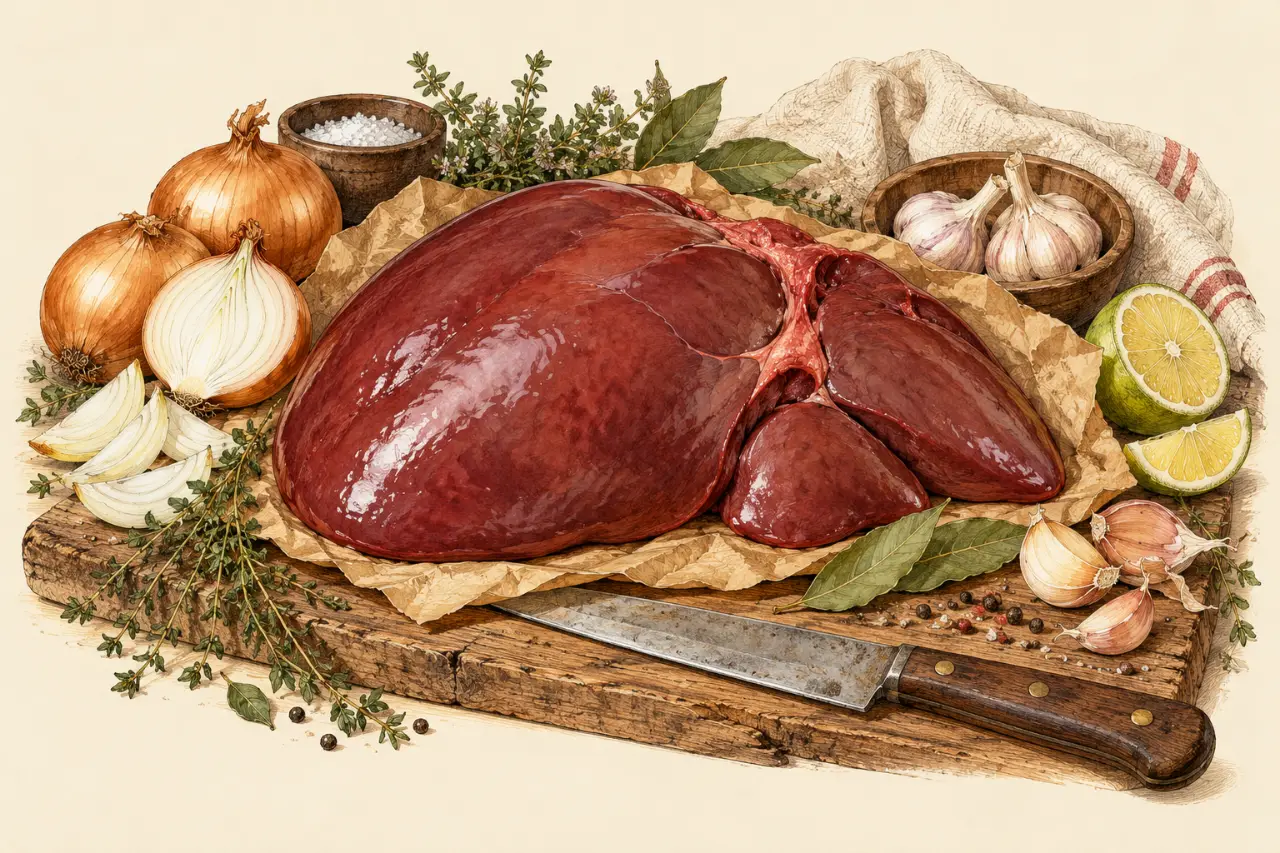
Ever since history began to be recorded, liver has ranked first among the organ meats as one of the most coveted delicacies in the kitchen. "Its tradition is a distinguished one, whether it is savored by young warriors after the hunt or blended with truffles and cognac in fine pâtés of foie gras," wrote Margaret Gin and Jana Allen in the book Innards and Other Variety Meats, published in San Francisco in 1974.
Practically every cuisine in the world has its liver specialties. Some cultures value it so highly that no human hand may touch it: it has to be moved with special chopsticks. The Li Ji, a ritual manual from China's Han dynasty (202 BC to 220 AD), places liver among the "eight delicacies." For most of history, human beings preferred liver to steak by a wide margin, and considered it a source of great strength, with almost magical healing powers.
In this article, adapted from one of the most-read texts of the Weston A. Price Foundation, you will learn why traditions call liver a sacred food, what to make of the supposed dangers of eating it, and how to prepare it in ways that please even those who swear they don't like it.
A long list of nutrients
What makes liver so special? The answer is simple: gram for gram, it contains more nutrients than any other food. In short, liver provides:
- high-quality protein;
- the most concentrated source of vitamin A in nature, a nutrient the foundation explains in detail in the article A Saga da Vitamina A, translated into Portuguese;
- all the B-complex vitamins in abundance, especially vitamin B12;
- one of the best sources of folic acid;
- iron in a form the body uses very well;
- trace minerals such as copper, zinc and chromium, and it is our best source of copper;
- a still-unidentified anti-fatigue factor;
- coenzyme Q10, a nutrient especially important for the cardiovascular system;
- a good amount of purines, nitrogen-containing compounds that serve as raw material for DNA and RNA.
The mysterious anti-fatigue factor
Liver's anti-fatigue factor, still unnamed to this day, has made it a favorite food of athletes and bodybuilders. It was described by Benjamin K. Ershoff, PhD, in a July 1951 paper published in the Proceedings of the Society for Experimental Biology and Medicine.
Ershoff divided laboratory rats into three groups. The first received a basic diet enriched with 11 vitamins. The second received the same diet, plus a boost of B-complex vitamins. The third received the original diet, but instead of the extra B vitamins, 10% of its feed was replaced with powdered liver.
After a few weeks, each rat was placed in a drum of cold water it could not climb out of: it was swim or sink. The rats in the first group swam an average of 13.3 minutes before giving up. Those in the second, with the B vitamin boost, swam 13.4 minutes. In the group that ate liver, three rats swam 63, 83 and 87 minutes, and the other nine were still swimming vigorously when the test was ended, after two hours. Something in liver kept them from wearing out. As Prevention magazine reported in 1975, scientists were never able to put a name to this factor.
Is eating liver dangerous?
Despite its ancient tradition and the evidence for its benefits, conventional nutritionists and government agencies have begun to advise against eating liver. The supposed dangers come from two concerns: the idea that liver is full of toxins, and its high vitamin A content.
Does the liver store toxins?
One of the liver's jobs is to neutralize toxins, such as medications, chemical agents and poisons. But the liver does not store toxins. Poisonous compounds that the body cannot neutralize and eliminate tend to lodge in fatty tissue and in the nervous system.
The liver is indeed a storage organ, but for nutrients: vitamins A, D, E, K, B12 and folate, and minerals such as copper and iron. These are precisely the nutrients that give the body some of the tools it needs to get rid of toxins.
How to choose good-quality liver
Of course, liver should come from healthy animals: beef, lamb, buffalo, pork, chicken, turkey, duck and goose. The Weston A. Price Foundation suggests this order of preference:
- Liver from animals that live outdoors and on pasture. This is the best choice.
- Organic liver from chicken, beef or calf, when the first option is not available.
- Supermarket calf liver, if that is your only option, since the young animal spends its first months on pasture. Conventional beef liver is more problematic, because cattle are usually finished in feedlots.
- Liver from conventionally raised chickens and pigs is not recommended.
Finding people who raise their animals on pasture is the first step. The Nu&Cru producers map can help with that search.
What about vitamin A?
The concern about vitamin A comes from studies in which moderate doses of synthetic vitamin A caused problems and even contributed to birth defects. The natural vitamin A in liver, on the other hand, is an extremely important nutrient for health and only causes problems in extremely large amounts.
According to the Merck Manual, a classic medical reference, acute vitamin A poisoning in children can occur with a single dose of synthetic vitamin A in the range of 300,000 IU, or with 60,000 IU daily for a few weeks. In the vast majority of cases, recovery after stopping is spontaneous and without lasting effects.
In adults, the manual reports poisoning in Arctic explorers who, a few hours after eating several million units of vitamin A from polar bear or seal liver, had drowsiness, irritability, headache and vomiting, followed by skin peeling. In these cases too, the symptoms went away once the food was stopped. Apart from this unusual example, only megadose tablets of synthetic vitamin A, on the order of 100,000 IU per day for many months, have caused poisoning.
In other words: unless you are an Arctic explorer, it is very hard to reach vitamin A toxicity by eating liver. The supposed toxic dose of 100,000 IU per day is found in two and a half 100-gram servings of duck liver, or in about three 100-gram servings of beef liver. Based on Weston Price's work, it is estimated that the diets of traditional peoples provided about 50,000 IU per day.
Liver During Pregnancy
On liver for pregnant women, a study in Rome found no birth defects among 120 babies exposed to more than 50,000 IU of vitamin A per day (Teratology, 1999). A Swiss study measured vitamin A in the blood of pregnant women and concluded that a dose of 30,000 IU per day resulted in levels with no association with birth defects (International Journal of Vitamin and Nutrition Research, 1998).
Nutrition books written before World War II recommended that pregnant women eat liver often. Today, they are told to avoid this extremely nutritious food. The foundation explains its view in the articles on diet for pregnant and nursing mothers and on sacred foods for healthy babies.
How Much Liver to Eat
The foundation's recommendation is one 100-gram serving of beef, lamb, bison or duck liver, once or twice a week, which provides about 50,000 IU of vitamin A per serving. Chicken liver, which has less vitamin A, can be eaten more often. If you get headaches or joint pain at this amount, cut back until the symptoms go away.
For babies, the Ancestral Complementary Feeding Guide includes liver from 6 months of age, with a pâté recipe designed for this stage.
Raw Liver? Why Would Anyone Do That
Eating raw liver is definitely not part of the modern diet. So why would a sensible person consider it? Most of the reasons come from experience: people who eat it regularly report how good they feel. A few examples:
- In the southern United States, hunters have a tradition of eating the liver of a freshly killed deer.
- In Argentina, the peões (ranch hands) eat raw or very lightly cooked liver and meat.
- People who grew up on farms say they ate liver still warm, fresh from the animal and only lightly cooked, just like the other organs and glands.
- Weston Price documented the consumption of raw liver among African hunter-gatherer tribes. The liver was so sacred that it was never touched with the hands, only with spears. They ate it both raw and cooked.
- The physician Max Gerson used raw liver juice, extracted with a special press, in his original protocol for patients with pancreatic cancer. His daughter, Charlotte Gerson, dropped this part of the treatment because of the difficulty of finding fresh liver free of bacterial contamination. The New York physician Nicholas Gonzalez, who treated cancer with an integrative approach, insisted that all his patients eat raw liver.
How to eat raw liver, according to the foundation
It takes some getting used to. There are two basic methods, and with both of them the liver must be the best quality available and very fresh.
Grated. Freeze the liver in large pieces for 14 days, which, according to the foundation, eliminates pathogens and parasites. Then grate it on the fine side of the grater and mix it into milk, a juice or even a hot porridge. The foundation suggests adding one or two teaspoons of grated raw liver to the baby's egg yolk or to a vegetable purée.
As "capsules". Cut fresh liver into small pieces about the size of a pea and freeze for 14 days. Then simply swallow them as if they were vitamin pills.
Liver recipes from around the world
Modern cookbooks hardly include liver, but if you go looking, you will find preparations from cuisines all over the world. The foundation itself gathers more ideas in Gourmet Organ Meat Recipes.
Collections of medieval European recipes show that, long before the campaign against cholesterol, Europeans turned liver into fritters, terrines, sausages and "puddings", and used it as a filling for pies and pastries. One of the most famous examples of a filled pie contains chicken livers, hearts and gizzards with sour cherries.
Old cookbooks also describe using liver to thicken sauces: raw liver was puréed, pushed through a fine sieve and added to the sauce, which was then heated carefully, without boiling. During Lent, fish livers were used for the same purpose. As long as the flavor of the liver doesn't dominate the sauce, this is a great way to bring it to the table without the family noticing.
Liver with onion and cinnamon (Spain, 1529)
A Spanish cookbook from 1529 teaches you to slice onions very thin and cook them slowly with fatty bacon. Then you add kid, lamb or goat liver, cut into slices about the size of half a walnut, and sauté everything until the liver loses its color. Separately, a slice of toasted bread without the crust is moistened in white vinegar, ground and dissolved in sweet white wine. This liquid is strained and poured over the liver and onions, ground cinnamon is sprinkled on top, and it is cooked until well thickened.
Mufarraka (Middle East)
A dish from an old Arabic cookbook, with spices we don't normally associate with liver.
- 400 g chicken livers
- 400 g chicken gizzards
- ½ teaspoon salt
- 8 egg yolks
- 1½ teaspoons ground coriander
- 1½ teaspoons cumin
- ¾ teaspoon black pepper
- 1½ teaspoons cinnamon
- 2 tablespoons sesame oil for frying
- ¼ cup lemon juice
Boil 700 ml of water with a pinch of salt, add the gizzards and simmer over low heat for 50 minutes. Near the end of that time, boil another 700 ml of water with a pinch of salt and cook the livers for 3 minutes. Drain everything, cut into cubes of about 1 cm, place in a bowl and mix with the yolks and spices. Heat the oil, fry the mixture for about 4 minutes, sprinkle with the lemon juice and serve.
Scandinavian Liver Pâté
Unlike French pâtés, Scandinavian ones usually contain no alcohol or garlic and have a smoother texture. Makes 8 to 10 servings.
- 300 g veal or pork liver
- 300 g lean pork, such as loin
- 300 g pork fatback
- 1 onion, finely chopped
- 2 tablespoons butter
- 2 tablespoons unbleached wheat flour
- 300 ml milk
- 1 egg
- 1 pinch ground cloves
- 1 pinch ground allspice
- sea salt and freshly ground black pepper
Cut the liver, pork and fatback into small cubes. Set aside 75 g of the fatback, put it in a baking dish in a low oven until it melts, and use that fat to grease a loaf pan. Preheat the oven to 180 °C. Pass the onion, liver, pork and remaining fatback through a meat grinder 3 to 4 times, until very smooth.
Melt the butter in a saucepan over medium heat, add the flour and cook for a few minutes. Gradually add the milk, stirring, until you have a thick, smooth sauce. Add the liver mixture and stir well. Take it off the heat, let it cool slightly and stir in the egg, cloves, allspice, salt and pepper.
Pour into the loaf pan, set it inside a larger baking dish and fill the dish with hot water to ¾ of the height of the pan. Bake on the middle rack for 1 hour 30 minutes. To test, insert a thin knife in the center: it should come out clean, and the center of the pâté should reach at least 77 °C. Let it cool in the pan, turn it out and serve with mustard, watercress, pickles, grapes or chutney, as canapés or on bread, as in traditional Danish open-faced sandwiches. For a simpler version, see our liver pâté recipe.
Liver with Sour Cream (Russia)
Serves 4.
- 1.1 kg liver (veal, pork or beef), sliced
- 2 onions, chopped
- 1 cup sour cream
- 4 tablespoons butter
- 2 cups beef broth
- 2 tablespoons chopped fresh dill
- 2 tablespoons unbleached wheat flour
- sea salt and pepper to taste
Rinse and dry the liver slices and season with salt and pepper. Dredge in the flour, fry on both sides in the butter and set aside. Brown the onion in the same pan, then layer the liver and onion in a deep pot. Pour the broth into the frying pan, scraping the bottom, add the sour cream, mix and pour over the liver. Cover and cook over low heat for 20 minutes. Uncover, stir, cover again and cook for another 10 minutes. Serve the slices drizzled with the sauce and sprinkled with dill, with boiled or fried potatoes, or rice.
Nira Reba (Japan)
The Japanese consider liver an important food for pregnant women. Serves 4.
- 225 g pork liver
- 1 bunch nirá (garlic chives)
- 2 tablespoons arrowroot
- 1 tablespoon grated ginger
- 2 tablespoons soy sauce
- 1 tablespoon sake
- 1 tablespoon water mixed with 1 teaspoon potato starch
- lard for frying
Cut the liver into small pieces and marinate for 20 minutes in the soy sauce with the sake and ginger. Remove from the marinade, pat dry and dredge in the arrowroot. Heat the lard in a deep pan and fry the liver. Set aside on a warm plate. Cut the nirá into short pieces and sauté in a frying pan. Add the fried liver and the marinade, stir well, add the water and starch mixture, stir quickly and take off the heat. Serve immediately.
Comparison of the Types of Liver
The values below are per 100 grams, calculated from the table published by the foundation, which is based on John D. Kirschmann's Nutrition Almanac.
Vitamin A (IU): lamb 50,500; beef 43,900; duck 39,900; goose 31,000; veal 22,500; chicken 20,600; turkey 18,000.
Vitamin B12 (micrograms): lamb 104; beef 80; turkey 63; veal 60; duck 54; chicken 23.
Iron (milligrams): duck 30.5; lamb 10.9; turkey 10.8; veal 8.8; chicken 8.6; beef 6.5.
Copper (milligrams): veal 7.9; goose 7.5; duck 6.0; lamb 5.5; beef 2.8; turkey 0.5; chicken 0.4.
Riboflavin, vitamin B2 (milligrams): beef 3.3; lamb 3.3; veal 2.7; turkey 2.2; chicken 2.0; goose 0.9.
The Cure for Pernicious Anemia
Pernicious anemia is a debilitating disease caused by a lack of vitamin B12. Until 1926, the only treatment was blood transfusion. Shortly afterward, the physicians George Whipple, William Murphy and George Minot received the 1934 Nobel Prize in Medicine for discovering liver therapy.
Murphy told how it all began. Whipple, at the University of Rochester, had shown that liver helped dogs made anemic by bleeding recover their blood quickly. From there, Murphy and Minot proposed that liver might help in pernicious anemia, even though it was a completely different disease.
Getting permission for the study was not easy. The chief physician at Peter Bent Brigham Hospital in Boston was quite skeptical and only allowed the research on the guarantee that no transfusion would be denied to anyone who needed one. Murphy started the therapy with a patient of about 40 who was in critical condition and partly in a coma. They had observed that with half a kilo of liver a day, it took about five days for the red blood cell count to begin to rise.
On the fifth day, however, the patient seemed worse, and according to the rules he should have received a transfusion. Murphy spent the night awake, deciding whether to continue with the liver. Around midnight, he noticed that the count had risen a little, and that gave him the courage to go on. The next morning, he went back to the hospital at seven o'clock, afraid, and peeked into the room to see whether the patient was still alive. To his amazement, the man was sitting up in bed and asked cheerfully: "What time is breakfast?" His blood count had reached its peak, and the patient lived for many more years. With this success, the hospital staff began to cooperate.
Later, patients no longer had to swallow liver: they began to receive extracts and, afterward, vitamin B12 itself. For those who want to keep pernicious anemia from appearing, the best path, according to the foundation, is to eat liver once a week, as our ancestors used to do.
Favorite Ways to Prepare Liver
These suggestions came from members of a traditional nutrition discussion group connected to the foundation.
- Overnight marinade. Leave the slices in the fridge in lemon juice, or water with vinegar, with plenty of garlic and bay leaves. Pat dry and fry in olive oil, lard or butter until well browned on the outside and slightly pink inside. The marinade is the secret to getting rid of the unpleasant taste. It works with kidneys too.
- Slow-cooked. Use liver from a young animal raised without hormones. Dredge in flour on both sides and cook with a little butter or ghee over very low heat for a few minutes, otherwise it gets tough. Add sliced onion, a little vinegar and water, raise the heat to 180 °C for a few minutes and finish over low heat for about 20 minutes. Fresh mushrooms and salt go in at the end. Serve with pasta, rice or vegetables.
- Breaded in almond flour. Cut slices half a centimeter thick and dredge them in a mixture of almond flour, salt and plenty of pepper. Fry on both sides in ghee or lard. You can fry the whole liver at once and eat the leftovers during the week, warm or cold, instead of a snack bar.
- With wine vinegar and honey. Marinate the slices for an hour in red wine vinegar with two teaspoons of honey. Fry one or two onions in plenty of beef tallow and butter for half an hour, until small and golden. Remove the onions and quickly fry the liver with a little of the marinade, turning constantly. Serve hot with the onions, the sauce and kimchi.
- Lots of garlic. Sauté one onion and at least five cloves of garlic with herbs and spices in lard. Add the liver in thin slices and cook for about 5 minutes, turning every minute, finishing with a little olive oil. Don't overcook it. Serve with chopped bacon, with the onion and garlic on top.
- Jewish-style chopped liver. Brown sliced onion in fat and transfer to the food processor. In the same pan, sauté 340 g of chicken livers until pink inside. Let cool and process with the onion and 2 hard-boiled eggs, leaving a few small chunks. Season with salt and pepper. It hardly tastes like liver.
- Breaded in nuts. Cut into small pieces, dip in beaten egg and then in flour made from soaked and dried nuts. Fry in hot coconut oil, with salt and pepper.
- Classic liver pâté. Bake 450 g of beef or chicken liver and chop. Mix with 2 chopped hard-boiled eggs and one medium sautéed onion. Mash everything together with salt and pepper and refrigerate before serving.
- In strips, still pink. Cut strips of 7.5 cm by 1 cm and marinate in lemon juice. Pat dry. Sauté onion in bacon fat, remove it, and cook the liver in that fat until almost entirely pink: when it darkens too much, the taste gets stronger. It goes well with kale in butter and fermented carrots.
- Hidden in ground beef. Sauté onion in butter or coconut oil, add the liver in large pieces and cook for a few minutes. Process until finely chopped and mix into any dish made with ground beef, such as Bolognese sauce, escondidinho (a Brazilian meat pie topped with mashed potato or cassava) or meatballs in tomato sauce.
- With a sauce. Marinate the liver in lemon juice or vinegar for a few hours and pat dry. Fry quickly in very hot lard and keep warm in the oven. With the fat left in the skillet, there are three ways to go: a thick gravy, browning a little flour and adding beef broth; a light, buttery sauce, deglazing with wine or cognac, adding broth, reducing and finishing with butter; or a tangy sauce, sautéing well-rinsed capers and shallots, deglazing with white wine and reducing with beef broth. This last suggestion comes from Sally Fallon Morell, president of the foundation.
Raw Liver Smoothie
This drink was created by the author of the original article, Lynn Razaitis, together with Becky Mauldin, also a member of the foundation. Lynn, who was a teacher, says nothing gave her as much energy during stressful periods, and that her husband started drinking it too.
- 15 to 30 g of liver from a grass-fed animal, cut into small pieces and frozen (it needs to be frozen to blend well)
- 1 cup of organic tomato juice
- juice of ½ lemon
- a few drops of hot sauce
- 1 or 2 raw egg yolks from free-range hens
- 2 to 4 tablespoons of fermented young coconut water
- 1 tablespoon of raw cream
- ¼ teaspoon of concentrated mineral solution
- 1 to 2 teaspoons of bee pollen (optional)
Blend everything in a blender. If a liver aftertaste lingers, eat a piece of fresh papaya afterward. Another option is to soak the liver pieces in sour milk or lemon juice before freezing, to soften the flavor.
Read also
On Nu&Cru
- How to prepare liver for people who don't like it
- Bone marrow: benefits and how to prepare it
- Eating to get pregnant: the ancestral lesson
- Baby's first foods: what to offer
- Weston A. Price: what traditional peoples can teach us about eating
- Is lard bad for you? The wrongly accused fat
- Bone broth: benefits and how to make it
- Recipes with liver and organ meats: liver and onions, liver pâté, beef heart and liver salami, organ meat sausage, beef heart and roasted bone marrow
- 181 Receitas Ancestrais, the Nu&Cru recipe book
- Producers map for buying liver from grass-fed animals
On the Weston A. Price Foundation (in English)
- How to Cook Liver for Liver-Haters and Win Them Over
- Gourmet Organ Meat Recipes
- Bone Marrow
- Vitamin A Vagary
- Princípios Atemporais de Dietas Tradicionais Saudáveis (in Portuguese)
This article is an adaptation of "The Liver Files," by Lynn Razaitis, published in the magazine Wise Traditions in Food, Farming and the Healing Arts, from the Weston A. Price Foundation, in spring 2005. Read the original in English.
As informações têm caráter educativo e não substituem avaliação individual de profissional de saúde habilitado.