Blogfrom the farm to the table · meat and organ meats · real food
How to Buy Beef Directly from the Farmer: Inspection Stamps, Labels and Quarter Cows
How to find a farmer, what to ask about pasture and finishing, what Brazil's SIF, SIE and SIM inspection stamps guarantee, and how much meat a quarter cow for the freezer really yields.
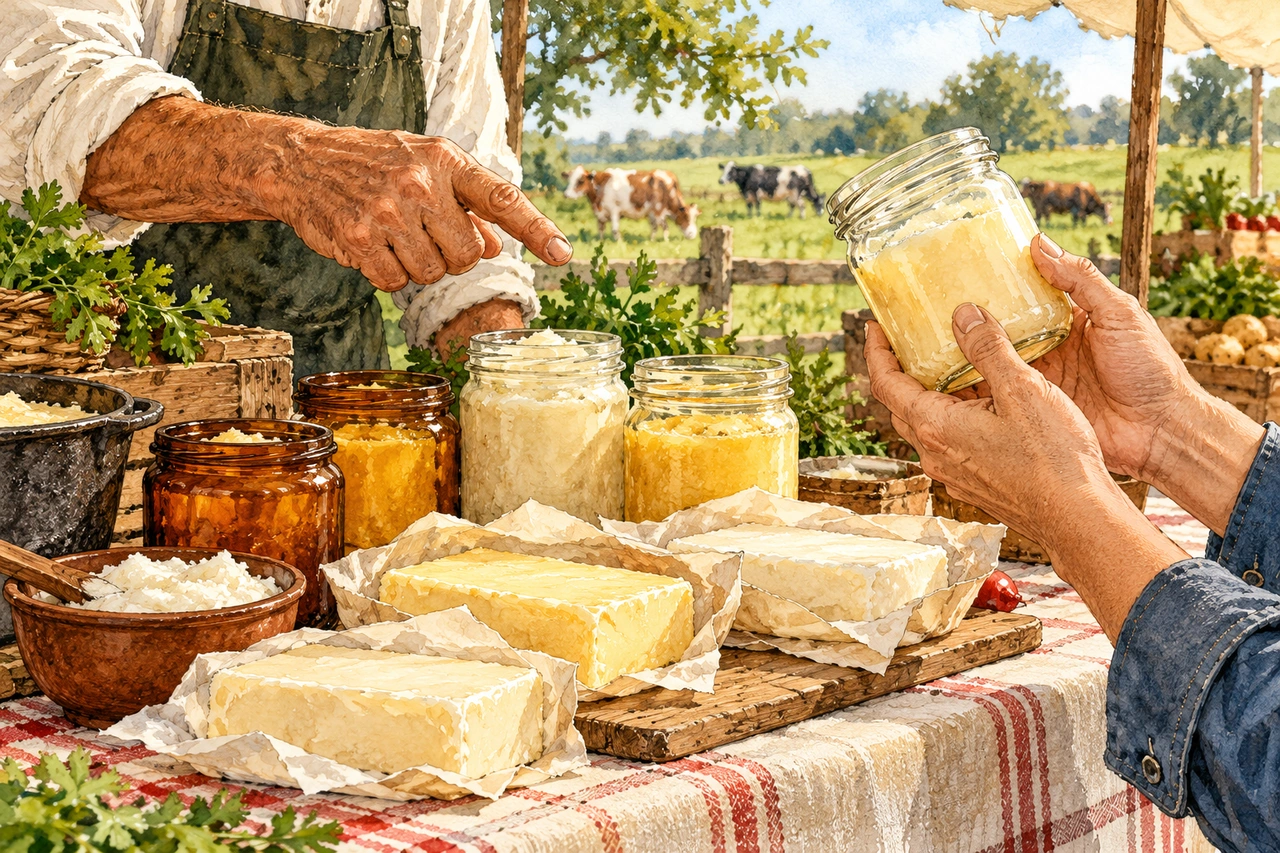
Buying beef directly from the people who raise it is the simplest way to know where your food comes from. Here's how it works: you find a farmer, talk about how the animals are raised, confirm that slaughter happens at an officially inspected meat plant, and pick the buying format that fits your household, from a box of cuts to a quarter cow. Inspection is non-negotiable. Everything else is a conversation.
The non-negotiable: inspection
All meat sold in Brazil must come from an animal slaughtered at a registered, inspected facility. Law 1,283/1950 makes prior inspection mandatory for every animal product and splits responsibility according to how far the product is sold:
- SIF (Federal Inspection Service), run by the Ministry of Agriculture: required for anyone selling to other states or exporting.
- SIE (State Inspection Service): for those selling between municipalities in the same state.
- SIM (Municipal Inspection Service): for those selling only within their own municipality.
There is also Sisbi-POA, a system that standardizes inspection procedures (MAPA). State and municipal services registered in e-Sisbi become part of Sisbi-POA, and the law allows interstate trade in the products they inspect, as long as the facility and the products are also registered in e-Sisbi beforehand (Law 8,171/1991, art. 29-A, §§ 4 and 7). For you, this means a small meat plant with SIM or SIE can indeed ship meat to another state, if both the plant and the product are in Sisbi.
In practice: the farmer raises the animals, and an inspected meat plant does the slaughter. Many small farmers don't have their own plant and take their cattle to a regional slaughterhouse. That's normal. What matters is that the meat arrives with the inspection service's stamp and a label.
What about uninspected "farm-killed" meat?
It is considered unfit for human consumption under the inspection regulation, RIISPOA (Decree 9,013/2017, art. 498, sole paragraph), precisely because the animal did not go through sanitary inspection. For the seller, it's an offense subject to penalties ranging from a warning and a fine to condemnation of the product and revocation of registration (Law 14,515/2022, art. 27), and selling goods unfit for consumption may constitute a crime against consumer relations (Law 8,137/1990, art. 7).
The reason isn't bureaucratic. Inspectors examine the animal before and after slaughter and discard anything showing signs of disease, something no consumer can see in packaged meat. Raising animals on pasture doesn't replace that. Grass-fed beef can carry bacteria too, and needs the same care as any meat: refrigeration, proper cooking and a separate cutting board.
The Brazilian context: nearly all cattle are pasture-raised
Much of what you read about "grass-fed beef" was written in the United States, where the typical steer spends its final phase in a feedlot eating grain. In Brazil, the reality is different. According to Embrapa, about 86% of cattle production, from calving to fattening, is done with grazing animals (CiCarne Bulletin 33). Feedlots exist, but they're mostly used to finish a smaller share of the herd (Embrapa, animal nutrition chapter).
So asking "is it grass-fed?" tells you little. The answer will almost always be yes. The questions that set one farmer apart from another are about the dry season and finishing:
- In the dry season, the grass loses quality. It's common to supplement cattle on pasture with mineral salt with urea, protein supplement or feed; when the feed gets heavier, the system is called semi-feedlot, in which pasture remains the main roughage (Embrapa). None of this is hidden or wrong: it's management. You just want to know.
- During finishing, the last months before slaughter, the animal may stay on pasture only, get supplement in the trough, or go to a feedlot. This is where one farmer's "grass-fed" beef can be quite different from another's.
What does this change in the meat? For flavor and texture, the animal's age, breed, fat cover and aging matter a lot. In fat composition, Brazilian studies show real but modest differences between pasture and feedlot. We go through the numbers in our guide on how to choose animal fat. And the higher price of grass-fed beef from a small farmer has its reasons, which we discuss in why grass-fed beef costs more.
Questions to ask the farmer
Bring this list to your first conversation. A serious farmer answers calmly, and many enjoy telling the story.
About how the animals are raised
- What breed or cross do you raise?
- At what age are the animals slaughtered? Steers, heifers or both?
- Are the animals on pasture all year? What do they get in the dry season?
- How are they finished: pasture only, supplement on pasture or feedlot? If there's grain, how much and for how long?
- Do you use feed additives or routine antibiotics? (Treating a sick animal is the farmer's duty; the question is about constant use, without illness.)
About slaughter and the meat
- Where are the animals slaughtered and under which inspection, SIF, SIE or SIM? Does the meat come with a label and stamp?
- Is the meat aged? For how many days?
- Who does the boning and packaging? What kind of packaging does it arrive in, vacuum-sealed or not?
- Does it arrive chilled or frozen? How is it transported to your home?
About buying
- Do you sell individual cuts, pre-packed boxes or quarters? Is the price per kilo of carcass or of trimmed meat?
- Do you sell bones, tallow and organ meats?
- Can I visit the farm?
Questions 6 and 10 are the ones that prevent the most frustration. The first ensures safety; the second keeps you from comparing a carcass price with a trimmed-meat price, which are very different things, as you'll see below.
Stamps and documents: what each one guarantees
- SIF, SIE or SIM stamp: guarantees that slaughter and processing were inspected. It says nothing about pasture, breed or welfare.
- Organic seal (SisOrg): organic products sold in stores must carry the federal seal. There's one exception: a producer registered only for direct sales may sell without the federal seal, but only directly to the consumer, as at a farmers' market (MAPA).
- "Pasture-raised", "grass fed", "boi verde" ("green ox"): we found no official Brazilian regulation defining these terms for meat. RIISPOA allows the label to state the production system; without a specific rule, the facility must put text on the label explaining that system and is solely responsible for its truthfulness (art. 446-A). The general ban on labels that mislead consumers also applies (art. 446). In practice, these terms are worth whatever the farmer can show.
- Embrapa concept brands, such as Carne Carbono Neutro (Carbon Neutral Beef) and Carne Baixo Carbono (Low Carbon Beef): these are voluntary protocols, with third-party certification, tied to gas emissions and, in the first case, to the presence of trees in the pasture (Embrapa). They speak to the production system, not to flavor.
- GTA (Animal Transit Permit): the health document that travels with animals whenever they're moved, including from the farm to slaughter (MAPA). It shows the movement was recorded, not how the animal was raised.
- SISBOV: an individual traceability system, voluntary to join, used mainly for exports to countries that require animal-by-animal tracking (MAPA). In 2024 the government launched the national plan for individual identification of cattle and buffalo, PNIB, to be phased in gradually from 2025 to 2032.
In short: the inspection stamp is mandatory and the rest is extra information. What guarantees the origin, in a direct purchase, is your relationship with the person raising the animals.
Cuts, a box or a quarter cow
How much meat one steer yields
An example from Embrapa Beef Cattle helps set expectations (Embrapa). A 600 kg Nelore steer on the farm arrives at the meat plant weighing about 564 kg. After slaughter, the carcass weighs 287 kg. Taking out bones, tallow and losses, the source arrives at 197 kg of meat; adding up the parts it lists, the total comes to about 195 kg. The breakdown:
- Hindquarter: 88.6 kg, with tenderloin, striploin, rump, top round, bottom round, knuckle, eye of round, flank and cap cuts, shank and trimmings.
- Forequarter: 69.2 kg, with chuck, neck, cupim (the hump of zebu cattle), brisket, shoulder clod, shank and trimmings.
- Ponta de agulha (short plate and ribs): 36.2 kg, with the short plate and the flap meat.
- Organ meats, separately: 14.6 kg of liver, heart, tongue, oxtail, brain, kidneys and tripe.
Carcass yield ranges from 48% to 62% of live weight, depending on breed, age, sex and finish, so treat these numbers as a ballpark. But the lesson holds for any steer: for every 100 kg of carcass, you get well under 100 kg of trimmed meat. When comparing prices, always ask whether the price is per kilo of carcass or of boneless meat.
Buying formats
- Individual cuts: the easiest way to start and get to know the farmer. You pay more per kilo, but you choose what you want.
- Mixed box: the farmer puts together a package with premium cuts and stewing cuts. It's the balance between price and freezer space.
- Quarter or half carcass: the lowest price per kilo and meat from a single animal, but it takes a big freezer and a willingness to cook cuts you may not know. Going by the example above, a boned-out half carcass yields close to 100 kg of meat.
A common choice among the quarters is the hindquarter, with the best-known cuts, or the forequarter, cheaper and full of stewing cuts that make excellent braises, stews and broths. The book 181 Receitas Ancestrais has recipes for these cuts, such as carne de panela (Brazilian pot roast), beef rib stew with pumpkin and ossobuco.
Ask for what the butcher doesn't offer
When you buy direct, you can ask for what usually gets left over: bones for broth, bone marrow, oxtail, mocotó (cow's feet), tallow and organ meats. They're cheap and go a long way.
- Bones and cow's feet become bone broth.
- Liver, prepared the right way, wins over even people who don't like it. See how to cook liver so it tastes good.
- Tallow becomes cooking fat. The step by step is in how to render lard and tallow at home, and what to do with it, in beef tallow: what it is and how to use it.
Freezer, transport and thawing
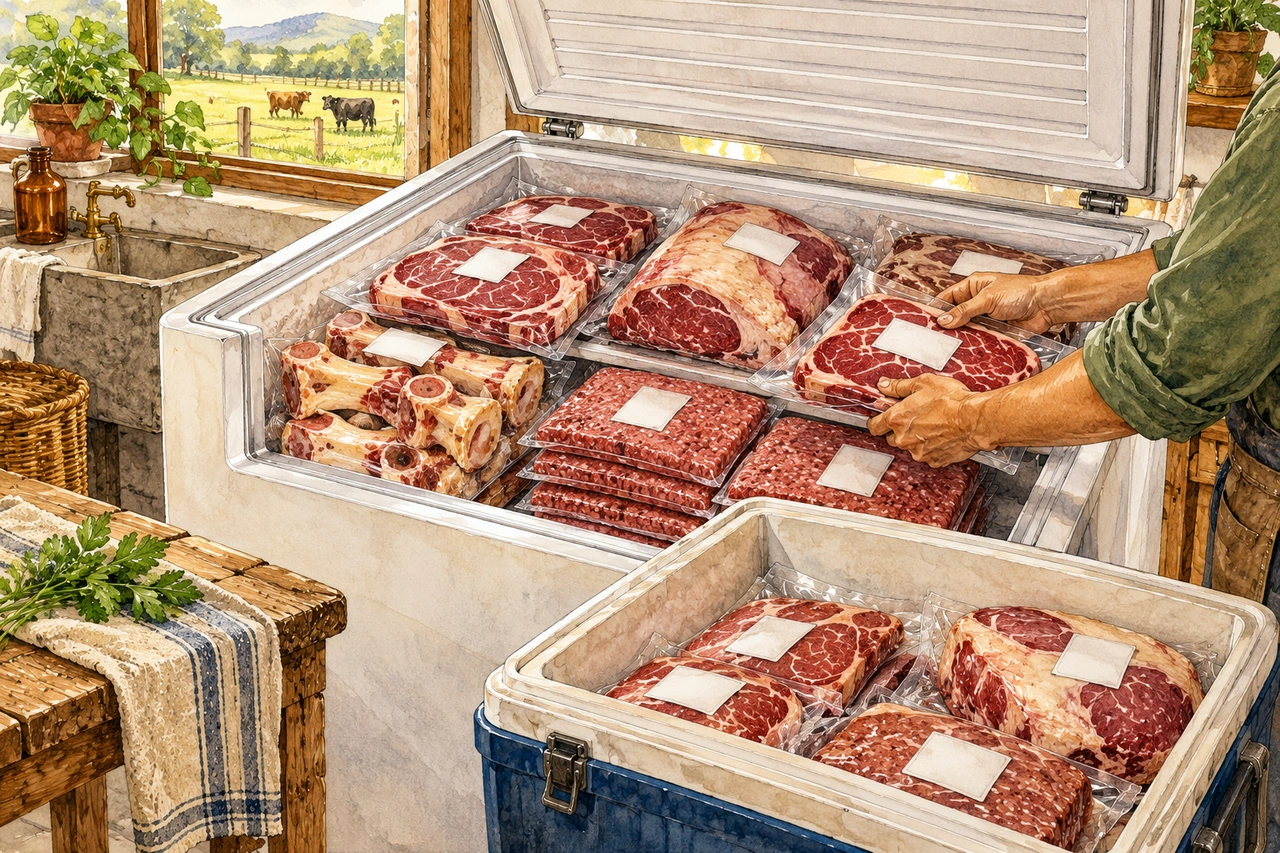
Before committing to a big purchase, measure the free space in your freezer with the packaged meat in mind. Vacuum-sealed meat in flat pieces takes up much less room than trays.
- Temperature: the food safety benchmark for frozen food is -18 °C or below (Anvisa, RDC 216/2004). Check your freezer's thermostat.
- Transport: if you pick up the meat, bring a cooler and go straight home. If it's delivered, ask how it's kept cold along the way.
- Storage time: meat that leaves the inspected facility frozen and packaged carries on its label the expiration date and storage instructions, which RIISPOA requires (art. 443, items VII and XI). As long as the package stays sealed and the freezer at -18 °C, that date applies. Meat you freeze at home follows the Ministry of Health table, the same one used in our other posts: up to 30 days in the freezer (Dietary Guidelines for Brazilian Children Under 2 Years, p. 169). The difference lies in the process: industrial freezing, vacuum packaging and controlled temperature, versus a home freezer that gets opened and closed. The United States Department of Agriculture notes that food kept constantly at -18 °C stays safe and, over time, mainly loses quality; even so, plan your purchase so you use it within the date on the label.
- Organization: label each package with the cut and date, and keep what goes out first in front.
- Thawing: in the fridge, overnight, never on the counter. The same Anvisa rule calls for thawing under refrigeration, below 5 °C, or in the microwave when the meat goes straight to the stove, and not refreezing what has been thawed.
Where to start
- Open the Nu&Cru farmer map and look for beef producers in your area or who ship to your city. The map is free, our team checks the contact details and production methods before publishing, and you buy directly from the farmer, with no middleman role on our part.
- Pick two or three and send them the questions about raising, slaughter and buying format.
- Start with individual cuts or a small box. Cook, taste and, if you like it, move up to the mixed box or the quarter.
If what you're after is the fat from grass-fed cattle rather than the meat, Nu&Cru Beef Tallow is made from the fat of 100% pasture-raised cattle, with a single ingredient, in small batches and packed in glass. The current batch is sold out. On the Beef Tallow page you can see the composition and reserve the next one via WhatsApp.
The first step fits in a single message: pick a farmer on the map and ask where the animals are slaughtered. The answer already tells you a lot about the rest.
As informações têm caráter educativo e não substituem avaliação individual de profissional de saúde habilitado.