Blogmeat and organ meats · recipes · Weston A. Price
How to Cook Liver So It's Tender and Doesn't Taste Strong
How to choose, trim, slice and fry liver in very hot fat, the safe doneness for each type, and why it calls for moderation, especially during pregnancy.
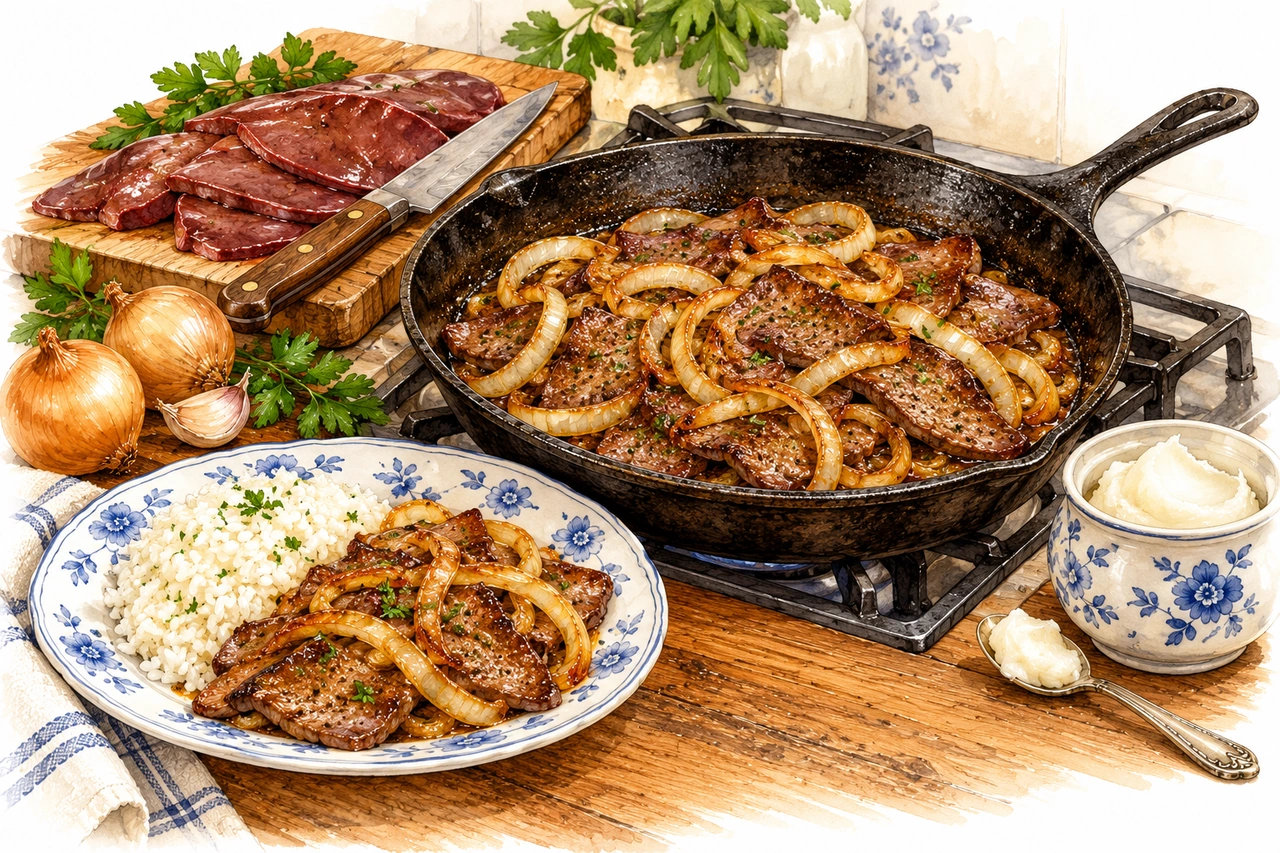
Almost everyone who says they hate liver has eaten a thick steak of it, cooked until it turned to shoe leather, from an old animal, in a lukewarm pan. You can get it right by changing four things: buy fresh liver from a young animal, remove the membrane around it, cut it into thin strips, and fry it quickly in very hot fat until it reaches a safe doneness (for chicken and pork liver, no pink left in the center). Caramelized onion and a touch of acidity at the end do the rest.
The American veterinarian Will Winter has been making the case for this conversion for years, and he wrote a humorous piece on the subject for the Weston A. Price Foundation. He grew up in a farming family where his father and uncles fought over the "different" pieces on the platter, and he worked with a grass-fed beef producer in Minnesota who, he says, sent much of the liver to pet food because nobody wanted to buy it. "Lucky them," he joked. Here we use the cooking technique he teaches, correct what doesn't hold up, and add what he left out: safe doneness and care with the amount you eat.
Why Liver Goes Wrong
The flaws of badly cooked liver have known causes, and each one has a fix:
- Strong taste and smell: liver from an older animal tastes more intense than liver from veal, lamb or chicken. Liver that has spent days in the fridge also gets worse. Winter blamed the smell on "toxins" in confined animals; we found no study that supports this, and what we know in the kitchen is that freshness and the animal's age matter more.
- Rubbery texture: the outer membrane shrinks in the heat and pulls the slice tight. Remove it beforehand.
- Sandy texture and bitter taste: overcooked. Liver cooks very fast, and every extra minute leaves it drier and grainier.
- Gray, soggy slices: cold fat or a crowded pan. The liver cooks in its own juices instead of browning.
How to Choose Good Liver
Fresh liver has a smooth, shiny surface and an even color, from dark red to purplish brown in beef and lighter in chicken, and it is firm to the touch. Avoid pieces with spots, a sticky surface or a sour smell. Buy it close to the day you'll cook it, or freeze it the same day.
The types, from mildest to strongest:
- Chicken: small and creamy, the best place to start for anyone who has never liked liver. Great for pâté.
- Veal and lamb: tender, with a delicate flavor.
- Adult beef: firmer, with a pronounced flavor. It yields a lot and is usually cheap.
- Pork: has a flavor of its own, good in pâtés and sausages.
Origin matters twice: for flavor and for safety. Buy meat and offal with sanitary inspection (the SIF, SIE or SIM seal) and, if you can, from a producer you know. The Nu&Cru producer map brings together grass-fed cattle ranchers and free-range poultry farmers, and the article on how to buy meat directly from the producer lists the questions worth asking, including about organ meats.
Recipe: Fried Liver with Onions
This is the recipe Will Winter uses to convert people who don't like liver. It is a cousin of fegato alla veneziana, which Italians make with onion and a touch of acidity, and of liver and onions, one of the organ meat recipes in the book 181 Receitas Ancestrais.
Ingredients for 4 people
- 500 g beef, veal or chicken liver
- 2 large onions, thinly sliced
- all-purpose flour for dredging, seasoned with black pepper and a pinch of cayenne pepper
- fat with a high smoke point: beef tallow, lard or bacon fat
- salt
- juice of half a lemon or 1 tablespoon of white wine vinegar
- chopped parsley
- milk for soaking (optional)
Method
- Clean it. With the tip of a knife, loosen the thin membrane covering the beef liver and pull it off with your fingers. Remove the thicker vessels. With chicken liver, separate the two lobes and cut out the white sinew that joins them.
- Cut into thin strips. About 0.8 to 1 cm thick and a few centimeters long. For Winter, this is "the most important part of the whole story," and he's right: a thin strip cooks through quickly without drying out.
- Soak in milk (optional). Soaking the strips in milk for about 20 to 30 minutes is an old tradition for softening the flavor. It works as a matter of personal taste; it doesn't "detoxify" anything, as is sometimes said. Keep it in the fridge in the meantime.
- Dry well. Drain the strips and dry them with a clean cloth or paper towel. A wet surface won't brown.
- Brown the onion. In a skillet, cook the onion over medium heat with a little fat and a pinch of salt until caramelized, about 15 to 20 minutes. Set aside.
- Dredge. Coat the strips in the seasoned flour and shake off the excess.
- Fry in very hot fat. Heat a layer of about 0.5 cm of fat in a cast-iron or stainless steel skillet. Winter's rule: if the fat doesn't sizzle loudly when the first strip goes in, it isn't hot enough yet. Fry in batches, without crowding, for 1 to 2 minutes per side, until browned outside and the center is no longer raw (see the safe doneness note below).
- Finish. Return the onion to the skillet, sprinkle with the lemon juice or vinegar, add salt and top with parsley. Serve right away. Mashed potatoes, inhame (a starchy root similar to taro) with butter, or rice and beans go well with it.
Many cooks salt liver only at the end, believing that salting beforehand toughens the slice. We found no test that proves it; salting at the end simply doesn't get in the way.
With a stainless steel skillet, preheating is what keeps the liver from sticking. The article on how to cook in a stainless steel pan without sticking shows the water drop test, and the one on cookware for the home kitchen compares cast iron, stainless steel and the other options.
Which Fat to Use
Liver is lean, and it needs fat to brown and to taste good. For quick frying over high heat, the best choices are animal fats that stay stable under heat: beef tallow, lard and bacon fat. Regular butter burns before the liver browns; if you want its flavor, add a spoonful at the end, with the heat already turned down.
The original text by Winter included claims that we do not repeat here, such as that all solid fats would be hydrogenated, or that heart attacks were unknown before industrial vegetable fat. Defending animal fat in the kitchen doesn't need them: the argument is one of technique and flavor. Lard and tallow stand up to the heat of the skillet, give you a crust and flavor, and are the fats traditional kitchens have always used for frying.
If you don't render tallow at home, Nu&Cru Beef Tallow is beef fat from 100% grass-fed cattle, a single ingredient, made in small batches and packed in glass, with a high smoke point for frying and grilling. The current batch is sold out: on the page you can see the ingredients and reserve the next one through WhatsApp. What tallow is and how it fits into everyday cooking is covered in beef tallow: what it is and how to use it.
The Safe Point: Chicken Liver Doesn't Stay Pink
Here the original text needs a correction. Winter recommended liver cooked rare and even suggested raw liver blended into smoothies as a "remedy." We don't recommend either of these.
Liver can carry bacteria on the inside as well, not just on the surface. The food safety agency of Australia and New Zealand explains that poultry livers must be cooked all the way through, mainly because of Campylobacter, that browning the outside is not enough, and that the center must reach 70 °C for at least two minutes. The same agency allows a slight pinkness in the center, as long as the liver is never bloody or looks raw. At home, without a thermometer, we follow a stricter rule that is easy to check:
- Chicken liver: cooked until the center is no longer pink. Cut one piece in half to check.
- Beef liver: cooked until the center is no longer raw or bloody. With thin strips, this takes just a few minutes and the liver stays tender.
- Pork liver: the same rule as chicken, with no pink at all in the center. The UK's food safety agency asks for liver and pork to be cooked all the way through, until steaming hot in the middle with no pink left, because of the hepatitis E virus.
- Thermometer, if you have one: 70 °C in the center, the same reference as the WHO Five Keys for cooking meat and poultry thoroughly.
For a pâté, cook the livers all the way through in the skillet before blending, keep it in the fridge and eat it within 3 days, the limit the Brazilian Ministry of Health gives for ready-made food kept in the refrigerator.
Hidden Liver: Other Ways to Get It to the Table
For anyone who won't eat a liver steak, there are gentler routes:
- Pâté. Creamy, with butter and herbs, it's the easiest way in. The liver pâté in the book uses chicken liver.
- Grated into ground beef. Freeze the cleaned liver in pieces, grate it while still frozen and mix it into the ground beef for meatballs, burgers or bolognese sauce, in a small proportion: one part liver to four or five parts beef. Nobody notices, and it all cooks through completely.
- Traditional sausages and stews. Brazilian and Portuguese cooking have always made use of offal: sarapatel (a spiced pork offal stew), chouriço de órgãos (organ meat sausage), salame de coração e fígado de boi (beef heart and liver salami).
Winter had a favorite pâté, made with what he called "four roots": ginger, horseradish, turmeric and beet. Here is his version, adapted and with full cooking:
- Melt 1 cup of lard in a pot and sauté 5 small grated beets, 7 cm of sliced ginger, 2 tablespoons of grated fresh horseradish and 1 teaspoon of grated fresh turmeric.
- Add 2 sliced onions and 2 tablespoons of chopped garlic and let them caramelize. If it sticks to the bottom, add a splash of water and scrape.
- Add 680 g of pork liver in pieces and cook until the center of each piece is no longer pink.
- Season with 2 tablespoons of ground coriander, 1 teaspoon of cayenne pepper, salt and black pepper. Cook a few more minutes and let it cool until just warm.
- Blend in a food processor with 1 cup of butter and the juice of 2 limes. Pour into a mold and refrigerate until firm.
How Much to Eat: Watch the Vitamin A
Liver is where the animal stores vitamin A. That is why it is so nutritious, and for the same reason it is not a food to eat in large amounts every day.
The most famous case comes from the Arctic. Winter said that polar bear liver was poisonous because of a moss the animal supposedly ate; the accepted explanation is different, an excess of vitamin A, the subject of a 1943 study on the vitamin A content and toxicity of bear and seal liver. Beef or chicken liver has far less vitamin A than polar bear liver, but the logic is the same: preformed vitamin A, the kind that comes from animal sources, builds up in the body, and too much is harmful.
During pregnancy, extra care is needed. The UK's health service lists liver and liver products among the foods to avoid in pregnancy, because the high vitamin A content can harm the baby. Liver pâté counts too. If you are pregnant or trying to get pregnant, talk to the professional who follows your prenatal care before including liver and pâté, and also tell them which supplements you take, since many already contain vitamin A.
For the rest of the family:
- Adults: liver works well as one of the meats of the week, in moderate portions and not every day. Winter himself said you don't need to eat liver daily, because it is so concentrated.
- Children: portions smaller than an adult's. The original text told of children eating half a kilo of fried liver in one sitting; that is not an example to follow.
- Babies: amount and frequency depend on age and on the rest of the diet. Follow the guidance of your pediatrician or nutritionist; the start of introducing solid foods is covered in baby's first foods.
- Anyone taking a vitamin A supplement or who has a liver disease should talk to their doctor about how often to eat it.
We don't give amounts in grams or in units of vitamin A here: the right number depends on the person, on what else they eat and on the supplements they take.
What we can say with confidence is that liver is a source of well-absorbed iron: the Guia Alimentar para Crianças Brasileiras Menores de 2 Anos (Brazil's Dietary Guide for Children Under 2) lists it among the foods that contain iron and notes that iron from animal sources is easily absorbed (p. 90). In moderation, it is an inexpensive and tasty way to put that iron on the plate.
What Traditional Kitchens Did
The dentist Weston A. Price traveled the world in the 1930s and described, in Nutrition and Physical Degeneration, peoples who valued liver and other organ meats. As the WAPF reads it, these societies reserved offal for children, pregnant women and the elderly. This is a field observation, not a health trial, and current guidance for pregnancy, cited above, calls for caution. What remains of this tradition for today's kitchen is the practice of using everything: the whole animal becomes food, and offal stops being a leftover.
In Brazil, this memory is still alive in the fígado acebolado (liver with onions) of Sunday lunch, in the Northeastern sarapatel (a stew of pork offal and blood) and in the moela (gizzard) that goes into the pot along with the chicken. If you buy a whole chicken, the liver comes with it; the article on how to use the whole chicken shows what to do with each piece of offal.
To Start: 300 g and a Hot Skillet
Buy 300 g of chicken or calf liver, clean it, cut it into thin strips and make the recipe above on a day when you're not in a rush. Serve a small portion, alongside something your family already loves. If the first reaction is good, pâté is the next step.
To go beyond the plain liver steak, the 181 Receitas Ancestrais (181 Ancestral Recipes) includes liver with onions and liver pâté with step-by-step instructions, as well as beef heart, stuffed tongue, oxtail, sarapatel and cured sausages like heart-and-liver salami, alongside the broths and fermented foods that go with these dishes. Three recipes from the book are open in full in the public recipe index, so you can get to know the style first.
Educational content; it does not replace individual assessment by a health professional.
Part of this text was based on an article by Will Winter published by the Weston A. Price Foundation ("How To Cook Liver For Liver-Haters And Win Them Over!").
As informações têm caráter educativo e não substituem avaliação individual de profissional de saúde habilitado.