Blogbabies and children · meat and organ meats · Weston A. Price
When to Start Weaning Your Baby: Egg Yolk, Liver and First Foods
When should you start introducing solid foods, and what should your baby eat first? Why the Weston A. Price Foundation recommends starting solids by 6 months, with egg yolk and liver.
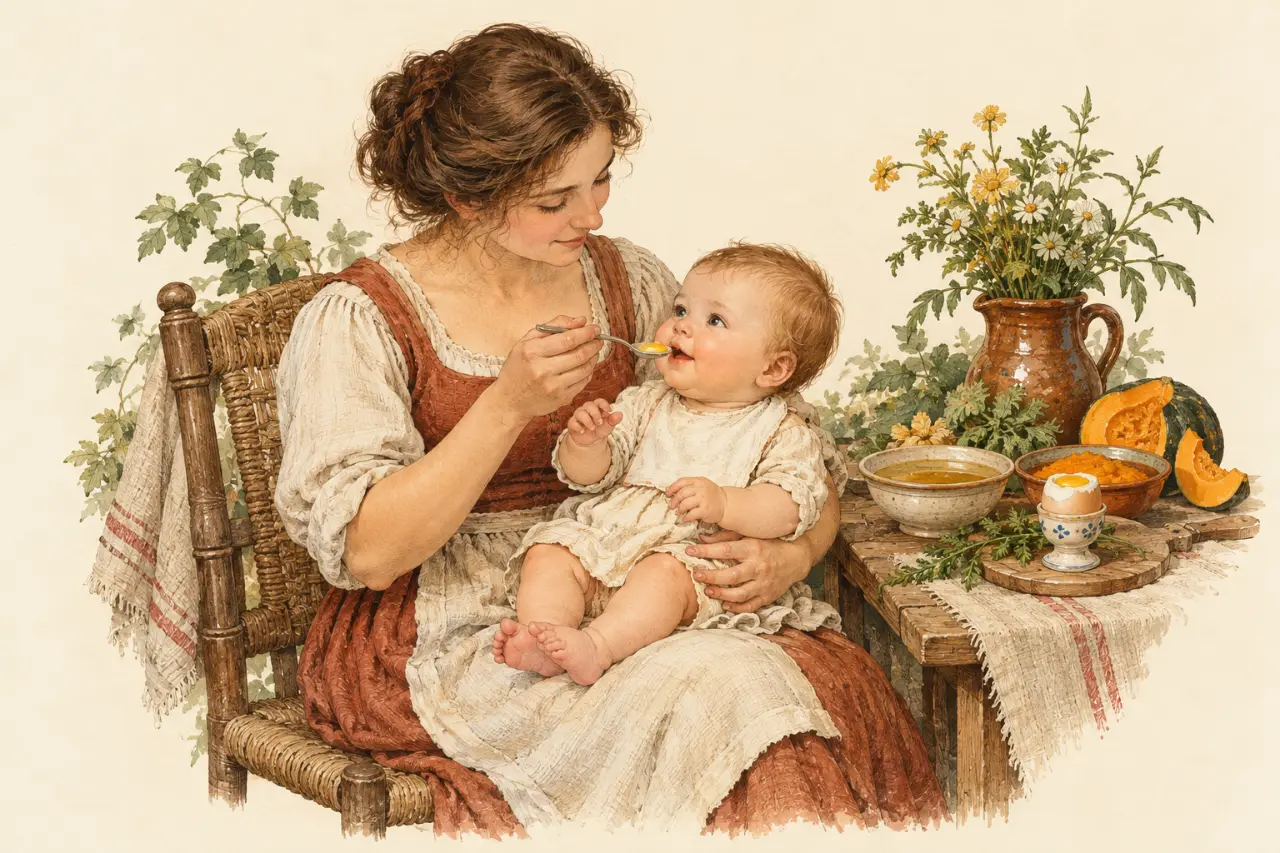
When should weaning begin, that is, the gradual move from milk to solid food? Which foods should come first? Is baby-led weaning, where the baby feeds himself, the best way to go? And does it really matter what a baby eats? The debate over how to feed a growing baby has taken over the internet.
In these debates, many mothers agree with the saying "food before one is just for fun." But the practices of non-industrialized peoples, backed by modern science, show the opposite: the first months are the stage of life when the right food matters most. A nutrient-dense diet at this time shapes growth and development in the early years and health for the rest of life.
This article is an adaptation of a text by Sally Fallon Morell, president of the Weston A. Price Foundation and mother of four.
When should weaning begin?
Online discussions about infant feeding start with the best time to introduce solids. Most medical organizations, including the American Academy of Pediatrics (AAP), the World Health Organization and the European Society for Paediatric Gastroenterology, Hepatology and Nutrition, recommend starting solid food between the fourth and sixth month.
They all agree that solids before four months may predispose a baby to gastrointestinal problems and allergies. They also warn that delaying the introduction until after six months may leave a baby without all the nutrients he needs. These recommendations on when to start are in full agreement with those of the Weston A. Price Foundation.
Very mature babies, or those who grow fast, will be ready for some solid food at four months; smaller, less mature babies may not be until six. Many mothers notice that once purées arrive, the baby is less fussy, goes longer between feeds and sleeps better at night, an enormous relief for a mother who can then also sleep through the night and settle into a better routine.
Of course, the mother can and should keep breastfeeding, or giving raw milk formula, for as long as she wishes. Some babies like to nurse until three or four years old; others lose interest before they turn one.
"Only breast milk until after one year"?
In online debates, many mothers oppose any solid food before six months, and some argue for delaying solids as long as possible, in other words, prolonging exclusive breastfeeding. Some say a baby can get everything he needs from breast milk alone, even after one year.
One mother, acknowledging the research showing that after six months a baby needs more iron than the mother can supply, and that the minerals in breast milk decline over time, suggested solving the problem by letting the baby get minerals by playing in the dirt! Others cite their children's "lack of interest in food," often describing how little food actually reaches the baby's mouth when they practice baby-led weaning (more on this below).
What Traditional Peoples Do
On questions this important, the first step in the foundation is to look at the practices of traditional peoples and then check whether they line up with what modern science says. On this topic, two studies offer valuable information.
The first is a 1983 survey of childbirth and breastfeeding practices in 186 non-industrialized cultures. Its main focus was the traditions of bonding between mother and baby, but the authors also looked at feeding, and were surprised to find that most cultures began weaning at six months or earlier:
- in one third of the cultures, solids were introduced before the baby was one month old;
- in another third, between one and six months;
- only in the remaining third were solid foods left until after six months.
A more recent survey, from 2001, analyzed infant feeding in 113 non-industrialized populations around the world. More than half of the cultures introduced solids before six months, and between five and six months was the most common time. Breastfeeding continued for 10 to 29 months.
Solid Food Is Not the Opposite of Breastfeeding
Some online comments take the foundation's defense of solids by six months as proof that it is "against" breastfeeding. Nothing could be further from the truth, the author replies: solids are added to breast milk (or to homemade formula, when necessary), and this combination can continue for many months.
This is exactly what we see in the animal world. Young animals nurse exclusively for only a short time (about a month, in the case of cows and pigs) and then feed for a much longer period on a combination of solid food and milk.
Why Iron Decides the Timing
The main reason to introduce solid food by six months is the baby's iron stores. Breast milk contains lactoferrin, which helps the baby absorb 100% of the iron in the milk, but the amount of iron is generally low. One explanation is that, in the first months, the baby needs more zinc than iron, and breast milk is rich in zinc.
The baby should also receive a good iron reserve through the blood of the umbilical cord, but red blood cells are normally renewed every four months. By six months, iron deficiency is a real possibility in a baby fed only breast milk.
In fact, the mineral levels in breast milk begin to fall almost from birth and keep falling after six months. A 1984 study showed a drop in zinc, copper and potassium, and a 1990 study of mothers in Bangladesh documented the decline in zinc and copper over time.
Does Delaying Solids Prevent Allergies?
And what about the argument that delaying solid food prevents allergies? A review of the available research concluded that, when the risk of allergy is a central concern, introducing solids between four and six months may result in the lowest risk. In the words of the review's authors, taking all aspects of health into account, the recommended duration of exclusive breastfeeding and the age for introducing solids were confirmed at six months, "but not later".
What about the leaky gut?
Another argument says a baby's gut is too permeable for solid food at four months, or even well beyond that. The foundation asked for the opinion of Dr. Natasha Campbell-McBride, creator of the GAPS protocol and one of the world's leading experts on intestinal permeability. Her answer:
Most babies are ready for weaning at six months, but many are ready earlier: they start to feel hungry because they are not getting enough of their mother's milk. Adding formula for these babies is not a good idea; it is much better to start adding real food, but without grains, beans or other starchy vegetables that are hard to digest. Foods of animal origin should be introduced (meat broth, meats, fish, eggs and raw fermented dairy, from suitable milk), along with cooked vegetables and a little freshly squeezed raw vegetable and fruit juice. Gradually! The gut wall of babies is permeable for a reason: it needs to develop oral tolerance to an enormous number of antigens in the environment. Introducing foods at this stage ensures that the child develops tolerance and is able to eat natural foods without reacting with allergies.
The author notes that she is not sure she agrees about the juices, but that on everything else Dr. Campbell-McBride and the foundation are in agreement.
"Food before age one is just for fun"?
Back to the sentence at the start. At no other age does a baby grow so fast, and form so many connections in the brain, as from birth to one year. This is no time to be careless about feeding, because food before age one matters, and matters a lot. According to the author, the way you feed your baby (when, what and how) will make all the difference to their health, appearance and intelligence in the future.
The bad advice on what to feed your baby
Both tradition and science make it clear that a baby should be given solid food by six months, and on this the foundation fully agrees with the official recommendations. On what to give the baby, however, the disagreement is almost total.
For the author, what circulates as advice on infant feeding in books and online is not only confusing and contradictory, but woefully inadequate. Most health professionals, she says, have no idea how to nourish a baby in this crucial first year.
What the American Academy of Pediatrics says
You would expect the AAP to have the most precise and detailed advice on how to feed a baby. Its recommendation: introduce solids around six months, expose the baby to a wide variety of healthy foods and offer varied textures. Suggestions that, to say the least, don't help much.
An older AAP recommendation, which lasted for many years, was to give iron-fortified rice cereal as the first food. Widespread criticism of starting a baby's life with pure carbohydrate, together with the recent arsenic scandal, which found high levels of this element in conventional rice, made the AAP back away from that dogma. Today, anyone who searches hard on the academy's website will find a reluctant recommendation of red meat as a source of iron for the baby.
The author also recalls that, years ago, the AAP refused to recommend soy infant formula because of reports of serious intestinal damage and thyroid problems in babies fed with it. But when it built its new headquarters, the organization accepted a large contribution from the formula industry, and the objections to soy formula disappeared.
Store-Bought Baby Food
Most mothers, however, don't consult the AAP when it's time to give their baby solid food: they go to the supermarket. There they find mostly fruit and vegetable purées, along with odd mixtures like quinoa with peas. Plain puréed meat comes in a "sauce" of water and cornstarch. You used to be able to buy liver or egg yolk purée for your baby, but not anymore.
Even worse, careful mothers will hardly find many options in glass. A good share of today's baby food comes in plastic (so the baby can meet phthalates early, the author remarks wryly) or in aluminum-lined aseptic packaging that is rapidly heated to 146 °C. And yes, aluminum leaches into food heated to such high temperatures, especially acidic foods like applesauce.
The U.S. Government's Plate
And what about the dietary guidelines from the U.S. Department of Agriculture, which created MyPlate? The book MyPlate for Moms, which translates these guidelines for mothers, recommends the following for babies:
- lean meat or tofu;
- egg once in a while;
- cheese once in a while;
- fruits and vegetables;
- whole grains and dry breakfast cereals;
- low-fat milk;
- vegetable spreads low in trans fat;
- less salt.
It is basically a plant-based diet, with most of the calories coming from fruits and vegetables. The baby gets no butter or any other animal fat, and there is no mention of organ meats at all. The baby gets a little fat from the lean meat and from the occasional egg and cheese, but if the mother chooses tofu instead of meat, even those sources disappear.
A Book the Foundation Refused to Endorse
The foundation was asked to endorse the book What to Feed Your Baby, by pediatrician Tanya Altmann, who presents herself as a spokesperson for the AAP. According to the back cover, the author offers "the latest nutritional recommendations" for feeding babies and toddlers. These recommendations suggest eleven key foods for the baby:
- eggs;
- prunes;
- avocado;
- fish;
- yogurt, cheese and milk (soy milk, if there is an allergy to cow's milk);
- nuts;
- chicken or beans;
- fruits;
- green vegetables;
- whole grains;
- water.
The book also advises parents not to give the baby any salt. There is no butter or other animal fat, no red meat and no organ meats. After age two, the child moves on to low-fat or skim milk, but gets plenty of coarse whole grains, which may include rice cookies, "multigrain" breakfast cereals and even granola, foods that, according to the author, the baby cannot digest. Needless to say, the foundation did not endorse the book.
Overall, it seems that fruits and vegetables have taken the place of rice cereal as baby's first foods, as shown by an image circulating online in which pasta, cheese, tofu and toast (why toast?) appear as "ideas for later." These guidelines allow small amounts of animal foods, but say it's fine to swap them for tofu. In every version of the conventional guidelines, including Dr. Altmann's, and in supermarket baby food, animal fats are absent, and nobody seems to understand the concept of nutrient density for babies.
Baby-led weaning: what's wrong with it, according to the author
Recently, the author says, she visited a Whole Foods store in Washington and went up to the café for lunch (cheese and homemade pâté) before shopping. At the next table sat a woman with a baby of about eight months. She ate a meal bought from the deli. And what did the baby get in the high chair? A few pieces of green pepper and cucumber on the tray. By the time they left, the vegetable slices were scattered across the floor, with no sign that the baby had eaten much at all.
That mother was probably following the suggestions in Baby-Led Weaning, a best-selling book on how to feed babies. Its promotion presents the approach as "the natural, no-fuss, no-purée way to start solids" and promises to bust the "myth" that babies need to be spoon-fed: with BLW, you would skip the purées and make the transition by following your baby's cues.
The premise of the method
The premise of baby-led weaning is that a mother doesn't need to spend any time in the kitchen making purées for her six-month-old, because the baby can be fully nourished on pieces of food like broccoli and rice cakes. The idea is to put "a variety of foods in front of the baby, and he will know what to eat."
In addition, according to the book's authors, babies need this practice to learn to put things in their mouths without being spoon-fed. Babies need to eat with the family at the table, and BLW would be the way to achieve that. And, the author says wryly, babies might be traumatized if you put a spoon in their mouths. As the mother of four children who grew up just fine after an infancy of purées, she wonders where this deep-rooted aversion to baby food and the spoon at the start comes from.
According to the book, a baby's early diet should be something like carrot sticks and pieces of lettuce. The author's question: how much nourishment does a baby get from carrot sticks and lettuce leaves? How much of it actually reaches the stomach? And what about the risk of choking?
The book's recommendations
In the author's view, there is a lot wrong with the book, starting with its own feeding guidelines:
- among the first foods suggested are raw carrot, raw broccoli and a strip of meat, and the baby doesn't have molars yet (even adults sometimes struggle to chew a strip of meat);
- the baby gets whole-fat dairy, but not butter; in its place come "healthy fats" such as vegetable oils, fatty fish and olive oil;
- salt is bad for babies, the authors insist;
- the baby gets whole grains, such as oat biscuits, rice cakes and dry breakfast cereal (puffed rice is especially recommended);
- pasta and pizza are allowed, since they're great finger foods;
- the microwave is also allowed.
The secret is for the mother to put a few of these items on the tray, and the baby "tells" her what he's going to eat. Once he learns to talk, he can dictate all of his choices. Don't be surprised, the author jokes, if he wants to eat only pizza.
Clara Davis's Study, Revisited
To justify the method, BLW advocates cite a study of infant feeding carried out in 1926 by Clara Davis at Mount Sinai Hospital in Cleveland. Davis fed a group of orphans by placing a variety of foods in front of them every day, and she described the results in a 1939 paper.
The first thing to notice, says the author, is the choice of foods that Davis considered important for babies. The list of 34 options included:
- water, fresh milk (in 1926, that meant raw whole milk), soured (lactic) milk and sea salt;
- fruits: apple, banana, orange juice, fresh pineapple, peach and tomato;
- vegetables: beet, carrot, pea, turnip, cauliflower, cabbage, spinach, potato and lettuce;
- grains: oats, wheat, cornmeal, barley and a Swedish rye crispbread;
- meats and organ meats: beef, lamb, chicken, bone marrow, bone jelly, thymus (sweetbreads), brain, liver, kidney and fish (haddock).
Look at all those organ meats and the lamb bone jelly! And to top it off, the babies could dip their fingers into a bowl of sea salt. Most important of all: Davis did not give the babies any food with sugar or white flour.
Did the Babies Know What to Eat?
The babies did well: they grew strong and had rosy cheeks. Does that mean they knew what they should eat? No, the author answers. It means that Clara Davis knew what babies should eat, and far, far better than the modern mothers who drop slices of green pepper on the high chair tray.
Commentators claim that Davis's study shows that "all the babies ended up eating a balanced diet." The babies did well, no doubt, but how can we know that all of them had a balanced diet? Did anyone measure the nutrients in the foods? Were the babies followed into adulthood? Were blood tests done to measure vitamins and minerals?
Davis's babies developed very definite tastes. One of them ate about 900 g of orange in a single day, which the author would hardly call a "balanced diet." If she had a child who only wanted to eat oranges, she would not let him decide, and she would do what she could to steer him toward other foods.
The Detail That Changes Everything
The key point, though, is this: in Davis's study, the food was mashed, ground or finely chopped, not raw and in big pieces. The babies were given about ten foods at a time, in small bowls or cups that they could point to. And when they indicated what they wanted, the nurses fed them with a spoon. The babies also ate with their fingers. In the author's view, BLW followers have twisted Davis's study to justify raw broccoli and carrots as first foods!
Another flaw: the cover of Baby-Led Weaning promises "no purées, no stress, no fuss," yet mothers are warned to "expect mess." Motherhood is hard enough without having to clean up a mess like that three or four times a day. Making purées for your baby is a happy, relaxed activity, says the author; cleaning up a terrible mess at every meal is what's stressful.
How to Do Parent-Led Weaning
It's easy to give a baby purée, even before he can sit up on his own. Put a bib on him and strap him into a little seat (later, he can move to a high chair). The purée should be thin and easy to swallow: the food can get thicker as the baby grows, but the first purées should be a bit runny.
At first, the baby will push some of the food back out with his tongue (this is called the tongue-thrust reflex). In fact, the first time he will push almost all of it out. Be patient and keep putting the food back in his mouth, and he will soon get the hang of it. (In the first attempts, you can also let him lick the food off your finger.) A baby pushing food out does not mean he is "not ready for solids" or that he is "not hungry", as some mothers say. It only means he is still learning how to eat.
While you feed him, talk to him and laugh. The baby will not be traumatized. At first he may look surprised, but soon he will babble and kick his little legs with joy. Instead of leaving the child alone with a few edible objects on the tray, you can turn the meal into a moment of real interaction: you look at him, talk to him, laugh with him. This is the right training for family meals: associating food with pleasant company. And, finally, no mess, no food stuck to the high chair, the floor and the baby.
The Baby at Family Meals
Is it necessary to practice BLW (baby-led weaning) for the baby to take part in family meals? Not at all, the author answers. In fact, many family members would not find it pleasant at all to eat next to a baby making a terrible mess with his food.
Instead, give the baby his purée before the family meal, so that he is well fed, satisfied and calm. Then, at mealtime, put a few small pieces of banana or cheese on the tray, something nutritious that does not make too much mess, and let him play while the rest of the family eats. If he is teething, give him a bone to gnaw on: bones are great for teething, but they are definitely not a source of food at this age. As he grows, you can start giving him a little of the family's food, such as soup or very finely chopped stews, by spoon, until he learns to feed himself.
Parents Decide What the Baby Eats
There are many disadvantages to BLW, the author lists: malnutrition, waste, choking risk, mess and dreadful family meals. But perhaps the most serious is that this way of feeding pretends to put the baby in charge of what he eats.
Mom and Dad need to be in charge. The baby does not know what to eat; only wise parents know what and how to feed the baby. Davis herself concluded that the choice of food for young children should be "in the hands of the elders, where everyone has always known it should be".
If you put a sweet cookie on the tray, the baby will eat it, even though it is a terrible choice. Of course, if he shows a real aversion to something you offer (vomiting, for example), you will need to find a substitute that is equally nutritious.
The precedent that the parents decide what the baby eats must be set from the very beginning. Give the baby plenty of freedom to play, develop and explore on his own, but take total charge of his feeding: his good health and development depend on it.
How to Make Baby Purées Without the Fuss
Does making purées seem intimidating? It isn't hard, and there are plenty of tools to help. The author sums it up like this:
- Gently cook your baby's food in water or bone broth.
- Drain the liquid and blend, adding some of the cooking liquid as needed.
- Stir in butter or cream and salt.
- Freeze the leftovers in metal ice cube trays, which make individual portions that are easy to pop out and thaw by steaming.
Avoid appliances that steam baby food inside plastic. The author's favorite is the old-fashioned food mill (passa-legumes), but a handheld mini blender or a mini food processor also does the job. And making purées at home builds the habit of preparing all of the family's food as your baby grows.
What to Feed Your Baby: Nutrients for the First Year
At no other time in life will a baby grow as fast or form as many brain cells as in the first year, and that growth demands abundant nutrition.
In the first year, a baby is programmed to create 700 new neural connections per second, and the cerebellum triples in size, keeping pace with the rapid development of motor coordination at this stage. Full vision develops in the first year, and the language circuits in the frontal and temporal lobes are consolidated.
In the early years of childhood, the number of nerve connections in the brain reaches a thousand trillion, double what the baby had at birth. Myelin, the insulating material that wraps around these nerves, is reduced in malnourished children because they produce fewer of the cells that make myelin, which can result in smaller brains.
Cholesterol and Choline
What does a baby need to produce myelin? First of all, cholesterol! There is no cholesterol in rice cereal or in vegetables, and, according to the author, at this age a baby still can't make its own cholesterol: it has to come from the diet.
Babies also need plenty of choline, another nutrient missing from ordinary baby purées. A baby goes through windows of opportunity when brain connections can be made, and without choline those connections don't happen. Consuming choline later doesn't make up for it: it has to be available during the right windows.
Iron, Fat and Fat-Soluble Vitamins
Iron deficiency in children between one and two years old has been linked to learning and behavior problems, including irreversible cognitive problems. Fat is also crucial at this age, because it is needed for the accelerated pace of myelin formation. Fats carry the fat-soluble vitamins A, D and K2, which are essential for neurological development. And a baby can't absorb iron without vitamin A.
That is why, according to the author, for the best brain development, at least 50% of a child's total calories should come from fat, mainly animal fat.
Bone density is established in the first year of life. While bones are forming and growing, a baby needs easily absorbed calcium and phosphorus, plus vitamins D, A and K2, along with several other cofactors. Vitamin B12 is essential for all of these processes, and there is no vitamin B12 in plant foods. Plenty of vitamin B6 is also important, and it comes mainly from animal foods.
Table: Apple, Carrot or Liver?
The original article compares the nutrients in six foods (per 100 g of apple, carrot, red meat, gizzard, egg yolk and chicken liver, in this order):
- Phosphorus: apple 6 mg; carrot 31 mg; red meat 140 mg; gizzard 148 mg; yolk 390 mg; chicken liver 299 mg.
- Iron: apple 0.1 mg; carrot 0.6 mg; red meat 3.3 mg; gizzard 2.5 mg; yolk 2.7 mg; chicken liver 9 mg.
- Zinc: apple 0.05 mg; carrot 0.3 mg; red meat 4.4 mg; gizzard 2.7 mg; yolk 2.3 mg; chicken liver 2.5 mg.
- Copper: apple 0.04 mg; carrot 0.08 mg; red meat 0.2 mg; gizzard 0.04 mg; yolk 0.08 mg; chicken liver 0.4 mg.
- Vitamin B2: apple 0.02 mg; carrot 0.05 mg; red meat 0.2 mg; gizzard 0.2 mg; yolk 0.5 mg; chicken liver 1.8 mg.
- Vitamin B6: apple 0.03 mg; carrot 0.1 mg; red meat 0.07 mg; gizzard 0.1 mg; yolk 0.4 mg; chicken liver 0.72 mg.
- Vitamin B12: apple and carrot none; red meat 1.84 mcg; gizzard 1.2 mcg; yolk 1.9 mcg; chicken liver 16.6 mcg.
- Vitamin C: apple 7 mg; carrot 6 mg; red meat none; gizzard 3.7 mg; yolk none; chicken liver 18 mg.
- Vitamin A: apple and carrot none; red meat 40 IU; gizzard 64 IU; yolk 2,300 IU; chicken liver 34,000 IU.
- Vitamin D: apple and carrot none; red meat 8 IU; gizzard no data; yolk 1,400 IU; chicken liver 370 IU.
- Vitamin K: apple and carrot none; red meat 2.5 mcg; gizzard no data; yolk 35 mcg; chicken liver 9.5 mcg.
- Choline: apple 3 mg; carrot 7 mg; red meat 38 mg; gizzard 104 mg; yolk 820 mg; chicken liver 290 mg.
- Cholesterol: apple and carrot none; red meat 78 mg; gizzard 537 mg; yolk 1,085 mg; chicken liver 631 mg.
First Foods for Weaning: Egg Yolk and Liver
Given these needs, which foods would you choose as your baby's first foods? For the author, the answer is obvious: the first foods should be liver and egg yolk, not only because of their abundance of cholesterol and choline, but also because of their minerals, their fat-soluble vitamins and their vitamins B12 and B6. Why liver is so nutritious is covered in another article on the blog.
For variety, red meat and gizzard are also good options, but nothing compares to egg yolk and chicken liver for nutrient density. Start offering them between four and six months, depending on your baby's maturity. Nu&Cru's Ancestral Guide to Introducing Solid Foods includes egg yolk and liver right from the first stage.
Natural cod liver oil, a source of vitamins A and D, can be introduced even earlier, from three months. It is easy to give with a syringe or a dropper.
What About Calcium?
None of these foods is an important source of calcium, but remember that your baby is still nursing or receiving raw milk formula. Raw milk (human or not) provides calcium, phosphorus and many other minerals in abundance (iron is the exception), along with a wealth of compounds that strengthen the immune system, reinforce the intestinal wall and protect against pathogens. And, according to the author, raw milk is an important source of vitamin C for the child.
How to Prepare Your Baby's Egg Yolk
Boil a whole egg, preferably from a pasture-raised hen, for three and a half minutes. Peel it and discard the white. Add a pinch of salt to the yolk, which will still be soft.
Start with just half a teaspoon (or let the baby lick the yolk off your finger) and increase gradually. An even easier way is to dip your finger into the runny yolk of your own fried egg and let the baby lick it off; then move on to a spoon.
If the baby doesn't take to the yolk or has an allergic reaction, wait a week or two and try again. Some mothers have found that their baby doesn't tolerate the yolk on its own but accepts the yolk mixed with liver purée well.
Liver, Meats and the Rest of the Menu
The baby's first liver purée should be very thin and include salt. You can also mix in a little butter or cream. For the rest of the family, try our recipe for liver pâté.
Once the baby has gotten used to the yolk and the liver, you can add other foods, such as purées of red meat, fish and dark chicken meat, and fruit and vegetable purées with cream or butter. Blend the meats with water, bone broth, raw milk or cream, and always with extra fat, especially butter. Introduce one new food at a time and watch for possible allergic reactions.
As the baby matures, they can also be given finger foods cut into small pieces, such as banana and cheese. Salmon roe is great finger food, and so are dried anchovies. And for a real treat, give the baby small pieces of natural bacon, as explained in the article Is Bacon Bad for You? How to Choose the Real Thing.
Can Babies Have Salt?
Another crucial food for the baby is salt. Salt supplies the chloride needed to produce hydrochloric acid in the stomach: without salt, the baby will have difficulty digesting the meats you offer. And the sodium in salt is essential for brain development.
Formula manufacturers learned this lesson the hard way, the author says, when they launched a soy formula low in chloride and sodium called Neo-Mul-Soy. Babies fed with it showed a markedly delayed intellectual development compared with those who drank regular soy formula and, after several lawsuits, the product was taken off the market.
Even so, very few baby foods contain salt, and almost all books on infant feeding state that babies should not consume salt. A shame, in the author's view! Put salt in all of the baby's purées and in the egg yolk, and consume plenty of salt while you are breastfeeding, preferably unrefined salt, which provides adequate magnesium and trace minerals. The foundation goes deeper into the subject in The Salt of the Earth.
Fruit, Vegetables, Grains and Egg White: When They Come In
At first, fruit and vegetables should be well cooked, puréed or mashed, and mixed with butter or cream. Raw fruit contains pectin, which is too heavy for an immature digestive system. The exception is ripe banana, a great food for the beginning and a good source of vitamin B6. Mash a few slices of banana with a little cream and a pinch of salt: your baby will love it!
Foods that are harder to digest, such as grains, egg white and raw fruit and vegetables, should wait until the baby is at least one year old. Again, introduce them gradually and watch for allergic reactions.
- Whole egg: start with scrambled eggs made with extra yolks and cream.
- Grains: they should soak overnight in an acidic medium (water with a little lemon juice, vinegar, yogurt, kefir or whey) and then be well cooked, as shown in the article Oatmeal Porridge: How to Make It More Nutritious.
- Bread: a small child can eat bread, as long as it is a genuine natural sourdough bread, with a good layer of butter, of course.
Above All, Animal Fat
Remember that, above all, babies need animal fats. They are essential for growth, hormone production and practically every function of the body, even in the mitochondria. Animal fats provide cholesterol for neurological development, arachidonic acid for the health of the skin, brain and digestion, and the fat-soluble vitamins needed for almost everything, including iron absorption and hormone production.
And remember, above all, that you are in control, especially in this crucial first year. In fact, it is the only stage of life in which you will have total control over what your baby eats. This is when habits and tastes are formed, and when the path to ideal growth and development is set.
When your baby becomes a child and then an adult, you will no longer have this control. But the good start you give in the early years, especially in the first, will protect them against the inevitable excesses of industrialized food that will come when they go out into the world.
Supplements for Babies: Are They Worth It?
Should babies take supplements? The AAP says yes and recommends extra iron and vitamin D, a tacit acknowledgment, according to the author, that the infant diet the academy itself promotes lacks these nutrients.
The foundation, however, holds that iron supplements should be avoided at all costs in babies. The inorganic iron in supplements can increase susceptibility to infectious diseases and favor chronic inflammatory diseases such as diabetes, obesity, metabolic syndrome, atherosclerosis, neurodegeneration, liver disease and even cancer, as explained in the article Toxic Iron and Ferroxidase, the Master Antioxidant. Babies do need iron, but only from iron-rich foods that also bring the important cofactors (copper and vitamin A), such as liver and egg yolk.
Likewise, according to the author, vitamin D supplements can cause calcium to build up in soft tissues, where it should not be. Babies need vitamin D from foods such as cod liver oil, butter and egg yolk, which also provide vitamin A.
Beware of children's chewable vitamins, which contain refined sweeteners (sugar, fructose, maltodextrin and sorbitol), as well as dyes, flavorings and fillers. The "vitamins" in them are all synthetic and are unlikely to do your baby any good. Instead, your baby will be very well nourished with real, nutrient-dense foods: liver, egg yolk, butter, cod liver oil, unrefined salt, raw dairy and meat from pasture-raised animals. With these in the diet, no essential nutrient will be lacking.
One More Reason to Make Baby Food at Home
In February 2021, a report from a subcommittee of the US Congress made headlines when it revealed that 95% of the baby foods tested contained toxic heavy metals, capable of lowering IQ. According to the report, titled Baby Foods Are Tainted with Dangerous Levels of Arsenic, Lead, Cadmium, and Mercury, both conventional and organic baby foods had high levels of these metals, and not a single product carried a warning for parents.
The authors of the report pointed out the troubling implications: exposure to toxic heavy metals causes permanent IQ reduction, lower future economic productivity and a greater risk of criminal and antisocial behavior in children, and it endangers the baby's neurological development and long-term brain function.
Four companies (Nurture, owner of the HappyBABY brand; Beech-Nut; Hain, owner of Earth's Best Organic; and Gerber) complied with the request for internal documents and test results. Arsenic, lead and cadmium were found in the baby foods of all four, and high levels of mercury appeared in Nurture's products, the only company that tested for mercury. For all four metals, the results were "many times higher than what existing standards allow for other products." Three companies (Campbell, owner of Plum Organics; Walmart, owner of Parent's Choice; and Sprout Organic Foods) refused to cooperate, and the report's authors speculated that this lack of cooperation could be hiding even higher levels of heavy metals.
Read Also
On Nu&Cru
- A Baby's First Foods: What to Offer
- Baby at the Family Table: How to Start, another take from the foundation on feeding your baby from the family's food
- Masterclass on Introducing Solid Foods
- Recipes for weaning: chicken broth and milk kefir
At the Weston A. Price Foundation (in English)
References
- Lozoff B. Birth and 'bonding' in non-industrial societies. Dev Med Child Neurol. 1983;25(5):595-600.
- Sellen DW. Comparison of infant feeding patterns reported for nonindustrial populations with current recommendations. J Nutr. 2001;131(10):2707-2715.
- Dewey KG, Finley DA, Lönnerdal B. Breast milk volume and composition during late lactation (7-20 months). J Pediatr Gastroenterol Nutr. 1984;3(5):713-720.
- Simmer K, Ahmed S, Carlsson L, Thompson RP. Breast milk zinc and copper concentrations in Bangladesh. Br J Nutr. 1990;63(1):91-96.
- Anderson J, Malley K, Snell R. Is 6 months still the best for exclusive breastfeeding and introduction of solids? A literature review with consideration to the risk of the development of allergies. Breastfeed Rev. 2009;17(2):23-31.
- American Academy of Pediatrics. Infant food and feeding. Accessed January 21, 2021.
- Johnson D. First AAP recommendations on iron supplementation include directive on universal screening. AAP News, October 2010.
- Ward EM. MyPlate for Moms, How to Feed Yourself & Your Family Better: Decoding the Dietary Guidelines for Your Real Life. Loughlin Press, 2011.
- Altmann T. What to Feed Your Baby: A Pediatrician's Guide to the 11 Essential Foods to Guarantee Veggie-Loving, No-Fuss, Healthy-Eating Kids. HarperOne, 2016.
- Rapley G, Murkett T. Baby-Led Weaning: The Essential Guide to Introducing Solid Foods and Helping Your Baby to Grow Up a Happy and Confident Eater. The Experiment, 2010.
- Davis CM. Results of the self-selection of diets by young children. Can Med Assoc J. 1939;41(3):257-261.
- Wilson B. Are we born craving a balanced diet? Discover, January 20, 2016.
- Edwards B. Toxic iron and ferroxidase, the master antioxidant. Wise Traditions. 2020;21(3):17-25.
- Subcommittee on Economic and Consumer Policy. Baby Foods Are Tainted with Dangerous Levels of Arsenic, Lead, Cadmium, and Mercury. Committee on Oversight and Reform, U.S. House of Representatives, February 4, 2021.
This article is an adaptation of "Bringing Up Baby: When to Wean... and How," by Sally Fallon Morell, published in Wise Traditions in Food, Farming and the Healing Arts, the journal of the Weston A. Price Foundation, in Spring 2021. Read the original in English.
As informações têm caráter educativo e não substituem avaliação individual de profissional de saúde habilitado.