Blogbabies and kids · introducing solid foods · real food
Family Food for Baby: How to Adapt Meals Without Salt
How a baby can eat the family's food from 6 months: setting aside baby's portion before the salt goes in, the right texture for each stage, and what stays off baby's plate.
Babies can eat the family's food from the very start of introducing solid foods, around 6 months, as long as the food at home is real food. The Brazilian Ministry of Health's Dietary Guidelines for Brazilian Children Under 2 Years of Age says it plainly: from the beginning, a child "can and should be fed the family's food," prepared with natural seasonings and a minimal amount of salt (p. 103).
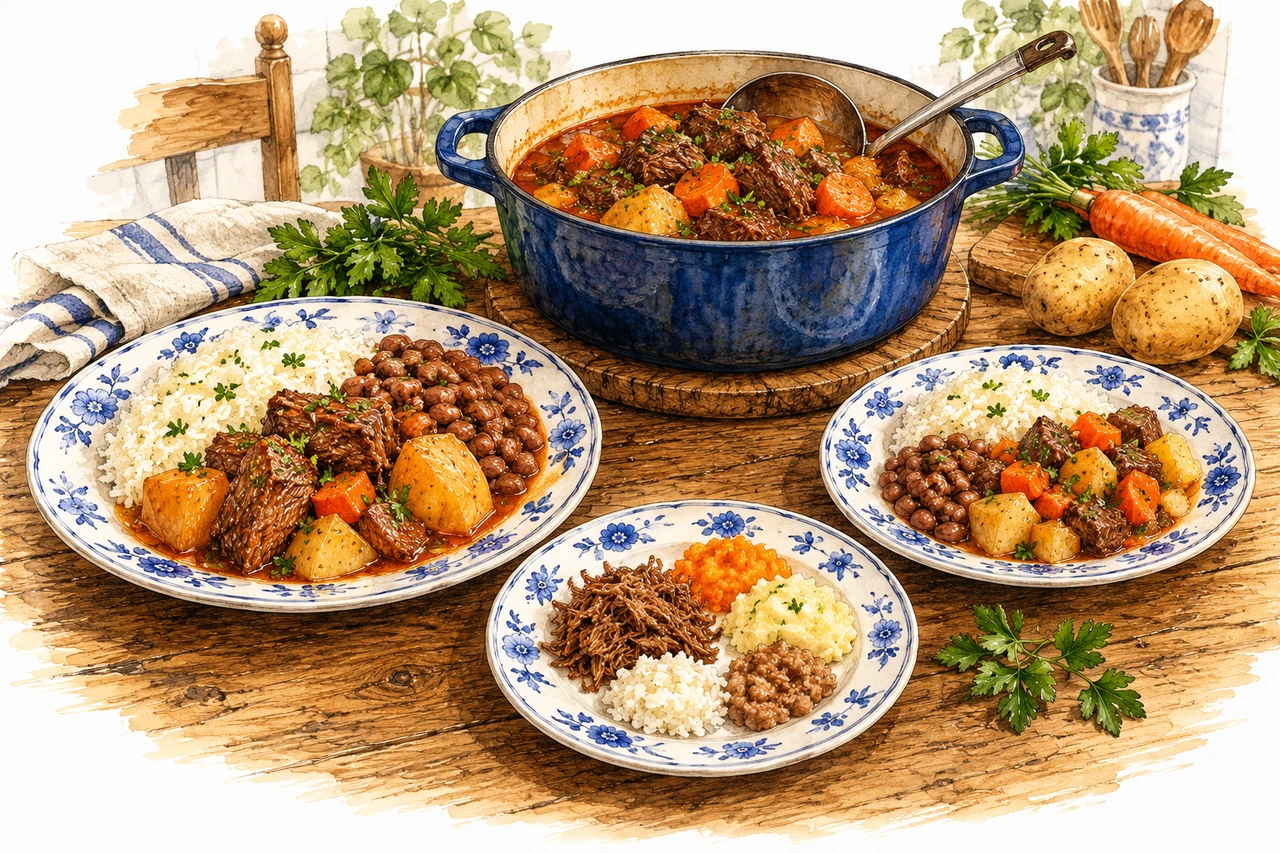
What changes from one stage to the next is not the pot. It is the moment you set aside the baby's portion, which comes before the salt, and the texture it arrives in on the plate. This article shows how a single pot becomes three dishes: one for a baby who is just starting, one for a baby who already grabs food with their hands, and one for the family.
Why one pot
Jarred baby food is a 20th-century invention. Before it, the baby's food came out of the household pot. The Weston A. Price Foundation article that inspired this text cites examples gathered by the American author Cynthia Lair in the book Feeding the Whole Family: in Oceania, babies were given fish and liver; Polynesians made a breadfruit pudding with coconut cream; Inuit babies ate seaweed and seal fat; in Japan, a rice porridge that grew thicker over time and gained dried fish and mashed pumpkin. These are accounts of tradition, not studies, but they show the same logic: the baby's food was the home's food, prepared in a way the baby could eat it.
The Ministry of Health arrives at the same place by another route. Children pay attention to everything and tend to imitate what others do; eating together with the family helps a child take an interest in new foods and makes the meal more enjoyable (p. 99). And there is the argument of whoever does the cooking: one pot is less work than two.
The condition is the one in the opening sentence. If the food at home relies on bouillon cubes, processed meats and a lot of salt, the baby should not eat from it, and perhaps that is the push the family needs to change together, one pot at a time.
The rule that organizes everything: set aside before the salt
The baby's portion comes out of the pot before the salt, before the chili pepper and before any strong seasoning. The Ministry suggests exactly this for families who like spicy food: set a little aside for the child before adding those seasonings (p. 111). Garlic, onion, bay leaf and fresh herbs go in from the start of the sauté and season the whole pot, including the baby's share.
Two ingredients never go into the pot that will feed the baby: ready-made seasonings (cubes, sachets, powders or liquids) and industrialized broths. The Ministry classifies them as ultra-processed, with large amounts of salt and additives, and advises against using them in preparations served to children (p. 89).
On salt, the references differ in the details. The Ministry speaks of a minimal amount. The Brazilian Society of Pediatrics advises avoiding salt from the start, according to the summary of the SBP practical guide published by the Afya portal. The Ancestral Complementary Feeding Guide accepts a little unrefined salt once the baby begins sharing the family's food. Setting aside the portion before the salt satisfies all three at once: the baby's portion comes out with no added salt at all.
One pot, three plates: the method
The example is a pot roast-style beef stew with pumpkin and chayote (chuchu, a mild green squash), two vegetables the ancestral guide has used since the first month. It is a template to adapt to whatever you have at home.
Ingredients
- 600 g of stewing beef (chuck, shank or shoulder), cubed
- 1 tablespoon of beef tallow, lard or olive oil
- 1 chopped onion and 2 cloves of garlic
- 1 bay leaf and a sprig of thyme
- 1 large slice of pumpkin and 1 chayote, cubed
- water or unsalted beef and bone broth
- for the family's portion: salt, pepper and cassava or yam
Method
- Heat the fat, sauté the onion and garlic, and brown the beef in batches. This step builds the flavor.
- Add the bay leaf, the thyme, and enough water or broth to cover. Cook, preferably in a pressure cooker, until the beef falls apart with a fork.
- Add the pumpkin and chayote and cook until very soft.
- Set aside the baby's portion now: a few pieces of beef, pumpkin and chayote, with a little of the broth. Remove the bay leaf and thyme from this portion.
- Only then season the family's pot with salt and pepper and, if you like, add the cassava or yam to thicken it.
For the adults' table, 181 Receitas Ancestrais has its own versions of pot roast beef and short rib stew with pumpkin, among broths, stews and roasts where one base feeds the next recipe. It is a book for the family, not for babies: the baby's portion always comes out before the salt, as in step 4.
Plate 1: the baby who is just starting (6 to 8 months)
Very finely shredded beef, with pumpkin and chayote mashed with a fork, each in its own corner of the plate, moistened with a little broth and a drizzle of the fat. No blender and no sieve: the Ministry of Health advises offering food mashed with a fork, with the foods kept separate (p. 116), at a consistency that does not run off the spoon. If it looks dry, a spoonful of the cooking broth fixes it.
Plate 2: the baby who already grabs with their hand (9 to 12 months)
The food is less mashed, in soft little pieces, and the beef is shredded. Larger soft pieces come in for the baby to hold: a stick of cooked pumpkin, a cube of chayote. At this stage, the baby uses the pincer grasp, brings the spoon to the mouth and chews firmer foods, but still needs help (p. 121). The ancestral guide introduces soft pieces from 9 months and finger-food pieces from 10 months.
Plate 3: the family, with the child over 1 year old
The child starts eating from the same pot, already seasoned, and the big pieces are cut up. That is why it is worth keeping the salt in the whole pot low, as the Ministry recommends for the entire family (p. 103). A spoonful at the edge of the plate is enough to taste the family's seasoning. If the family likes pepper, the child's portion still comes out before it is added.
Other pots that divide well
- Free-range chicken or chicken stew. The meat is shredded, without tough skin and with extra attention to small bones. For the adults, there is the book's free-range chicken.
- Steamed or stewed fish. The Ministry suggests fish with few bones, such as cação (small shark), pirarucu, pintado, tambaqui and catfish, and says to check again before serving (p. 86 and p. 178). Cooked fish keeps only 1 day in the fridge.
- Beef and bone broth soup with vegetables. For the baby, the solids are taken out of the soup and mashed; the broth is used only to moisten.
- Liver. The ancestral guide includes it from the 7th month, in a small portion, cooked in broth or as a well-cooked pâté. Raw or pink liver does not go to the baby.
What about rice and beans?
At a Brazilian table, this is the inevitable question. The Ministry of Health allows beans and rice from 6 months, with the beans mashed with a fork and soaked for 8 to 12 hours before cooking (p. 77). The ancestral guide prefers to leave grains and legumes until after 18 months, always soaked and well cooked. It is a difference of path, not of safety, and each family decides which to follow. With either one, the baby's beans come out of the pot before the salt and seasonings go in, as the Ministry teaches (p. 174), and they never include carne-seca (dried salted beef), sausage or pig's trotter.
What stays off the baby's plate
- added salt, chili pepper, ready-made seasonings and bouillon cubes;
- sugar of any kind, until age 2 (p. 104);
- honey before 1 year, because of the risk of botulism, and the Ministry recommends avoiding it until age 2 (p. 104);
- cured and processed meats, such as sausage, salami, bacon and ham;
- raw or undercooked meat, fish, liver or eggs (p. 86);
- raw milk and raw-milk cheese;
- bones to gnaw on: chicken bones splinter and shed bits of cartilage;
- fish bones, even the small ones;
- hard, round or small foods served whole, such as grapes and cherry tomatoes, which should be cut into very small pieces and seeded (p. 84); nuts only finely ground (p. 88); popcorn stays off the menu until age 2 (p. 78).
At the table: what you decide and what the baby decides
One sentence sums up the division of roles: you decide what to serve, and the baby decides how much to eat. The Ministry describes the baby's signs of fullness (turning the head away, closing the mouth, pushing away the hand offering food) and asks that they be respected (p. 114). Forcing, bribing and distracting with the TV or a phone make it harder for the baby to recognize their own hunger (p. 97 and p. 124).
Spoon or hands? The references converge on a mixed approach. The ancestral guide recommends, until close to 1 year, a base of mashed, nutrient-dense food, with soft pieces alongside for the baby to explore. The Ministry advises offering food on a spoon and letting the baby use their hands to pick up the food and the spoon itself (p. 107 and p. 116). In practice, it is the same plate: the spoon makes sure the baby eats, and the hands let the baby learn.
There will be mess, frowns and food on the floor. A grimace does not mean the baby didn't like it, only that the flavor is new, and some children need to try a food more than eight times before accepting it (p. 107). Let the refused food come back a few days later, prepared a different way.
When the family's food isn't yet where you want it to be
Not every home cooks every day, and that's okay. The baby can be the reason to start with one pot a week: the Sunday pot roast, broth frozen in portions. Fridge and freezer storage times and the safe way to thaw are covered in how to prepare and freeze baby food. If your baby hasn't started yet, the roadmap for the first weeks is in baby's first foods.
Frequent choking, refusal that drags on for weeks or weight loss call for an individual assessment: talk to your pediatrician before changing the routine.
Next time you make a pot roast
Next time you cook a carne de panela (Brazilian pot roast), set a small bowl next to the stove and put aside the baby's portion before adding the salt. Mash it with a fork right on their plate.
To find out what goes into each stage, the Guia da Introdução Alimentar Ancestral (Ancestral Complementary Feeding Guide) lays out the structure of the sopinha (baby soup: a combination of meat, vegetable, fat and a fermented food), five-week meal plans and more than 80 recipes by age, written by nutritionists Laura Valentim and Dalyla Peçanha.
Educational content; it does not replace an individual assessment by a health professional.
Part of this text was based on an article by Jen Allbritton published by the Weston A. Price Foundation.
As informações têm caráter educativo e não substituem avaliação individual de profissional de saúde habilitado.