Blogfermentation · from the farm to the table · Weston A. Price
Sourdough Rye Bread: What Weston Price's Swiss Villages Can Teach Us
Natural sourdough rye bread fed the Swiss villages Weston Price visited. Here is what remains of it today, and the people working to bring it back.
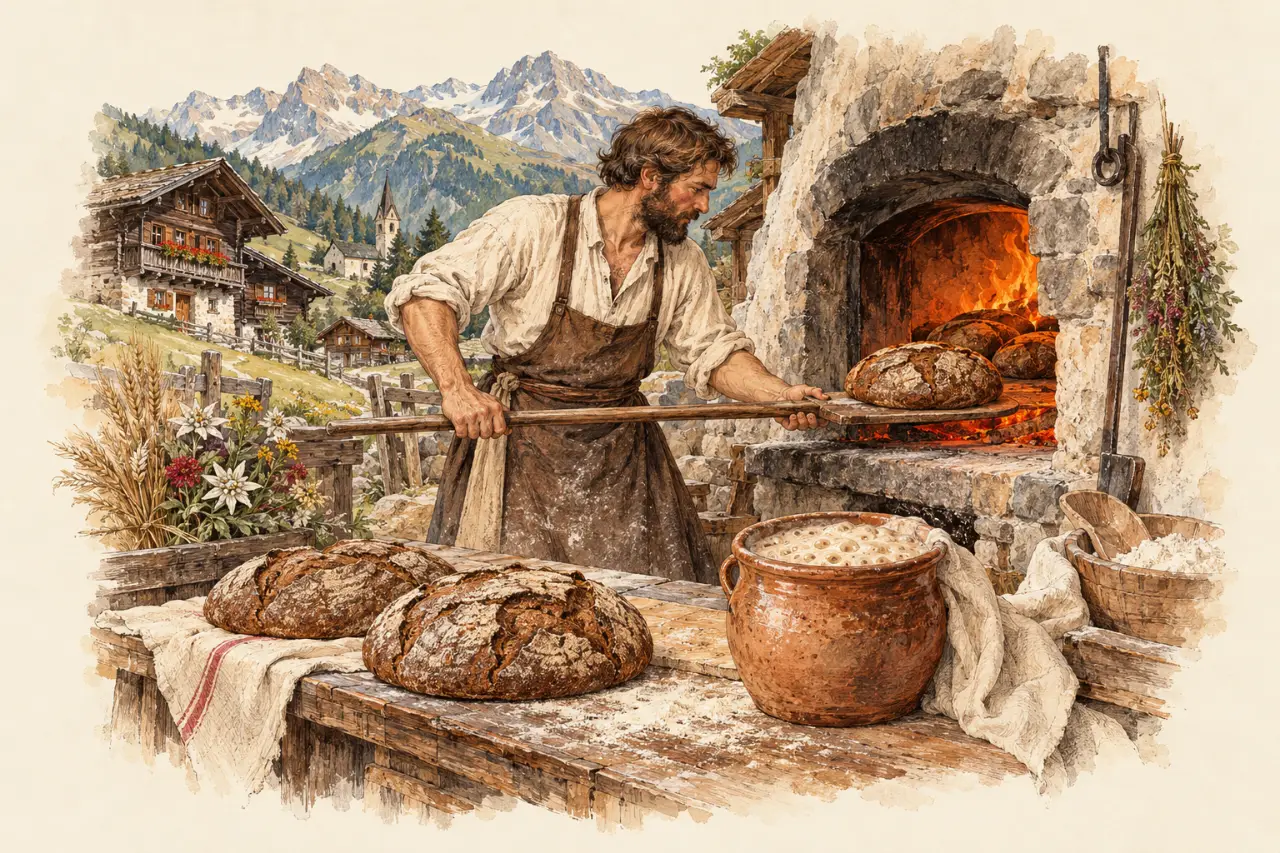
Anyone browsing Swiss tourism websites will soon come across references to the country's centuries-old baking traditions and the more than two hundred types of bread on offer to visitors. Talking about centuries is no exaggeration: the oldest traces of bread on record, dating from 3500 BC, are said to have been found in Switzerland. The curious thing is that the rye sourdough bread that fed the Alpine valleys for generations has become harder to find than the festive breads.
Swiss breads aren't just for tourists, either. According to a website about life in the country, the average Swiss person eats 49 kg of bread a year, compared with about 17 kg for the average American. (Americans, the author jokes, make up for their "insufficient" bread consumption, by European standards, by supporting more than thirteen thousand donut shops.)
Unfortunately, much of that bread seems to come in variations on the same theme: yeasted breads made only or mainly with refined white flour. Temptingly displayed in supermarkets, bakeries and even in "traditional food" museums, breads such as the braided Zopf and the raisin brioche, once reserved for Sundays and special occasions, now seem easier to find than the "everyday" breads of the past, such as the traditional rye sourdough bread.
This article, adapted from a text by Merinda Teller published in the magazine of the Weston A. Price Foundation, tells the past, the present and the possible revival of this bread.
The bread of the past: the rye of the Lötschental
Members of the Weston A. Price Foundation know the story well: hearty, nutrient-rich rye sourdough bread was the staple food of the villagers whom the dentist Weston Price encountered when he visited the Lötschental valley in Switzerland in the early 1930s.
The Lötschental lies in the upper part of the Valais, one of Switzerland's 26 cantons, which are roughly equivalent to our states. The Valais is home to some of the most famous peaks in the Alps, such as the Matterhorn.
To evoke what the valley was like in Price's day, a blogger asks readers to imagine an isolated village surrounded by steep mountains, "with no paved roads, no hospitals, no dentists, no doctors and no electricity," subject to "long, cold winters" and dependent on what the residents "could harvest and produce on their own."
Despite this bleak picture, Price found villagers glowing with health there, living on rye bread, raw dairy and, now and then, mutton. Even today, visitors describe the valley as a "secret" and "magical" place, ideal for getting to know "untouched Swiss rural villages." The foundation published an account of one such trip in A Visit to Switzerland's Loetschental in the Footsteps of Weston A. Price.
Why Rye
Rye was a natural fit for the Lötschental and the other Alpine valleys because it is hardier than other grains and has a long history of adapting to extreme conditions: "winter cold, snowstorms, summer heat and drought, and high altitudes."
Because its starch profile is very different from wheat's, naturally fermented rye bread had another advantage: it could keep for up to a few months. This was crucial, because the villagers baked their bread in communal ovens, fired up only every two or three months. Making bread took a lot of strength, so it was a job for the men of the village, and an occasion for drinking wine and beer.
The loaves were made with a hole near the edge so they could be hung on hooks to cure. The villagers considered two weeks the minimum for a well-cured loaf.
Today's Bread: The AOP Label and Baker's Yeast
Written records of rye bread in the Valais go back to the early 13th century. Perhaps because of this history, the Valais is the only region in Switzerland with a bread bearing the AOP quality label (appellation d'origine protégée, or protected designation of origin).
The label, also granted to cheeses, meats, wines and other regional products across the country, aims to "help consumers take a stand against standardized, mass-produced products," guaranteeing that the product was "produced, processed and refined in a clearly defined region." The Valais presents the label as a way of preserving the landscape, by ensuring that rye continues to be grown.
Despite this philosophy against mass production, the Valais produces more than a million loaves of "traditional Valais rye" a year. Promoters say the bread "still looks the same as it did a hundred years ago." But would the people of the Lötschental in Price's day think it tastes the same?
What Changed in the Recipe
Probably not. According to the Slow Food Foundation for Biodiversity, the AOP rules allow producers to add up to 10% wheat flour as well as baker's yeast, "for quicker and easier preparation."
The handful of artisan bakers who remain faithful to the "simple, old recipe," on the other hand, use only pure rye, water and salt. The natural starter, which many people in Brazil know as levain (like our einkorn levain), and a dough rest of up to eighteen hours are the decisive factors that give the bread its characteristic flavor.
Portrait of an Artisan Baker
The switch from natural sourdough fermentation to baker's yeast began in the 19th century. The "quick and simple fermentation process" that yeast allowed, combined with new mechanized production methods, seemed preferable to the long fermentation and time-honored techniques that sourdough bread requires.
For some 21st-century consumers, however, the pendulum has begun to swing back. For this food-conscious group, in the United States, Switzerland or anywhere else, traditional sourdough bread offers more flavor, more nutritional value and longer shelf life, without any additives.
Where Baptiste Dujardin Came From
Baptiste Dujardin (whose last name, by happy coincidence, means "of the garden") is part of a new generation of Swiss bakers committed to reviving the artisanal production of food and bread. Born in the south of France, he came to Switzerland after a transformative stay in an intentional community in the United Kingdom in his late teens.
There he discovered an "alternative" world that sparked a lasting interest in health, traditional foods and biodynamic agriculture, a model that goes beyond organic, launched in the 1920s by the Austrian philosopher Rudolf Steiner.
After moving to Vevey, in the canton of Vaud, which borders Valais to the northwest, Baptiste supported himself with a catering service while learning about artisanal food production and baking. He attended local workshops and did a lot of experimenting. He also spent three years studying Ayurvedic medicine, but concluded that he would better fulfill his purpose by helping build the local, traditional food networks that were beginning to emerge in the canton. Vaud is one of Switzerland's main farming regions, known for its wines and fruit, and it leads the country in the production of grains suited to bread baking.
Le Pain Holistique: Grains Straight from the Farm
Around 2015, under the name Le Pain Holistique ("the holistic bread"), Baptiste began selling artisanal breads on a small scale, all made using the traditional method of natural sourdough fermentation. From the start, he has insisted on buying grains, seeds and legumes directly from small biodynamic farms that mill the grain on their own property.
Thanks to Switzerland's compact size, he drives only fifteen minutes to the few farms he works with. Baptiste describes them as farms that understand permaculture, "in the style of Joel Salatin": they integrate animals, vegetables, grains and fruit trees in diversified landscapes and, most importantly, are willing to innovate and experiment.
From these farmers he gets rye and several ancient forms of wheat, such as spelt, einkorn and emmer, as well as buckwheat and chickpeas. Each recipe features one of these ingredients as the "star," to highlight the unique flavor of each grain. Einkorn, incidentally, is the basis of our natural sourdough bread with einkorn wheat and our long-fermentation bread with ancient einkorn wheat.
From Puzzlement to a Loyal Clientele
At the beginning, Baptiste baked about 30 kg of bread a week, but, "since people weren't used to this kind of bread," he couldn't always sell everything. The higher price compared with ordinary bakery bread held back growth at first, until people came to understand the value of high-quality biodynamic ingredients and the slow process of natural sourdough fermentation.
Over time, Baptiste's integrity, word of mouth and the breads themselves won over many fans. Today he has an enthusiastic clientele that has learned to appreciate the fact that artisanal bread is not uniform, and that buys about 150 kg of bread a week.
Baptiste also sells eggs from pasture-raised hens and, true to his Ayurvedic training, a golden ghee "prepared with harmony" from organic butter from grass-fed cows. To keep costs low, his main point of sale is the local farmers' market, which runs twice a week. He also sells at a natural foods store (which offers, among other things, kombucha and raw milk) and at a foundation that carries on the ideas of Rudolf Steiner.
The wood-fired oven dream
Baptiste rents the space, along with a 1980s oven, from a commercial bakery, but his long-term goal is to bake in a wood-fired oven, as the people of the Lötschental once did. There are plans to join forces with other farmers and food producers to create a farming community in a small municipality above Vevey. He dreams of the day when every step, from growing the grain to milling, baking and selling, happens in one place.
The crossroads of Swiss farming
Baptiste notes that Swiss agriculture is at a crossroads and full of contradictions. On one side, businesses like his, working with innovative small farmers focused on regenerative agriculture, are on the front line of the effort to reclaim Switzerland's historically important role in the organic movement.
In the 1920s, Swiss farmers were among the first to use biodynamic methods. In the 1940s, the country went on to refine "organic-biological" farming, and in the 1970s and early 1980s it created the Research Institute of Organic Agriculture (FiBL) and Bio Suisse, the umbrella association of the country's organic farming organizations, along with standards for organic production.
Small farms at risk, organic on the rise
Today, small conventional Swiss farms are struggling, partly because of national subsidy policies that favor "fewer but larger farms". In addition, the technocratic Organisation for Economic Co-operation and Development (OECD) has taken sides against small family farms, advocating "the emergence of larger farms" and "changing the current inheritance rules, which favor farming across generations".
Organic farms, on the other hand, are thriving. After a decline in the 2000s in the share of Swiss farmland devoted to organic production, chemical-free farming began to grow again from 2010. Today, one in every seven Swiss farms (14.4%) is organic, double the share in the year 2000.
The pesticide problem
The growth of organic farming may be driven in part by a growing awareness that Switzerland has a serious pesticide problem. Studies document "alarming" contamination, "worse than feared", of waterways in farming areas, with seventy to ninety active pesticide ingredients detected at every sampling site. In 2018, the government even raised the maximum permitted concentration of micropollutants in Swiss lakes and rivers, including a limit 3,600 times higher for glyphosate.
On farms, the problem is not limited to conventional agriculture. A study released in April 2019 found pesticide residues at "alarmingly" high levels on 93% of the organic farms analyzed on the Swiss Plateau, a densely populated region that includes parts of the canton of Vaud. (Most French-speaking cantons, including Vaud, joined the return to organic farming later than the German- and Italian-speaking cantons.)
When the article was written, a popular vote, without government support, was expected in 2020 on an unprecedented initiative to "ban the use of all synthetic pesticides in Swiss agriculture and the import of food or feed for commercial use produced with pesticides".
The Paradoxes of Self-Sufficiency
Swiss agriculture has other paradoxes. Despite its charming farm landscapes and strict import regulations, the country is far from self-sufficient in food: its food imports per capita are among the highest in the world.
And it isn't just food for people. Despite its clear strength in milk and meat production, Switzerland imports large quantities of animal feed, especially soy: about 1.2 million tonnes a year. Government agricultural researchers say the country "could be self-sufficient in an emergency", but only if citizens gave up pork, poultry and eggs in exchange for "more bakery products and potatoes".
In the author's view, climate-change messaging and vegan zealotry already seem to be pushing in that direction: in a 2019 survey, 14% of the population said they did not eat meat, and another 17% called themselves "flexitarians", people who try to be "mindful of their meat consumption".
Direct Democracy Comes to the Table
A considerable share of the Swiss, apparently dissatisfied with the situation, is taking farming questions to the ballot box. The "undisputed world champion" of direct democracy, Switzerland has held more than a third of all national referendums ever held in the world.
Many recent referendums have dealt with agriculture, with somewhat contradictory results. In 2017, voters approved by a wide margin an amendment to the Constitution to "better define the kind of agriculture the Swiss people would like to see more of: local and sustainable". In 2018, however, a food sovereignty initiative that addressed similar issues, such as "the decline in the number of farms, the pressure of international competition on farmers [and] the power of big agri-food companies", was defeated at the polls.
The Share Held by Direct Sellers
In 2018, more than half of Swiss consumers (56%) bought organic products every day or several times a week, and organic sales grew 13.3% over the previous year. Although the country's two big supermarket chains, Coop and Migros, held 75% of that market, sellers who deal directly with consumers, such as Baptiste and Le Pain Holistique, won 5.2%.
The hope is that this share will grow as more Swiss people experience the tangible difference between small-scale, artisanal production and both conventional farming and "big organic". In Brazil, this is the path that Nu&Cru's producer map aims to make easier: buying directly from the people who produce the food.
The History of Sourdough Bread
Sourdough bread is made through the action of lactic acid bacteria and wild yeasts, with no commercial yeast at all.
Telling this story, the website Sourdough.co.uk points out that wild yeasts are used all over the world, in preparations so rooted in culture and history that they existed before any form of writing. Until commercial yeasts appeared, all leavened bread was made with natural yeasts. In other words: all bread was sourdough, with its slower rise.
One explanation for the importance of unleavened bread (made without yeast) in the Jewish faith is precisely this: when leaving Egypt, there was no time to let the dough rise overnight. From Egypt, baking made its way to ancient Greece, where bread was a luxury item, made first at home by women and later in bakeries. The Greeks had more than seventy kinds of bread, savory and sweet, made with various grains.
The Romans learned the craft from the Greeks and perfected kneading and the oven. The importance of bread in the Roman diet shows in the poet Juvenal's lament that all the people wanted was bread and circuses (panem et circenses).
French recipes from the 17th century called for feeding the starter three times before adding it to the dough, which leads the website to remark that "the French were obviously far more interested in a tasty loaf than in making the baker's life easy". With the arrival of commercial yeasts in the 19th century, speed and standardized production won out over the flavor and artisanal character of sourdough bread.
Anyone who wants to bring this tradition back into their own kitchen will find step-by-step instructions for the starter in How to Create a Sourdough Starter, from the foundation, along with recipes such as our einkorn focaccia and sourdough pizza.
Further reading
On Nu&Cru
- Lacto-fermentation: what it is and how to do it
- Weston A. Price: what traditional peoples can teach us about eating
- Oatmeal porridge: how to make it more nutritious
- Sauerkraut: benefits and how to make it at home
- Natural sourdough breads: einkorn levain, natural sourdough bread with einkorn wheat and natural sourdough bread with eggs and bacon
- 181 Receitas Ancestrais, Nu&Cru's recipe book
On the Weston A. Price Foundation (in English)
- A Visit to Switzerland's Loetschental in the Footsteps of Weston A. Price
- Sourdough Rye Bread
- Whole Grain Einkorn Sourdough
- Be Kind to Your Grains... and Your Grains Will Be Kind to You
References
- Bread. About Switzerland, Swiss Federal Department of Foreign Affairs (eda.admin.ch).
- The history of sourdough bread. Sourdough.co.uk.
- Is Switzerland the ultimate land of bread? Newly Swissed, June 14, 2012.
- Atchley C. Three bread trends shaping American diets. World-Grain.com, September 21, 2017.
- Tristano D. Growth in upscale doughnut chains becoming a little "strange". Forbes, April 10, 2018.
- Maison du Blé et du Pain (maison-ble-pain.com).
- Swiss Open-Air Museum Ballenberg. Brochure Korn und Brot (ballenberg.ch).
- Swiss bread recipe: Bütschella, a sweet roll from Graubünden. Cuisine Helvetica, April 11, 2018.
- Are you healthier than a 1930's primitive Swiss villager? Be Healthy Now!, February 29, 2012.
- Visit to the magic valley of Lötschental. British Residents' Association of Switzerland.
- Traditional Valais rye bread. Slow Food Foundation for Biodiversity.
- Valais, birthplace of the AOP Valais rye bread. Valais.ch.
- Valais rye bread AOP: the real thing. MySwitzerland.com.
- AOP and IGP: quality labels with character. Cheeses from Switzerland.
- Rye bread from the Swiss Valais: pain de seigle valaisan or walliser roggenbrot. The Fresh Loaf.
- Sourdough bread. ScienceDirect Topics.
- L'agriculture en terre vaudoise 2016. AGIR (agirinfo.com).
- Bio Suisse's roots. Bio Suisse.
- FiBL Switzerland: 40 years of organic farming research. FiBL.
- Three Swiss farms close a day. SWI swissinfo.ch, May 11, 2017.
- The unseen environmental cost of Swiss farming. Le News, March 2, 2015.
- Swiss organic farming continues to grow but with big cantonal differences. Le News, September 5, 2018.
- Bio Suisse. Organic sector in numbers 2018, figure 1.
- Excessive levels of pesticides found in small streams. SWI swissinfo.ch, April 2, 2019.
- Swiss government raises allowable limits for pesticide residues in waterways. Le News, March 27, 2018.
- Pesticide residues found on 93% of organic Swiss farms. SWI swissinfo.ch, April 7, 2019.
- Government rejects vote to ban synthetic pesticides in Switzerland. Le News, June 26, 2019.
- Bio Suisse. Organic sector in numbers 2018, figure 7.
- Bondolfi S. Does Switzerland produce half of all the food it needs? SWI swissinfo.ch, September 11, 2018.
- Swiss to vote on banning factory farming. SWI swissinfo.ch, September 17, 2019.
- 2.6 million Swiss are reducing their meat consumption. LIVEKINDLY.
- Kaufmann B. The way to modern direct democracy in Switzerland. House of Switzerland.
- Chandrasekhar A. Swiss voters demonstrate appetite for food security. SWI swissinfo.ch, September 24, 2017.
- Tognina A. Radical change for Swiss agricultural policy goes to vote. SWI swissinfo.ch, August 16, 2018.
- Swiss reject agriculture schemes in national vote. The Local, September 23, 2018.
- Bio Suisse. Organic sector in numbers 2018, figures 8 and 10.
- Bio Suisse. Organic sector in numbers 2018, figure 9.
This article is an adaptation of "Switzerland's Sourdough Breads: Revival of the Fittest?", by Merinda Teller, MPH, PhD, published in Wise Traditions in Food, Farming and the Healing Arts, the journal of the Weston A. Price Foundation, in Winter 2019. Read the original in English.
As informações têm caráter educativo e não substituem avaliação individual de profissional de saúde habilitado.