Blogtraditional eating · recipes · Weston A. Price
Oatmeal Porridge, Made More Nutritious the Traditional Way: Soaked Oats, Butter and Cream
Traditional oatmeal porridge was made with butter, cream and oats soaked overnight. Find out why that makes a difference, then try the recipe with pecans and cinnamon.
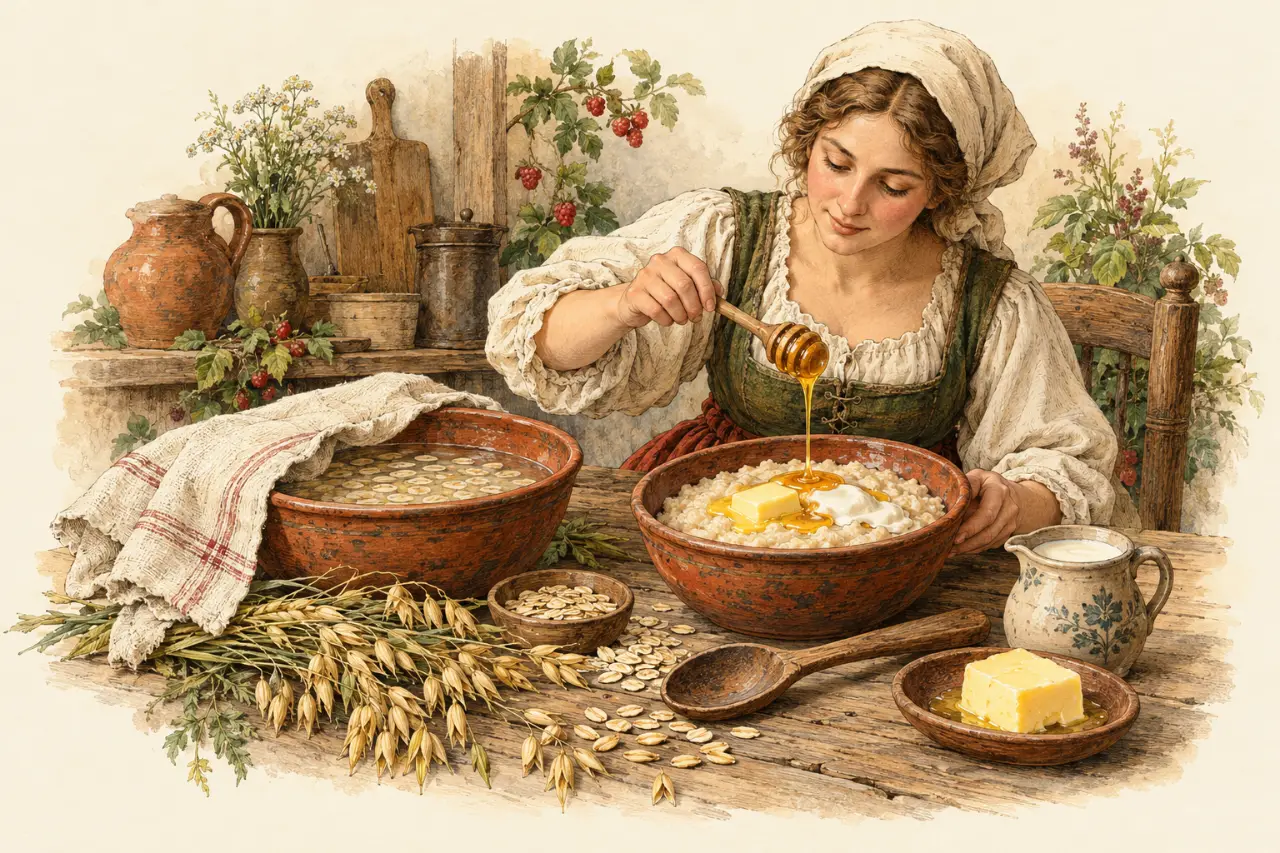
"Wisdom is in the morning porridge," says a Scottish proverb. Before breakfast came in boxes or in bars, it came from a pot on the stove. Oatmeal porridge was the quiet workhorse of the morning: the meal that kept farmers going in the fields, children in school and families through the long winters.
It was never instant and never skimmed. Every steaming bowl was finished with butter, cream or milk, because people knew what modern labels have made us forget: nourishment is not a matter of calories but of staying power.
This article is an adaptation of a text by Cristina MacArthur published by the Weston A. Price Foundation. It explains why porridge needs fat, why it is worth soaking the oats and how to prepare the traditional version.
The Oats That Sustained Scotland
Oats have kept people alive. In the Scottish Highlands, where wheat and barley often failed, they thrived in the shallow, stony soil. That resilience made them a lifeline: the grain of the poor, which kept families alive when other crops did not take. The foundation tells this long story in So Much More than Scottish Porridge.
In small cottages, porridge cooked slowly over a peat fire, filling the house with the smell of cream and smoke. Stirring the pot was a ritual: always clockwise, never counterclockwise, to bring luck and blessings for the day. When it cooled, the leftover porridge was poured into molds, sliced and taken along on the journey. It was an old way of having food ready for the week, with no need for glass containers.
In Gaelic folklore, oats were not only sustenance but protection. A bowl in the morning was said to guard against melancholy and cold, strengthening body and spirit before facing the freezing weather. Centuries later, the author says, we have discovered why: oats contain avenanthramides, rare antioxidants that calm inflammation and the nervous system, what folklore called "warming the heart".
Why Oatmeal Porridge Needs Fat
Butter was once a symbol of vitality and abundance, but it became a victim of modern "health" campaigns. In its place came skim milk, margarine and refined seed oils, made to last a long time on the shelf, not to give a long life to those who consume them. The result, according to the author, was meals that filled the stomach while quietly inflaming the body, draining energy and resilience over time.
Our great-grandparents knew better. They stirred butter into their porridge without guilt or confusion. Fats were sacred: the way nature found to turn a simple meal into lasting nourishment. For the author, modern research echoes what tradition never forgot: the vitamins and fatty acids in butter and cream help stabilize hormones, improve mood and help the brain produce serotonin, the "happiness molecule". A bowl of porridge with butter is not an indulgence: it is emotional stability disguised as breakfast.
What Fat Does for Oatmeal Porridge
Oats are healthy, but on their own they are incomplete. Without fat, they are digested quickly and hunger returns by mid-morning. When oats meet butter, cream or whole milk, the chemistry falls into harmony:
- fat slows digestion;
- it steadies blood sugar and prolongs energy;
- it helps the body absorb vitamins A, D, E and K2, nutrients that, according to the author, support mood, hormones and immunity.
Traditional cooks did not know these mechanisms. They simply knew it worked.
Whole Milk, Cream and Grass-Fed Butter
In porridge, whole milk and cream are not just the cooking liquid: they are vehicles of nutrition. For the author, raw milk and raw cream are in a class of their own, because they bring enzymes, probiotics and vitamins that are usable just as nature made them. The foundation runs an entire campaign on the subject, Real Milk, and in Brazil Nu&Cru's map of producers helps you find raw milk and butter straight from the farm.
A drizzle of cream or a spoonful of raw butter turns plain oats into a rich, balanced meal, the way our ancestors ate them. No "light vegetable cream" reproduces the richness and balance of a spoonful of butter. Butter from grass-fed cows, a deep yellow, is especially rich in vitamins A, D, E and K2. For those who are sensitive to milk solids, ghee is a gentle, lactose-free alternative, valued for calming digestion.
A tip from the foundation: off the heat, stir one or two yolks from free-range hens' eggs into the hot porridge. They add choline and vitamin A, and make the texture silky.
Honey, Maple Syrup and Salt: Sweet and Savory
Traditional sweeteners, such as raw honey and maple syrup, bring vitality and minerals, rather than the energy crash of refined sugar. Raw honey offers enzymes and friendly bacteria. Maple syrup brings minerals such as manganese and zinc. Together, the author says, they represent the two halves of the ecosystem: honey, from flowers and bees; syrup, from the bark and sap of trees.
Unrefined whole sea salt, such as Celtic salt, provides trace minerals that help with hydration and nerve balance. Its use was once sacred: it preserved food, blessed homes and symbolized the connection between people. The foundation makes the case for real salt in The Salt of the Earth.
Here, too, science and symbolism meet. Minerals such as magnesium and sodium are essential for nerve transmission and for regulating emotions. The morning bowl of porridge doesn't feed only the body, the author writes: it tunes the circuits.
Local Honey: The Beauty of Eating What Comes from Your Region
If you can, sweeten your oats with raw honey from a beekeeper near you. Local honey carries traces of the pollen in your area and, according to the author, works like a small dose that helps the body adapt to the allergens of each season. Over time, it may ease sensitivity to the very flowers that make you sneeze in spring.
Unlike commercial honey, which is often filtered, heated or blended from many different origins, local raw honey preserves enzymes, probiotics and antioxidants that, in the author's view, strengthen immunity and respiratory health. It is also a quiet gesture of care for the environment: every spoonful supports the bees, pollination and the farms that feed your community.
Don't Heat the Honey
Raw honey is alive, and strong heat destroys its delicate enzymes, pollen, probiotics and antimicrobial compounds. Heated above body temperature, honey changes structure and loses part of its healing power. Ayurveda considers heated honey toxic to the body, because it is said to form ama, a sticky residue that slows digestion.
So drizzle raw honey over warm porridge after serving, never during cooking. That is the moment, the author says, when sweetness becomes medicine, and not just flavor.
Maple Syrup and the Rest of the Bowl
Just as local honey reflects the song of the flowers, local maple syrup carries the voice of the trees. The sap that becomes syrup rises from the roots every spring, bringing up minerals from the soil you walk on. When you put maple syrup on your oats, you taste the minerals of your region, the pulse of the forest turned into sweetness. While honey teaches the immune system to adapt, the author writes, maple syrup nourishes the bones, the blood and the nerves with its quiet mineral power.
The same advice goes for the oats, the butter and the milk. Local food carries the mark of your soil and your season: it is fresher, richer in minerals and, in the author's words, in tune with the land that sustains you. Eating this way means stepping into the natural rhythm of your community and strengthening your health and the invisible web between people, animals and place.
That said, if you can only buy one thing locally produced, make it honey. Bees go where we cannot and gather the medicine of the land into something golden and sweet enough to heal. In Brazil, where maple syrup is imported, the advice weighs even more in favor of honey from a beekeeper in your own region.
Soaked Oats: The Secret of Acid
Modern diets are dominated by sweet and salty, but the old ways always included sour. In every traditional diet, a touch of acidity was a sign that the food had come alive. Before refrigerators and labels, people relied on fermentation and natural acids to make meals safer, tastier and easier to digest.
That lively flavor of lemon, kefir, vinegar or yogurt showed that the food had been transformed, and made more nutritious, by time and friendly bacteria, as we explain in the article on lacto-fermentation. A little acid throughout the day (lemon in the morning, kefir or vinegar at lunch, yogurt in the evening) keeps the body's chemistry alive and digestion working, just as nature planned. See the box below.
Why Soak the Oats
Our ancestors noticed that soaking oats overnight in warm water with a spoonful of yogurt, whey or apple cider vinegar made the porridge creamier and easier to digest. According to the author, science has confirmed this wisdom: soaking activates enzymes and reduces phytic acid, improving mineral absorption and the way the body uses nutrients. The foundation explores the subject further in Living with Phytic Acid.
Oats, like most grains, contain enzyme inhibitors and small amounts of oxalic acid: natural compounds that protect the seed but can block mineral absorption and irritate digestion when eaten without being neutralized. The gentle acidity of the soak helps break down these defenses and turns the grain from dormant into digestible, from survival food into real nourishment. Nu&Cru follows the same logic in its fermented oatmeal porridge.
Toast Before Soaking
Before soaking or cooking, many traditional cooks began with a small ritual: toasting the oats in butter or ghee. A few minutes over low heat release the grain's natural aroma, deepen the flavor and, according to the author, begin to neutralize the enzyme inhibitors. Toasting is said to improve digestibility and release antioxidants such as avenanthramides, the same compounds that calm inflammation and soothe the skin. Think of it as the grain's morning stretch, a gentle awakening before the slow cooking.
Emotional Alchemy: The Porridge That Soothes
Beyond its nutrients, oatmeal has a quiet psychology. According to the author, the smell of warm oats releases oxytocin, the same hormone of hugging and breastfeeding, which calms the body and softens the mood of the whole house. For centuries, mothers have served porridge not only to fill bellies but to calm hearts.
Perhaps that is why, in old herbal medicine, oats were prescribed not just as food but as a remedy for the nerves. A cup of oat straw tea or a bowl of porridge was believed to "cheer the sad and restore the weary." Today, the author says, we know that the B vitamins, magnesium and avenins in oats do nourish the nervous system. Food and mood never walk separately.
Real Food Fits the Budget
Real food is usually simpler and cheaper than packaged substitutes. A bag of oats, a stick of butter and a liter of milk feed a family for days. Meals like these stabilize blood sugar, reduce the urge to snack and bring calm, an idea that applies to children's mornings too, as we show in breakfast for kids.
When we eat in rhythm with nature, we regain our balance. Swapping synthetic vegetable spreads for butter, refined sugar for honey and table salt for mineral salt brings back not only flavor, but a connection to the land, to tradition and to other people. And if you doubt that a simple bowl of porridge can change your day, remember: food that calms the body calms the mind.
A Little Acid Every Day
Lemon. According to the author, a few drops of lemon in warm water or over your porridge gently wake up the liver and digestion. Lemon helps the body absorb minerals, provides vitamin C and supports the healthy flow of bile. Simple as it is, lemon water in the morning has long been one of the best ways to "switch on" the body's natural cleansing system.
Apple cider vinegar. Raw, cloudy apple cider vinegar, with its "mother," is one of the oldest digestive tonics in the world. Hippocrates himself, the father of medicine, used vinegar with honey, the oxymel, as an elixir of strength and vitality. One teaspoon in a little water before meals, says the author, balances blood sugar, helps absorb minerals and sharpens digestion.
Kefir, the king of probiotics. Among all fermented foods, kefir reigns supreme. Its tang comes from a powerful community of more than thirty strains of beneficial bacteria and yeasts, many more than yogurt or any pharmacy capsule. According to the author, these living organisms strengthen the intestinal wall, calm inflammation and build immunity from the inside out. Half a cup of raw milk kefir a day is enough to reseed your inner garden and keep it flourishing.
Yogurt. If kefir is the living spark, yogurt is the calm, steady flame. Its mild acidity refreshes and soothes the body, helps digest proteins and fats and brings beneficial bacteria to the gut. For the most nutrition, always choose whole milk yogurt with live cultures.
Recipe: Oatmeal Porridge with Butter, Cinnamon and Pecans
Serves 2 to 3. The original version uses maple syrup; molasses (melado de cana, a dark sugarcane syrup) can replace it.
Ingredients
- 4 tablespoons (about 55 g) butter, preferably from grass-fed cows
- ½ cup chopped pecans (the foundation teaches how to soak and dry them in Crispy Pecans)
- 1 teaspoon ground cinnamon
- 2 teaspoons pure maple syrup, or to taste
- 1 teaspoon local raw honey (for drizzling, not for cooking)
- 2 cups (480 ml) filtered water
- 1 cup soaked oats (see preparation below)
- ½ teaspoon sea salt
- ½ cup (120 ml) fresh cream
- extra maple syrup or reserved pecans, to finish
Preparing the oats (traditional method)
Spread 1 cup of rolled oats on a baking sheet and toast in the oven at 180 °C until lightly golden and fragrant. Process the toasted oats in a grinder or food processor to a medium grind: the result should be part flour, part small pieces.
Place the ground oats in a bowl and add 2 cups of warm water and 2 tablespoons of whey, yogurt, kefir or buttermilk. Those who are sensitive to dairy can use 1 tablespoon of lemon juice or apple cider vinegar. Soak in a warm place for 7 to 24 hours. The finest particles of flour will rise to the surface and can be carefully skimmed off with a spoon. The foundation also publishes its classic version in Breakfast Porridge: Soaked Oatmeal.
Method
- In a medium saucepan, melt 2 tablespoons of butter. Add the soaked oats and heat slowly, stirring, until fragrant.
- Add the water and salt. Bring to a gentle simmer and cook until creamy, 8 to 10 minutes, stirring often.
- In a small skillet, melt the other 2 tablespoons of butter. Add the pecans and cinnamon and toast until fragrant and lightly golden, 2 to 3 minutes. Stir in the maple syrup to caramelize and set aside a spoonful for the topping.
- Fold the rest of the buttered pecans into the porridge. Add the cream and more cinnamon or maple syrup, to taste.
- Serve in bowls and top with the reserved pecans, a drizzle of maple syrup and, last of all, the raw honey, added after serving to preserve its enzymes and properties. If you like, finish with one more drizzle of cream.
Read also
On Nu&Cru
- Lacto-fermentation: what it is and how to do it
- Is butter bad for you? Why it's the better choice
- Natural sourdough bread: the Swiss lesson
- Weston A. Price: what traditional peoples can teach us about eating
- Recipes with fermented oats: fermented oat porridge, fermented oat soufflé and fermented oat banana cake
- 181 Receitas Ancestrais, the Nu&Cru recipe book
On the Weston A. Price Foundation
- So Much More than Scottish Porridge: The Rich Culinary History of British Oats
- Be Kind to Your Grains... and Your Grains Will Be Kind to You
- Living with Phytic Acid
- Oatmeal Tutorial
- Savory Oatmeal
This article is an adaptation of "How To Make Oatmeal Healthier" by Cristina MacArthur, published by the Weston A. Price Foundation in 2026. Read the original.
As informações têm caráter educativo e não substituem avaliação individual de profissional de saúde habilitado.