Blogfats · traditional cooking · reducing waste
Reusing Frying Oil and Cooking Fat: How Many Times and How to Dispose of It
How to strain and store fat from frying, roasting and broth, how many times to reuse it, the signs it has gone too far, and how to get rid of it without pouring it down the sink.
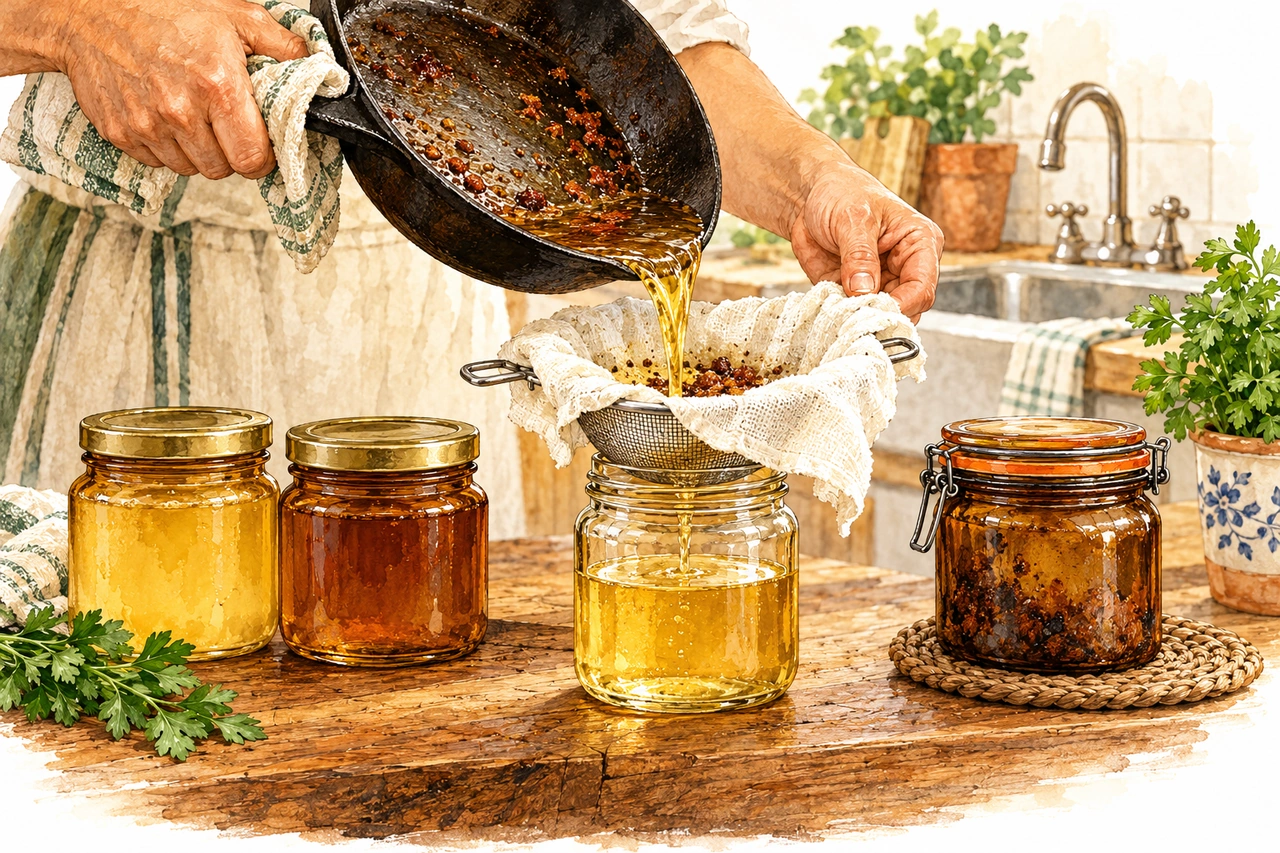
The fat left in the pan can go back into your cooking. For that, it needs to be strained while still warm, stored free of water in a closed jar away from light, and used until it shows signs of wear: smoke over medium heat, foam that won't settle, a dark color, an odd smell or taste. When that time comes, it goes cold into a sealed bottle and from there to a collection point. Never down the sink.
The four kinds of fat left over at home
1. Deep-frying fat. This is the largest volume: the beef tallow, lard or oil that covered the potatoes, the pastéis (Brazilian fried pastries), the fish. It comes out with crumbs and the flavor of whatever was fried. Strained, it works for another batch of the same kind.
2. Roasting fat. This is what drips into the pan under a chicken, a pork leg or ribs, mixed with the meat juices. It contains salt, seasoning and water. It's excellent, but it spoils like food, not like fat.
3. Broth fat. This is the disc that hardens on top of cold broth in the fridge: beef tallow if the broth is beef, chicken fat if it's chicken. It comes with a little broth stuck underneath. The bone broth article shows how to lift it off without breaking up the gelatin.
4. Bacon, pork crackling and chicken skin fat. It comes out nearly pure, salty and strongly flavored. How to render the bird's skin and fat is covered in how to make the most of a whole chicken.
The difference that matters between them is water. Pure fat keeps; fat with broth, meat juices or damp crumbs spoils quickly, because moisture encourages microbes and speeds up rancidity (Curry and Yates, University of Nebraska, 2026).
How to strain fat: step by step
- Let it cool to warm. Too hot, the fat burns your hand and warps plastic containers. Too cold, it hardens in the strainer. Warm and still liquid is just right.
- Set up the strainer. A fine sieve lined with a clean cotton cloth or a paper filter, over a funnel or directly over the mouth of the jar.
- Use a clean, completely dry glass jar. A single drop of water at the bottom shortens the fat's life.
- Leave the dregs behind. The dark layer at the bottom of the pan, with burnt crumbs, doesn't go into the jar.
- Label it. Write the type and date: "beef tallow, potato frying, October".
For broth and roasting fat, there's one more step if you want to keep it longer: melt it over low heat, uncovered, until it stops bubbling. The bubbles are water evaporating; when they stop, the fat is clean. Strain and store it like the others. Take your time, because fat with water spatters.
If the fat catches fire
Never throw water on it. When it hits hot fat, water turns to steam all at once and sprays burning fat across the kitchen. The Ceará Fire Department advises turning off the stove and the gas valve, covering the pan with its lid or with a damp, well-wrung cloth, and waiting for the pan to cool before uncovering it, because the fire can flare up again (CBMCE, 2022).
Where to store it and for how long
Four things spoil a fat: water, air, light and heat. The ideal container is glass, filled close to the top, tightly closed, away from the stove and the window.
- Unclarified broth or roasting fat: in the fridge, used within the next few days, like any leftover food.
- Strained, water-free beef tallow: the most stable. In a tightly sealed container, it lasts months at room temperature and more than a year in the fridge or freezer, according to Nebraska Extension (Curry and Yates, 2026). When in doubt, homemade tallow goes in the fridge.
- Lard and chicken fat: keep them in the fridge. They have more polyunsaturated fat, the kind that oxidizes most easily: about 11% in lard and 21% in chicken fat, versus 4% in tallow, according to USDA tables (lard, chicken fat, tallow).
- To make it last longer: freeze it in small portions, about a week's worth each.
Keep separate jars according to what was fried. Fish fat goes for fish; breaded-food fat for breaded food; fat from rabanada (Brazilian French toast) or bananas for sweets. Potato fat is the most versatile.
One safety rule: don't store fat with garlic, herbs or pieces of meat outside the fridge. Brazil's Ministry of Health lists fried meat preserved in fat among the foods linked to botulism when prepared or stored improperly (Ministry of Health, Botulism). Seasoned fat is for using right away or keeping cold.
How many times can you reuse frying fat
There's no fixed number. It depends on what you fried, the temperature and how carefully you strained it. Anvisa, Brazil's health regulator, doesn't set a number of uses in its rule for restaurants and snack bars: it says to heat the fat to no more than 180 °C and to replace it as soon as smoke, heavy foaming or a change in smell and taste appears (RDC 216/2004, item 4.8.11). Those are the signs to watch for at home too.
What makes fat last through more uses:
- Controlled temperature. Fry between 170 and 180 °C. Fat that goes past its smoke point breaks down faster.
- Always strain. Crumbs burn with every new batch and darken everything.
- More saturated fat. Under repeated heating, polyunsaturated oils such as soybean oil are the ones that change the most, notes a bulletin from the Adolfo Lutz Institute (Tavares and colleagues, 2012). That's why beef tallow and lard, with less polyunsaturated fat, tend to hold up better to reuse.
- Go easy on breaded foods. Loose flour in the fat burns and shortens the life of the jar.
With each frying, the fat builds up free fatty acids and its smoke point drops (Bazina and He, 2018). That's why used fat smokes sooner than fresh fat. When this starts happening over medium heat, it has reached the end of its cycle.
Ideas for using stored fat
- Chicken or pork roasting fat: rice, farofa (toasted cassava flour), roasted vegetables, pan-fried potatoes.
- Beef tallow from broth: sautéing the garlic and onion for beans, browning pot roast, making baião de dois.
- Chicken fat: roasted potatoes, caramelized onions, rice.
- Bacon or crackling fat: fried eggs, sautéed collard greens, beans. Use a little, because it's salty.
- Strained frying fat: the next frying of the same kind, like the bananas fried in fat.
If you plan your week around broths and roasts, you'll always have a jar of these fats in the fridge. It's one of the foundations of batch cooking for the week and a real saving, as the piece on real food on a budget shows. To know which fat to use for each dish, see lard, beef tallow or butter.
Signs it's time to throw it out
Throw the fat out if:
- it smells rancid, like paint, or like fish when it never fried fish;
- the taste has turned bitter;
- mold appears on the surface;
- it smokes over medium heat;
- it foams and the foam won't settle when food goes in;
- it has become dark and thick;
- it's unclarified broth or roasting fat that was left out of the fridge.
How to dispose of fat without using the sink
Disposed of the wrong way, fat clogs sewer lines and contaminates soil and groundwater (Agência Brasília, 2025). São Paulo's Environment Department sums up the right way like this: let it cool, put it in a container with a lid, such as a PET bottle, seal it well and, when it's full, take it to the nearest collection point (SEMIL-SP, 2025). The toilet goes to the same sewer and isn't a way out either.
In practice:
- Let it cool and strain it to remove the dregs.
- Collect it in a PET bottle with a cap. Keep topping it up over the weeks, always with cold fat.
- Find your city's collection point: eco-points, schools, cooperatives and programs run by the city or the water and sewage utility usually accept it.
- Solid animal fat: ask first. In Brasília, drop-off points accept animal fat as long as it's liquid (Agência Brasília, 2025). If your city's point only takes liquid oil, ask how to hand in fat that hardens; what it can't do is go down the sink.
- Small leftovers in the pan: wipe with a paper towel before washing and throw the paper in the regular trash.
The collected oil and fat become soap, biodiesel and other industrial products, according to the same report from the Federal District government.
When the fat from home isn't enough
A household that roasts and makes broth produces enough fat for sautéing, but rarely enough for deep-frying. For that, you either render beef tallow and lard at home, using the method in how to make lard and beef tallow at home, or buy the fat ready-made. What beef tallow is and how it behaves over heat is covered in beef tallow: what it is and how to use it.
For those who want ready-made tallow for frying. Nu&Cru Beef Tallow is beef fat from 100% grass-fed cattle, a single ingredient, made in small batches and packed in glass. The current batch has sold out: on the page you can see the composition and reserve the next one via WhatsApp.
The next step is a small one: set aside a clean, dry, labeled glass jar today for the next bit of leftover fat. And if you'd like recipes that use these fats, 181 Receitas Ancestrais has about 48 that call for tallow, butter or lard, plus the broths that yield fat to save.
As informações têm caráter educativo e não substituem avaliação individual de profissional de saúde habilitado.