Blogfamily routine · budget · meat and organ meats
Healthy Eating on a Budget: How to Eat Real Food Without Spending Much
Where to put your food money: a solid pantry base, cheaper cuts, organ meats, broth, buying direct and using up leftovers, plus a simple cost-per-meal calculation you can do at home.
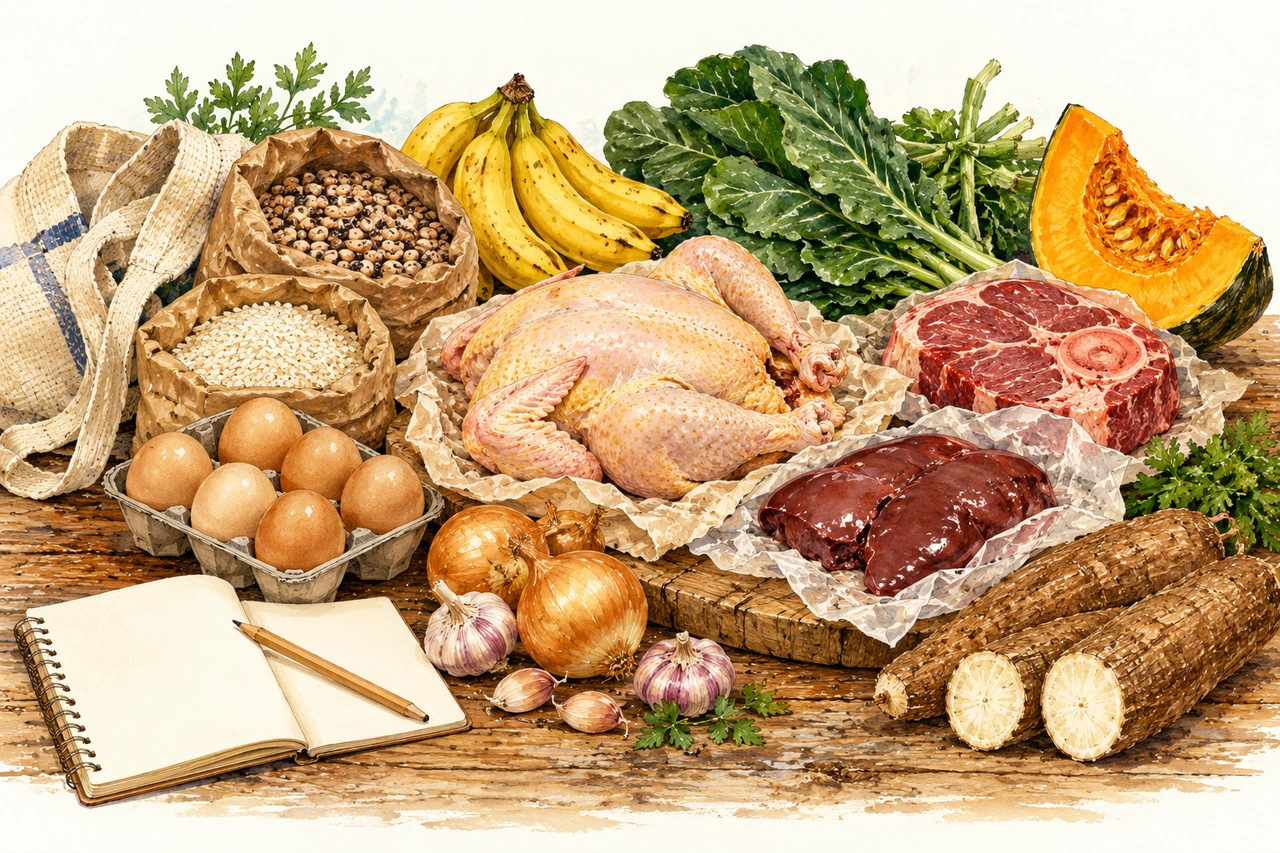
Eating real food without spending much depends less on finding "cheap" ingredients and more on knowing where to put your money. The numbers work out when the base of the pot is rice, beans, cassava, eggs and seasonal vegetables, when the meat comes in cuts that ask for time rather than prime steaks, when the bone becomes broth and the fat from the roast becomes tomorrow's sauté, and when part of the shopping goes straight from the people who produce it. What drives the cost up is buying ready-made food to get through the week and throwing out what's left of it.
None of this calls for perfection. A family that eats pizza on Friday or opens a pack of cookies in a hard week hasn't undone anything; what changes the budget is the pattern of your shopping, not the exception.
Is real food still cheaper?
The Dietary Guidelines for the Brazilian Population, published by Brazil's Ministry of Health, states that, based on IBGE's Household Budget Surveys, a diet built on fresh or minimally processed foods and on dishes made from them is, in Brazil, not only healthier than one based on ultra-processed foods but also cheaper. The guidelines explain that the opposite impression usually comes from the price of some vegetables, greens and fruits, which are eaten alongside lower-priced foods such as rice, beans, potatoes and cassava (p. 110).
The same guidelines, published in 2014, already warned that this could change. A Brazilian study that tracked prices from 1995 to 2017 showed that, since the early 2000s, ultra-processed foods went through successive price drops, and it projected that, per kilo, they would become cheaper than healthy foods in 2026 (Maia and colleagues, 2020). Meat weighs more on the budget, too: between September 2025 and September 2026, the price of prime beef rose in all 27 state capitals surveyed by DIEESE and Conab, with increases ranging from 3.78% in Brasília to 21.09% in Rio Branco.
So the honest answer is this: eating real food is still possible on a tight budget, but it doesn't happen by accident. It depends on choosing well where to spend and on trading money for a little time in the kitchen.
Do the math per meal, not per kilo
The price per kilo is misleading. A pack of cream-filled cookies looks cheap until you realize it doesn't keep anyone going until lunch. A kilo of bone-in beef ribs looks like it won't go far until it becomes a lunch and, with the bone, a broth and a soup. To compare for real, jot down on a sheet of paper, at your butcher and at your grocery store:
- Price per kilo of the item.
- How much of the kilo becomes food: you don't eat the rib bone, but it becomes broth; the fat on the cut melts and becomes cooking fat.
- How many family meals that kilo makes, counting the soup and broth that come afterwards.
- Price per meal = price per kilo divided by the number of meals it makes.
Do this once for five or six items you always buy, for example sirloin tip and chuck, chicken breast and whole chicken, ground beef and liver. The math is for your city and your week, and it's worth more than any ready-made list, because prices vary a lot between regions and months.
Where to put your money, in order
1. The base of the pot
Rice, beans, cassava, potatoes, taro, cornmeal, flour, eggs, onions, garlic, and seasonal vegetables and fruit. The Dietary Guidelines point out that eggs are accessible, relatively cheap in Brazil and very versatile (p. 83), and that fruits, vegetables and greens in season always cost less (p. 111). This is where real food pays off most. Beans bought dry and cooked at home in batches usually cost less per serving than ready-made ones, and they freeze well; see how to organize this in base cooking for the week.
2. Animal protein in cuts that ask for time
Cheaper cuts and organ meats are the heart of a thrifty kitchen, because what they ask for is time in the pot, not money. At many butchers, they cost less per kilo than prime cuts; check at yours.
- Chuck, shank, shoulder and ribs: pot roast, stews, shredded beef. The book 181 Receitas Ancestrais uses chuck, shank or ribs in its pot roast and has a beef rib and pumpkin stew.
- Oxtail and mocotó (cow's foot): they make a hearty dish and a thick broth. See the oxtail and the caldo de mocotó (cow's foot broth).
- Liver and heart: liver and onions, heart grilled or braised. Brazil's Ministry of Health lists organ meats as a source of protein, iron, zinc and vitamin B12, and liver also as a rich source of vitamin A (Dietary Guidelines for Brazilian Children Under 2, p. 86). Because of the vitamin A, liver goes in moderate portions, and anyone who is pregnant should agree on how often to eat it with their prenatal care provider. If you don't like it, the way in is how to prepare liver. The Dietary Guidelines themselves show "rice, beans, beef liver and sautéed zucchini" as an example of a lunch (p. 62).
- Tripe and dobradinha, tongue, pig's feet: waste-not cooking that many Brazilian families have known for generations. The book's dobradinha (tripe and bean stew) is one example.
- A whole chicken instead of parts: a whole chicken becomes Sunday's roast, the week's shredded chicken and a broth from the carcass. The step by step is in how to make the most of a whole chicken.
3. Fat you've already paid for
The fat that renders from the roast, the fat that rises and sets on cold broth, and the fat from torresmo (crispy pork cracklings) are all good for sautéing and roasting, in place of bottled oil. Strained and kept in a clean jar in the fridge, it saves you a purchase. How to strain it, store it and know when to throw it out is in how to reuse cooking fat.
4. Only then, the special items
Grass-fed beef from a known source, artisan cheese, good butter, free-range eggs from someone you know: they're worth the money, but they come in after the base is covered, and in amounts that fit. A whole free-range chicken that becomes three meals can go further, for the same money, than a tray of breast fillets; the per-meal math shows it. Why some of these products cost more, and when the difference is worth it, we explain in is grass-fed beef expensive?.
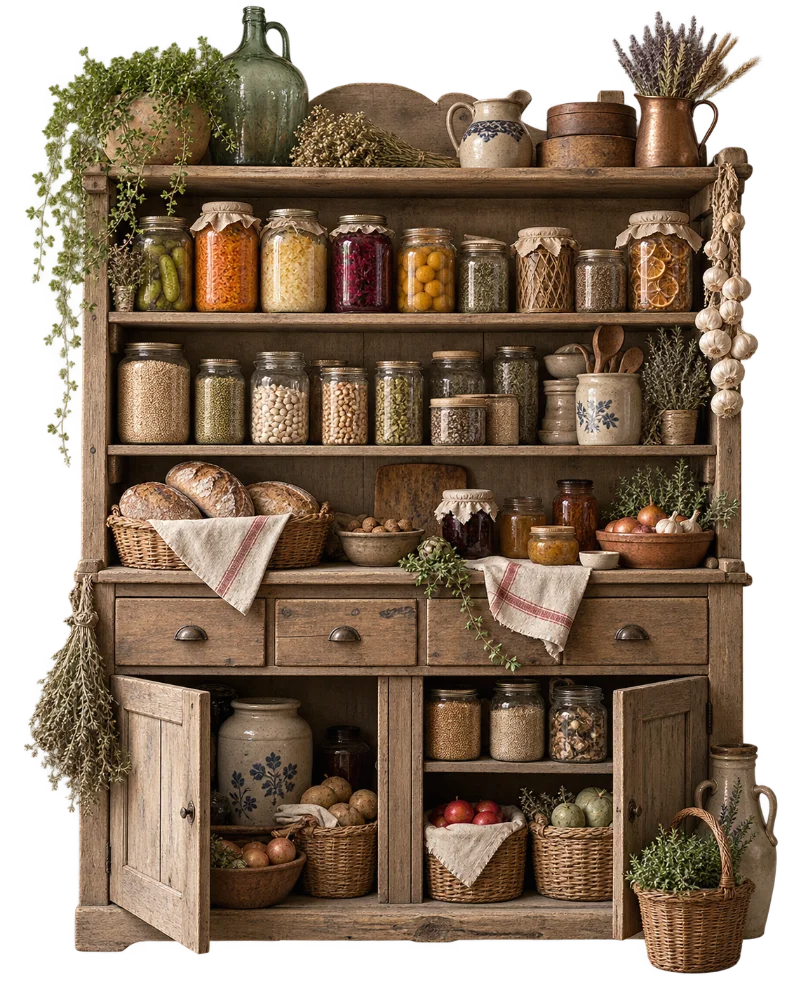
One shop, many meals
A thrifty kitchen is a kitchen that doesn't throw things away. A few simple swaps:
- The bone from the pot roast goes back on the heat with water, onion and stems and becomes broth.
- Stems, clean peels and vegetable ends saved in a container in the freezer through the week go into Sunday's broth.
- Yesterday's rice becomes rice fritters, baked rice or a thickened soup.
- Day-old bread becomes toast, breadcrumbs or the book's rabanada (Brazilian French toast).
- Very ripe bananas go into a cake or into the freezer, to be blended into ice cream.
- Leftover meat becomes a filling for crepes, a pie or escondidinho (a mashed cassava bake).
Using leftovers doesn't mean keeping them forever. For cooked food, the Ministry of Health recommends up to 3 days in the fridge and up to 30 days in the freezer (short version of the guidelines for children under 2, p. 62). Leftovers past that point get thrown out, however much it hurts.
Where to shop
The Dietary Guidelines give three ways to pay less for vegetables, greens and fruit: buy what's in season, buy at produce markets and discount greengrocers with fewer middlemen, and, better still, buy directly from producers, at farmers' markets or through group buying; in that last case, even organic produce can become affordable (p. 111).
In practice:
- The street market at closing time tends to drop prices on what won't last until next week. Good for the soup and sauce of the day.
- Group buying among neighbors or coworkers buys from a producer in volume and splits the shipping.
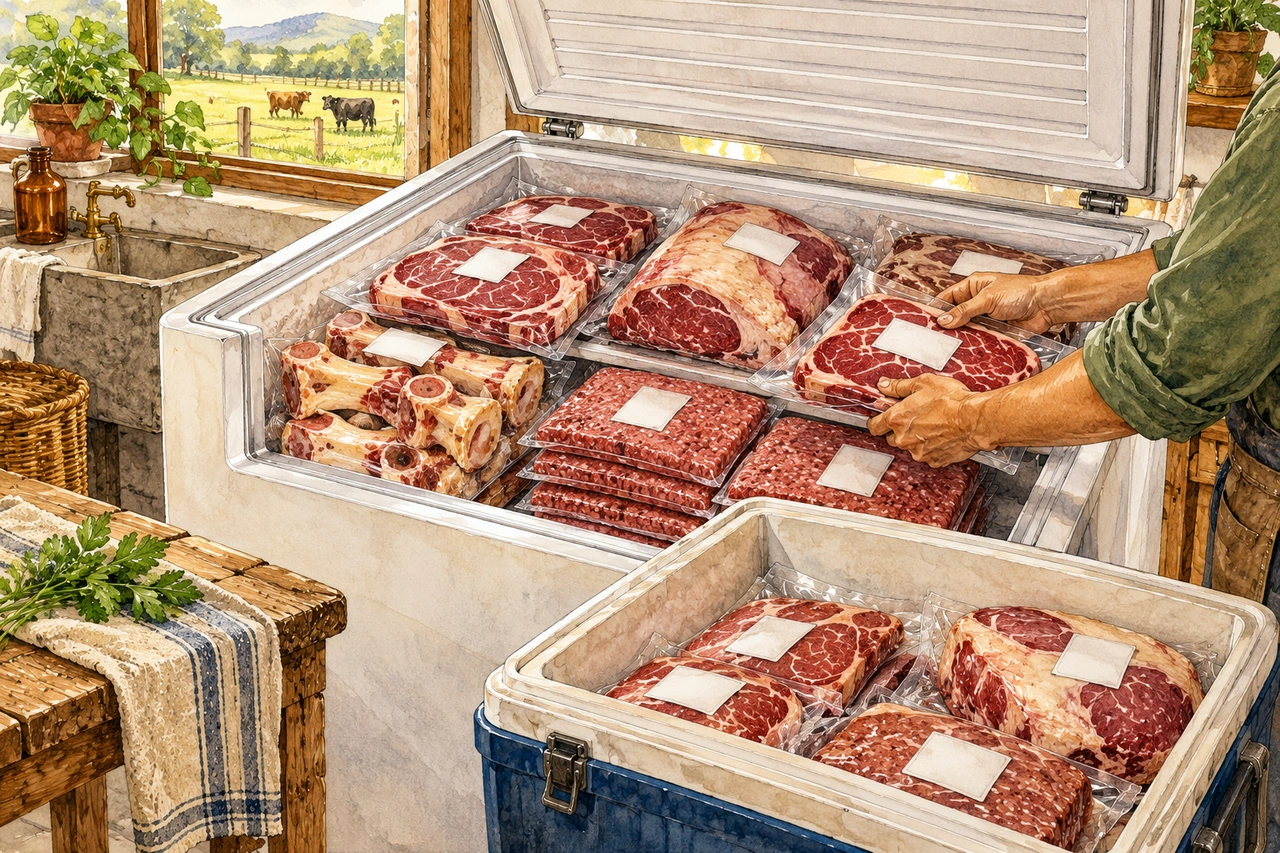
- Buying meat direct, a quarter or a half carcass split between families, can bring down the price per kilo, but it takes freezer space and planning. Meat you freeze at home follows the Ministry of Health's table, up to 30 days in the freezer; meat that comes already frozen and packed from the processing plant follows the use-by date on the label, as long as the package stays sealed and well frozen. Buy what your household can use within those times. The questions to ask the producer are in how to buy meat directly from the producer.
- The Nu&Cru producer map, free to use, brings together small-scale producers of meat, organ meats, eggs, milk, animal fat and fresh produce, with direct contact. Nu&Cru doesn't broker the sale; the arrangement is between you and the producer.
Where not to cut corners
- Health inspection. Meat, poultry and fish must carry an inspection stamp. The Ministry's guidelines for children advise checking for the SIF stamp (Brazil's federal inspection service) when buying (p. 167); local producers may instead work with the state (SIE) or municipal (SIM) inspection service. Meat of unknown origin is the most expensive false economy.
- Cold. Perishables go into the fridge as soon as you get home, and cooked food doesn't stay out of it for more than 2 hours, according to the WHO Five Keys.
- Dates. Packaging that is bulging, rusty or with altered contents should be neither bought nor used (p. 167 of the same guidelines).
- Flavor. Salt, garlic, onion, a good fat and herbs cost little and are what make someone want seconds. Cheap, bland food ends up as waste.
A week's menu with budget cuts
No prices, because they change from city to city and month to month; just the logic of one shop that unfolds into many meals.
- Sunday: whole roast chicken with potatoes and carrots in the fat. The carcass goes into the broth.
- Monday: rice cooked in the chicken broth, beans, shredded chicken, salad.
- Tuesday: pot roast with chuck, or with shank or bone-in ribs, and cassava. The bone is saved for the next broth.
- Wednesday: liver and onions, rice, beans, sautéed zucchini.
- Thursday: bean soup with vegetables from the market and the rest of the shredded meat.
- Friday: scrambled eggs with cuscuz (steamed cornmeal) or bread, sautéed collard greens. Or the family pizza.
- Saturday: oxtail or beef rib and pumpkin stew, so the next week starts with broth.
This week: one calculation and one swap
Do the per-meal math for three items you always buy and swap one of them: steak for chuck, chicken breast for a whole chicken, oil for the fat left from the roast. If you'd like step-by-step recipes that make cheap cuts go further, 181 Receitas Ancestrais has pot roast, oxtail, dobradinha, caldo de mocotó, liver and onions, beef heart and six recipes in the broths category, plus ferments made with cabbage and salt. To find people who sell direct near you, search the producer map. And if the question in your home is how to fit all of this into the budget and everyone's routine, the Nu&Cru family consultation starts from what the family already eats, the budget and access to food, with nutritionists Laura Valentim and Dalyla Peçanha.
Sources consulted
- Brazilian Ministry of Health. Dietary Guidelines for the Brazilian Population, 2nd edition, 2014.
- Brazilian Ministry of Health. Dietary Guidelines for Brazilian Children Under 2, 2019, and short version, 2021.
- Maia EG et al. What to expect from the price of healthy and unhealthy foods over time? The case from Brazil. Public Health Nutrition, 2020.
- DIEESE and Conab. National Survey of the Basic Food Basket: September 2026 results. Released on October 9, 2026.
- World Health Organization. Five Keys to Safer Food Manual, 2006.
As informações têm caráter educativo e não substituem avaliação individual de profissional de saúde habilitado.