Blogfats · traditional cooking · technique
Lard, Tallow or Butter: Which Fat Is Best for Each Kind of Cooking
For frying, searing, sautéing, roasting, pastry or sweets: compare lard, beef tallow and butter by flavor, how much heat they can take, texture and shelf life.
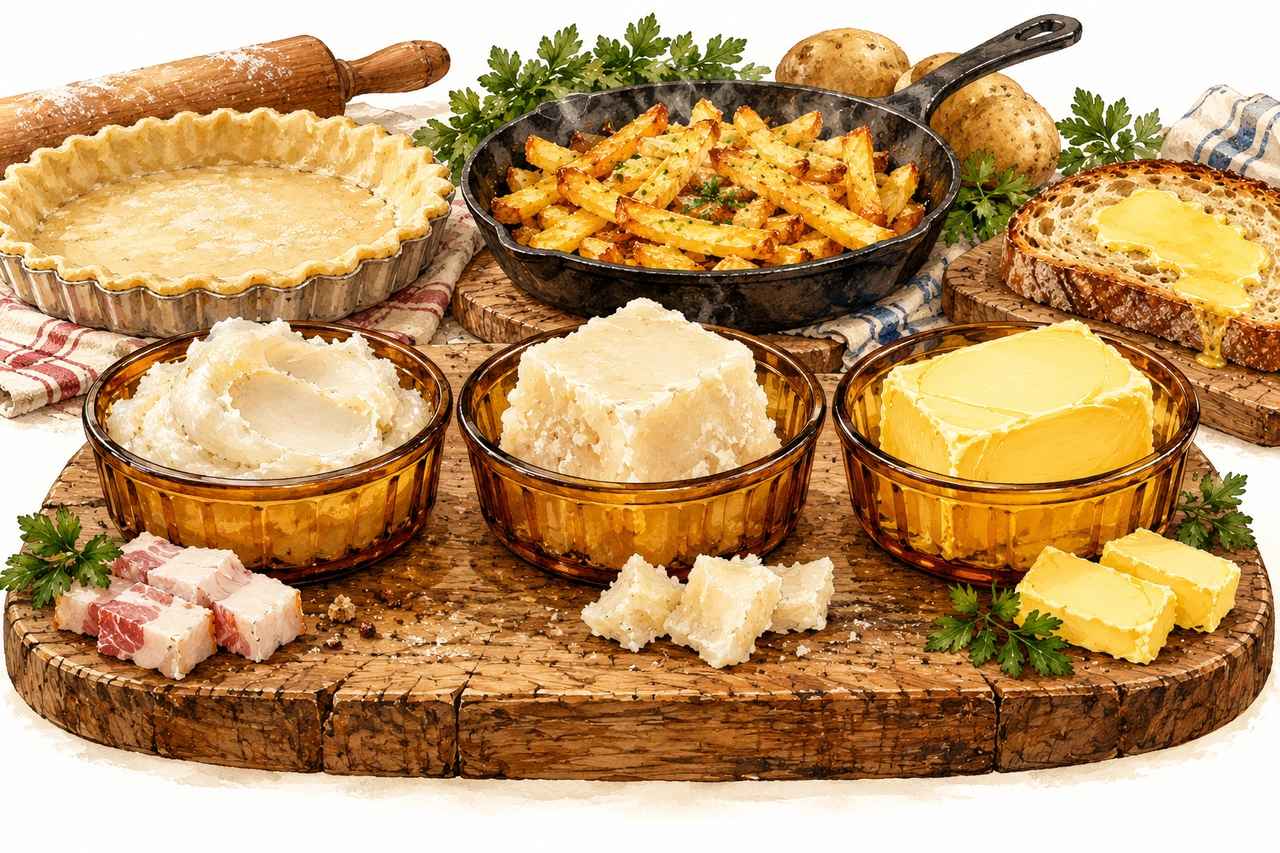
For deep frying and searing meat, use beef tallow or lard. For sautéing, all three work, and butter needs a lower flame. For roasting vegetables, tallow or lard; for brushing chicken and bread, butter. In pie crust, lard makes the dough flakier and butter adds more flavor and color. For sweets and morning toast, butter. If you can only keep one at home, lard is the most versatile: it fries, sautés and makes pastry.
That's the short answer. The reasons lie in the makeup of each fat, and understanding them helps you decide when a recipe doesn't say which one to use.
The three fats, side by side
The numbers below are reference values from USDA tables, and they vary with the animal and with the part of the fat used.
Beef tallow
- Where it comes from: beef or mutton fat, melted down and strained.
- Composition: practically 100% fat; about 50% saturated, 42% monounsaturated and 4% polyunsaturated (USDA, tallow).
- Texture: firm and crumbly at room temperature.
- Flavor: lightly beefy.
- Heat: smoke point around 204 °C, according to the University of Nebraska extension (Curry and Yates, 2026).
- Storage: the most stable of the three.
Lard
- Where it comes from: pork fat, melted down and strained.
- Composition: practically 100% fat; about 39% saturated, 45% monounsaturated and 11% polyunsaturated (USDA, lard).
- Texture: soft, creamy, easy to work into flour.
- Flavor: nearly neutral when it comes from the internal (leaf) fat; stronger when it comes from back fat.
- Heat: around 190 °C in the smoke point table on Wikipedia, which cites the Culinary Institute of America's textbook The Professional Chef.
- Storage: good, best kept in the fridge.
Butter
- Where it comes from: cream churned until the fat separates.
- Composition: about 81% fat, 16% water and a little milk solids; of the fat, close to two thirds is saturated (USDA, salted butter).
- Texture: solid in the fridge, creamy at room temperature.
- Flavor: distinctly dairy; when it browns, it picks up nutty notes.
- Heat: smoke point around 149 °C. The milk solids burn before the fat does, which is why it darkens sooner (Curry and Yates, 2026).
- Storage: the most perishable, because of the water and milk solids.
Two practical consequences follow. First, butter is the only one of the three that contains water, and that changes how it behaves in the oven and in the pan. Second, smoke point is not a fixed number. In a study of virgin olive oils, it dropped as the free fatty acid content rose (Díez-Betriu and colleagues, 2025). The study didn't test animal fats, but the kitchen logic is the same: poorly strained or previously used fat tends to smoke sooner. Homemade lard with bits left in it can smoke well below 190 °C.
For deep frying: tallow or lard
Deep frying at home works between 170 and 180 °C. Anvisa, Brazil's health regulator, uses 180 °C as the limit for restaurants and snack bars (RDC 216/2004, item 4.8.11). Tallow and lard work well in that range and, because they contain little polyunsaturated fat, they hold up better to reuse.
- Tallow: potatoes, cassava, polenta and breaded meat come out dry on the outside with a background note of beef. Serve hot: tallow firms up quickly as it cools.
- Lard: pastel (Brazilian fried pastry), torresmo (crispy pork cracklings), coxinha (fried chicken croquettes), fish and fried sweets, when you want a more neutral flavor.
- Butter: not suitable for deep frying. It burns before it reaches temperature.
If you don't have tallow at home yet, you can render your own with the step-by-step guide on how to make lard and tallow at home, or use a ready-made one, like Nu&Cru Beef Tallow, which is sold out and has reservations for the next batch on its page.
Sweet frying, like bananas fried in fat or rabanada, is a case of its own: in a shallow pan over medium heat, butter comes in for flavor, alone or with a little lard. The fat from deep frying, on the other hand, can be strained and saved for next time, as explained in the piece on how to reuse cooking fat.
For searing and grilling: tallow or lard, with butter at the end
Searing calls for a very hot pan and little fat. Tallow and lard handle that heat much better. Butter on its own burns and turns bitter.
A restaurant technique combines the best of both: sear the steak in tallow, lower the heat and, in the last minute, add a spoonful of butter with garlic and herbs, tilting the pan and basting the meat with the foaming butter. The crust comes from the tallow, and the aroma from the butter. To keep meat from sticking to stainless steel, preheating is what matters; the step-by-step is in how to cook in a stainless steel pan without sticking.
For sautéing, rice and beans: any of them
Sautéing happens over medium heat, and all three work. The choice is about flavor:
- Lard: the base for rice and beans in many country kitchens in Brazil. A rounded flavor that stays in the background.
- Tallow: goes well with beans, pot roast, stews and farofa (toasted cassava flour). It brings beef broth to mind.
- Butter: onion in butter is the base for risotto, mashed potatoes and light sauces. Keep the heat low so the butter doesn't brown.
A tutu de feijão (mashed beans thickened with cassava flour) or a pot roast takes well to lard or tallow.
In the oven: tallow and lard for vegetables, butter for chicken
- Roasted vegetables: potatoes, squash, carrots and onions brown better in melted tallow or lard. Since these fats contain no water, the surface of the vegetable fries instead of steaming.
- Chicken and poultry: butter under and over the skin gives a golden color and flavor. The whole roast chicken is the classic example.
- Large cuts of meat: brush with tallow or lard before roasting and baste with the drippings, as with a roasted beef rib.
In pie crust, cookies and baked savories
This is where the three differ the most.
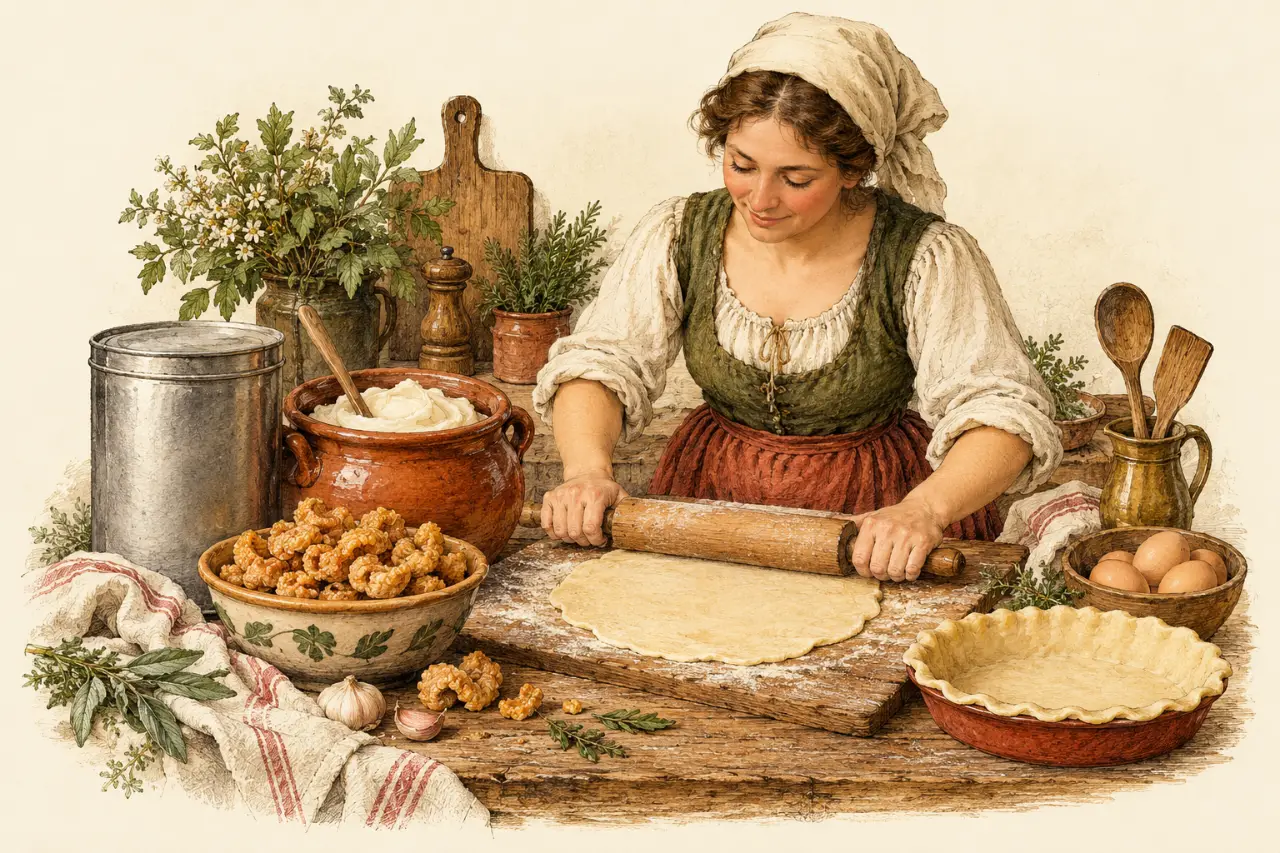
- Lard: because it is pure, soft fat, it coats the flour easily and gives a flakier dough that is light to bite into. It shows up in many old recipes for shortcrust, empada (small savory pies) and savory crackers. Use the most neutral lard, from internal fat.
- Butter: with 16% water, it releases steam in the oven, which helps separate the layers in puff pastry, and it adds color and flavor.
- Tallow: firm and stronger in flavor. In England, raw grated kidney fat goes into steamed puddings and a soft pastry, different from crisp butter pastry (Wikipedia, Suet entry). In sweet pastry, it comes through too strongly.
A classic combination is half lard, half butter: the texture of one and the flavor of the other. Lard has a long history in baking, told in Is lard bad for you? The wrongly accused fat.
In sweets and morning toast: butter
Cake, butter cookies, syrups, brigadeiro (Brazilian chocolate fudge balls), bread and butter, mashed potatoes. In these, the fat shows up as flavor, and nothing replaces the flavor of butter. Seasoned butter, with garlic and herbs, goes on bread, grilled meat and corn.
If you don't eat dairy, lard from internal fat is the most neutral substitute in pastry and cookies. Tallow rarely works in sweets.
What about clarified butter and ghee?
When you clarify butter, you separate out the water and milk solids and keep only the fat. Without what burned first, it handles more heat; without water, it lasts longer. Ghee goes one step further: the solids brown before being strained out, and the fat takes on a nutty flavor. Both can be used for searing and pan frying.
Storage and cost
- Tallow: in a tightly closed jar, it keeps for months outside the fridge and more than a year refrigerated, according to the Nebraska extension (Curry and Yates, 2026).
- Lard: more polyunsaturated than tallow, it oxidizes more easily. Keep it in the fridge.
- Butter: the same source says that, once opened, it lasts a few weeks in the fridge, and frozen, up to a year.
On price, compare a kilo of fat with a kilo of fat. A kilo of butter holds about 160 g of water, while a kilo of tallow or lard is almost entirely fat. Rendering tallow and lard at home, from raw fat bought at the butcher or from a farmer, can work out cheaper, depending on the price of raw fat where you live. The method is in how to make lard and tallow at home.
And which one is healthiest?
There is no scientific consensus that puts one of the three above the others. All three are rich in saturated fat, in different proportions, and the Dietary Guidelines for the Brazilian Population places lard, butter and oils in the same category of culinary ingredients, to be used in small amounts (pp. 34-36). The positions of Brazil's Ministry of Health, the WHO and the new US dietary guidelines on saturated fat are summarized, with sources, in the piece beef tallow: what it is and how to use it. This article stays in the kitchen: the choice here is about technique and flavor.
Which one to keep at home
If your kitchen does a lot of frying, searing and roasting, it's worth having tallow or lard for high heat and butter for flavor. To choose by label and origin, see how to choose animal fat.
For the high-heat side. Nu&Cru Beef Tallow is beef fat from 100% grass-fed cattle, a single ingredient, in 150 g and 450 g glass jars. This batch has sold out, and you can reserve the next one through WhatsApp, right on the product page.
To put all three to work, 181 Receitas Ancestrais (181 Ancestral Recipes) has about 48 recipes that call for tallow, butter or lard as the fat, from breakfasts to one-pot dishes and fried foods. A good start this week: make the same roast potatoes twice, once in tallow or lard and once in butter, and compare the crust.
As informações têm caráter educativo e não substituem avaliação individual de profissional de saúde habilitado.