Blogmeats and organ meats · from the farm to the table · recipes · Weston A. Price
How to Cut Up a Whole Chicken and Use Every Part
How to break down a whole chicken at home and what each part becomes: roast, bone broth, schmaltz and crispy skin cracklings. Plus how to use the organ meats and how to handle raw poultry safely.
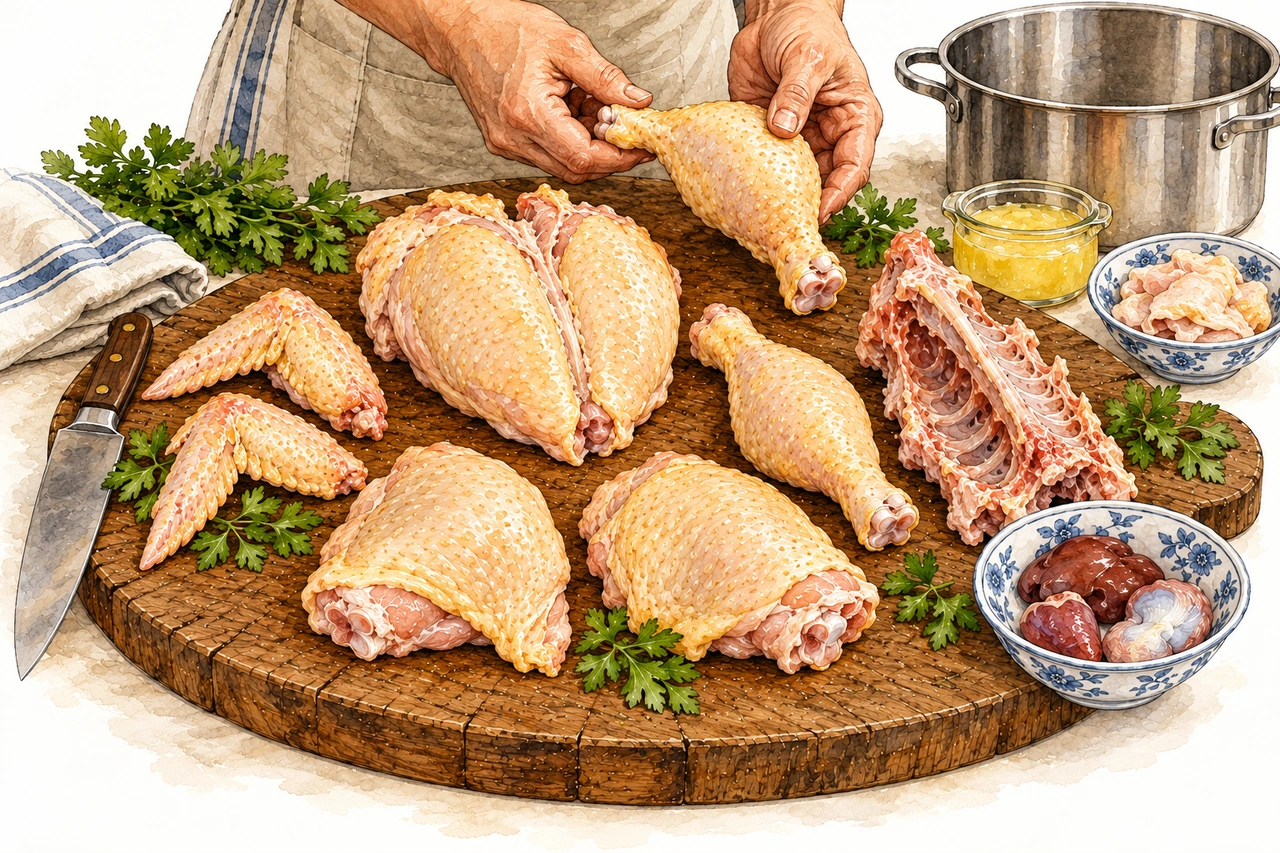
A whole chicken is worth more than a Sunday roast. The breast becomes one meal, the thighs and drumsticks another, the wings a snack. The carcass, neck and feet make a broth, the skin and fat become cooking fat and crispy cracklings, and the organ meats make a farofa (a Brazilian side dish of toasted cassava flour). You can roast the bird whole and use what's left, or break it down raw and spread the parts across the week. Either way, the safety rule is the same: do not wash raw chicken.
If you buy from a farm producer, you'll soon find that the bird usually comes whole, sometimes with the feet, neck and organ meats in a little bag. Cutting it up at home takes about ten minutes with a sharp knife and kitchen shears, and what comes off the board feeds you for the week.
The map of the bird: what becomes what
- Breast and tenderloin (sassami): grilled, breaded, cut into strips or shredded. This is the lean part and the one that dries out fastest, so it needs little cooking.
- Thigh and drumstick: roasted, stewed, or used in frango com quiabo (chicken with okra) and galinhada (a one-pot chicken and rice dish). They have more fat and collagen and hold up to long cooking without drying out.
- Wing: the drumette and the flat go in the oven or the frying pan; the tip, which has little meat, goes in the broth.
- Carcass, neck and feet: the base of the broth. The feet have the most collagen, and they are what makes the broth set like gelatin.
- Skin and fat: the yellow fat at the opening of the cavity and at the neck, plus the skin trimmings, can be rendered into schmaltz, the chicken fat of Jewish cooking, and into crispy skin cracklings.
- Sobrecu (the tail tip): remove the fat gland on it, the uropygial gland, which has a strong taste. The rest of the sobrecu is meat and fat, and plenty of people love it.
- Organ meats: gizzard, heart and liver. The gizzard needs long cooking; the heart is good over embers or in a frying pan; the liver becomes pâté or is cooked with onions.
Before you start: raw chicken is not washed
Rinsing chicken under the tap doesn't make the bird cleaner, and it spreads splashes around the sink and the counter. The CDC, the United States public health agency, notes that raw chicken can carry Campylobacter, Salmonella and Clostridium perfringens, and that raw chicken is ready to cook and does not need to be washed. The same page cites a study by the US Department of Agriculture: one in seven people who cleaned the sink after washing chicken still had germs in it. What kills the bacteria is cooking.
The precautions that apply to the raw bird:
- A board used only for raw meat, or wash the board with hot water and soap before cutting anything else. The WHO, in its Five Keys to Safer Food, calls for separate knives and boards for raw meat, poultry and fish.
- Wash your hands before and after handling the chicken, and keep the dish towel away from it.
- A clean plate for the cooked meat. Never put the roasted chicken back on the plate it sat on raw.
- Thorough cooking: the CDC recommends 74 °C at the center of the thickest part (165 °F). Without a thermometer, combine the signs: the thigh comes away easily at the joint, and the juice that runs out when you pierce the drumstick is clear, with no pink.
- Frozen bird: thaw it in the refrigerator, never at room temperature, in the sink or on the counter, as the WHO advises. The Anvisa rule for food services adds that what has been thawed must not go back in the freezer.
If the bird comes with pin feathers or any residue, remove it with a paper towel or the tip of a knife.
How to Break Down a Whole Chicken
You need a sharp, medium-blade knife and a sturdy pair of kitchen shears. Work with the chicken breast side up.
- Empty the cavity. Take out the bag of giblets, if there is one, and the loose yellow fat at the opening. Save the fat.
- Remove the wings. Pull the wing away from the body, find the joint with the tip of the knife and cut there. Then separate the tip, the flat and the drumette at the two joints.
- Remove the legs. Cut the skin between the leg and the breast. Bend the leg back until the hip joint pops out and cut close to the carcass, taking along the little piece of tender meat on the back, near the joint (the oyster).
- Separate the drumstick from the thigh. With the skin side down, look for the line of fat over the joint and cut there: the knife glides through without effort when it hits the joint.
- Separate the breast from the back. With the shears, cut through the ribs on both sides, from the cavity up to the neck. The back, along with the neck, goes into the broth.
- Divide the breast. For bone-in breast, cut in half along the center bone. For boneless fillets, slide the knife right along the center bone and the ribs, freeing each half. The little tenderloin, attached underneath, comes off with it or separately.
- Remove the tail gland (the "parson's nose") and any trimmings of skin and fat that are left.
In the end, you have 8 pieces to cook (2 drumsticks, 2 thighs, 2 wings and 2 breast halves) and a pile for the broth and for the pot of rendered fat.
One Bird, Four Meals
This is one possible plan for a family of four, with a chicken of about 2 kg. The proportions change with the size of the bird and the appetite of the household.
Day 1: roast chicken. Roast the whole bird, or just the drumsticks, thighs and wings, if you broke it down. Save the carcass from the roast.
Day 2: shredded chicken. What is left of the roast, or the breast cooked in the broth, becomes filling for a pie, a sandwich, salpicão (a Brazilian shredded chicken salad), fricassee or stroganoff.
Day 3: broth and soup. Carcass, neck, feet and wing tips go into the pot for a few hours. Half of the broth becomes canja (Brazilian chicken and rice soup) with the leftover meat; the other half goes into the freezer.
Day 4: organ meats. Farofa (toasted cassava flour) with organ meats, heart sautéed in a pan or liver pâté, using the organ meats that went into the freezer on the day you bought the chicken.
The timing rules the plan. Raw chicken, including the organ meats, keeps for at most 3 days in the fridge, and so does cooked chicken, according to the Ministry of Health's table in the Guia Alimentar para Crianças Brasileiras Menores de 2 Anos (p. 169), which applies to the whole family. Whatever you are not going to cook or eat within that window goes into the freezer right on the first day, not the third. Cooked chicken goes into the fridge within 2 hours of coming out of the oven, as the CDC advises. Timings and portions for other weekly staples are in the article on base cooking for the week.
Buying the whole bird is also a budget decision. At your butcher or farmers' market, compare the price per kilo of a whole chicken with that of breast and thigh sold separately, remembering that the whole bird comes with the carcass, the skin and the organ meats you are going to use. The article on real food on a budget covers using the whole animal as a strategy for the entire week.
Recipe: Whole Roast Chicken
Ingredients
- 1 chicken, 1.8 to 2 kg, with the tail gland removed
- 3 tablespoons chicken fat, butter or lard
- salt and black pepper
- a few sprigs of rosemary or thyme
- 1 large onion, sliced
- 1 cup chicken broth
Method
- Take the chicken out of the fridge about 30 minutes ahead and pat the skin dry with paper towels: dry skin is crispy skin.
- Rub salt and pepper on the outside and inside the cavity, and put the herbs inside it.
- Spread the onion in a roasting pan and set the chicken on top, breast side up. Brush the skin with the melted fat.
- Place in an oven preheated to 230 °C and, as you put the bird in, lower the temperature to 180 °C.
- Roast for about 1h20 to 1h30, basting with the pan juices from time to time, until the leg moves loosely at the joint and the center of the thigh reaches 74 °C.
- Let it rest for 10 minutes before carving.
The pan sauce: take out the chicken, set the pan over the heat, add the broth and scrape the bottom with a wooden spoon. Let it boil until it reduces a little and adjust the salt. For a thicker sauce, like the gravy in the original WAPF recipe, first brown a tablespoon of flour in the fat in the pan and only then add the broth, whisking.
The roast whole chicken from 181 Receitas Ancestrais is another version of the dish, with fresh herbs and the complete step-by-step.
Recipe: Carcass Broth
Put the carcass (raw or from the roast), the neck, 2 to 4 feet, the wing tips and, if you like, the gizzard in a pot. Add 1 onion, 1 carrot and 2 celery stalks in pieces, a bunch of parsley and thyme tied together, and cold water to cover, about 3 liters. Bring to a boil, skim off the foam, lower the heat to the minimum and cook for 6 to 8 hours, topping up with water if needed. Strain, cool quickly in smaller containers and refrigerate.
How to choose the bones, how long to cook, how to cool and freeze safely: it's all in the article on bone broth. The fat that hardens on top of the chilled broth goes into the next recipe.
Recipe: Schmaltz and Skin Cracklings
Schmaltz is the Yiddish word, related to the German Schmalz (rendered fat), for rendered chicken or goose fat, widely used in Eastern European Jewish cooking. The little bits of skin that stay crisp are called gribenes, a feathered cousin of our torresmo (pork cracklings).
- Cut the reserved skin and fat into small pieces.
- Put them in a heavy skillet or thick-bottomed pot, cover with about a finger's depth of water and add the fat taken from the broth, if you have any.
- Cook over medium heat, uncovered, until almost all the water has evaporated. The water keeps the skin from burning before it releases its fat.
- Lower the heat and add 1 onion, diced.
- Keep going until the onion browns and the skin is dry and crispy.
- Remove the cracklings with a slotted spoon and drain on paper.
- Let the fat cool slightly, strain it through a fine cloth into a clean jar and store it in the fridge.
Chicken fat sautés onion and garlic with a flavor no oil can give, and makes roast potatoes and rice tastier. The cracklings go on top of mashed potatoes or salad. To store this and other fats properly and know when to throw them out, see how to reuse cooking fat; to understand the differences between the fats you buy ready-made, how to choose animal fat by origin and by label.
To brown chicken skin in a stainless steel skillet without it sticking, preheating makes all the difference; the step-by-step is in how to cook in a stainless steel pan without sticking. And if the question is which pans to buy for roasting, stewing and frying, see cookware for the home kitchen.
Offal and Giblets
- Gizzard (moela): peel off the yellow inner lining if it is still attached, then cook it slowly, in broth or in a pressure cooker, until tender. After that it can go into a stew with tomato or into farofa (toasted cassava flour).
- Heart: trim the fat from the top and sauté in hot fat, whole or halved, as in the skewers at a Brazilian churrasco.
- Liver: separate the lobes, remove the sinew, and cook until the center is no longer pink. For anyone who doesn't like it, pâté is the easiest route. The article on how to prepare liver shows the technique and the safe doneness point.
- Offal farofa: already-cooked gizzard, with heart and liver chopped, sautéed with onion and garlic in chicken fat, and cassava flour added until it reaches the right texture.
Free-Range, "Colonial" Chicken and Hen: What Changes in the Pot
In Brazil, ABNT (the Brazilian technical standards association) has a standard, NBR 16389, covering the production, slaughter, processing and labeling of free-range chicken and hen, whether called caipira, colonial or capoeira. In broad terms, these are birds from slower-growing breeds than the ones in ordinary farm-raised chicken, raised with access to the outdoors. In the kitchen, it shows up like this:
- Free-range chicken (frango caipira): firmer meat, thicker skin and more yellow fat. It roasts well, but usually needs a little more time in the oven and some rest before cutting.
- Free-range hen (galinha caipira): an older bird, generally a laying hen at the end of her laying period. The meat is tough for roasting and excellent for slow cooking: canja (chicken and rice soup), galinhada (chicken and rice), stewed hen and broth. In the pressure cooker, the cooking time drops considerably. The galinha caipira in the book is this kind of preparation.
- Conventional farm-raised chicken (frango de granja): tender, quick to cook, and it works well for all the recipes in this article. For the broth, add feet bought separately.
When buying a whole bird directly from whoever raises it, ask the producer how the birds are raised, at what age they are slaughtered, whether the slaughter is inspected (SIF, SIE or SIM) and whether they can set aside the feet, neck and offal. Ask for the fattier birds too: the fat is part of the value. The Nu&Cru producers map lists small-scale producers of meat, offal and eggs, with direct contact and no intermediation by Nu&Cru, and the article on how to buy meat directly from the producer has the full list of questions and what changes when you buy in quantity for the freezer.
One tip from the original article: cooked chicken is great alongside sauerkraut. If you don't ferment yet, the article on lacto-fermentation at home shows how to start.
On Your Next Shopping Trip
On your next shopping trip, take home a whole chicken instead of trays of cuts, and ask for the feet as well. Break the bird down following the seven steps above, roast the legs on the first day, and put the carcass and feet on the stove while the oven does its work.
To vary the week, the 181 Receitas Ancestrais has whole roast chicken, galinha caipira and chicken broth, plus recipes for each part of the bird: thighs and drumsticks in the chicken curry; breast in the chicken stroganoff, the chicken with requeijão (Brazilian cream cheese) and the chicken loaf; and already-cooked shredded chicken in the yogurt pie with chicken. Each recipe lists the bases it uses, such as broth, and the full index can be found in Nu&Cru recipes.
Part of this article was based on an unsigned piece published by the Weston A. Price Foundation ("The Whole Bird", Wise Traditions magazine, 2002).
As informações têm caráter educativo e não substituem avaliação individual de profissional de saúde habilitado.