Blogreal food · Weston A. Price
Is Protein Powder Bad for You? The Problem With Whey, Soy and Other Powders
Whey, soy, pea and hemp: protein powders go through high heat and harsh processing. Here is why the Weston A. Price Foundation prefers meat, eggs, milk and liver.
Open any bodybuilding magazine and you'll find page after page of protein powder ads. Walk into a health food store and look at the tubs: there is often an entire aisle of them, in many varieties such as soy, hemp and whey, plus newer arrivals like pea and rice protein. In Brazilian gyms, the tub of whey has become almost a required accessory.
These powders are sold on the idea that bodybuilders, serious athletes, people who work out and even ordinary people need more protein than they can get from food. Countless websites promise that they are good for everyone and carry no danger at all. Occasionally there is a hint that they can cause indigestion and gas, or that overdoing it can lead to kidney stones and gout. But for the most part, many fitness gurus promote these products without any shame, as the road to endurance, muscle mass and health.
This article is an adaptation of "The Problem With Protein Powders," by Sally Fallon Morell, president of the Weston A. Price Foundation, published in an issue of the foundation's magazine devoted to men's health.
Protein Matters, but Where Should It Come From?
Getting enough protein is important for everyone, and especially for those who exercise hard. Protein is used to build and repair muscles and tissues, red blood cells, hair and nails, and to make hormones. It is also needed to reduce the risk of anemia from iron deficiency and to help with wound healing.
The question is a different one: should athletes and other people get this protein in the form of drinks, shakes and bars? The habits of healthy traditional peoples offer a clue.
Traditional Peoples Avoided Lean Meat
Healthy traditional peoples, the so-called Paleolithic cultures, lived off the animals of the land and sea. They preferred the organ meats and the fat of these animals, always avoiding lean meat. For Aboriginal Australians, a lean kangaroo, or a fish caught at the time of year when it carries little fat, was considered garbage and quickly thrown away (Lipids, 2003).
The explorer Vilhjalmur Stefansson, who lived among the Inuit and the Indigenous peoples of Canada, noticed that they took great care to avoid lean meat. In his view, the groups that depended on fat-rich animals, such as seals and whales, were the luckiest of the hunters, because they never suffered from "fat hunger."
"Rabbit Starvation"
According to Stefansson, in North America the problem was worst among the Indigenous peoples of the forests, who sometimes depended on rabbit, the leanest animal of the North, and developed an extreme form of fat hunger known as rabbit starvation. Anyone who ate only rabbit, with no other source of fat (beaver, moose or fish), developed diarrhea in about a week, along with headache, exhaustion and a vague sense of malaise. If there was enough rabbit, people ate until their stomachs were bloated, but no matter how much they ate, they never felt satisfied.
Some believed that a man would die sooner eating only lean meat than eating nothing at all, although, as the explorer acknowledged, there was not enough evidence to settle the question. Deaths from this cause were rare, because everyone understood the principle and took whatever precautions they could.
Weston Price described these peoples as muscular and hardy, splendid physical specimens, exactly what the modern athlete is after. They knew that a diet of lean meat would make them very sick and, over time, would lead to death. What is the scientific explanation for this danger?
Protein and Vitamin A: The Forgotten Link
The answer is in the article Vitamin A, The Forgotten Bodybuilding Nutrient, by Chris Masterjohn, published by the foundation in 2004. Masterjohn explains that using protein properly depends on vitamin A. Several animal studies have shown that a high-protein diet depletes the liver's vitamin A stores, while vitamin A rises in other tissues. One explanation is that protein is needed to transport vitamin A.
In one study, researchers gave radioactively labeled vitamin A to rats on low-protein and high-protein diets. By measuring radioactivity in exhaled air, urine and feces, they found that vitamin A is indeed used up faster on the high-protein diet.
And the relationship goes further. According to Masterjohn, vitamin A is not only used up by excess protein, it is also needed to make new protein, which is exactly what the bodybuilder is after. Rats deficient in vitamin A synthesize protein at a lower rate than well-supplied rats. And skeletal muscle cells grown in the laboratory increase their protein content when exposed to vitamins A and D together, but not when exposed to vitamin D alone.
In other words: eating lean meat or taking protein powder sends a message to the liver: "send vitamin A!" Protein consumed without the fat, which carries the precious fat-soluble vitamins, vitamin A among them, is an efficient way to quickly empty the liver's vitamin A stores.
What Happens When Vitamin A Runs Out
And what happens when the liver has no vitamin A left to supply to the body at the moment it is needed?
Vitamin A is a key player in nearly every process in the body, a kind of conductor. Besides protein synthesis, it takes part in the production of hormones (including sex hormones such as testosterone, and thyroid hormone), is essential for the immune system, for vision and hearing, plays a role in bone health, and works together with vitamins D and K2 in everything from preventing heart disease to producing the chemicals of well-being. The foundation tells this story in A Saga da Vitamina A, translated into Portuguese, and liver is the most concentrated source of this nutrient.
In the author's view, a diet of lean meat, or one that includes protein powder, is a recipe for hormonal imbalance, fatigue, depression, bone problems, autoimmune disease, vision and hearing problems, heart disease and even cancer.
Soy Protein Isolate: The Most Problematic
Besides flooding the body with protein, the powders bring other dangers. Soy protein is the most problematic, but, according to the author, all protein powders contain ingredients that do harm.
Making soy protein isolate is a complex, high-tech procedure that takes place in chemical plants, not kitchens:
- The starting point is defatted soy meal, boiled in a caustic alkaline solution to remove the fiber.
- It is then washed in an acid solution, which makes the protein precipitate.
- The resulting protein curd is dipped in another alkaline solution.
- Finally, it is spray dried (spray drying) at extremely high temperatures.
The proteins that come out of this process are inevitably denatured, but some very resistant ones, such as protease inhibitors, survive the treatment. They interfere with the digestion of proteins, possibly including the good proteins you eat. These resistant molecules have been linked to digestive problems, pancreatitis and even pancreatic cancer.
Hidden in Almost Everything
Soy protein isolate is mixed into almost every product sold today: not just powders, but also energy bars, breakfast shakes, burgers and sausages, not to mention soy-based infant formulas. At 90% to 92% protein, it loses some of soy's bitter, beany flavor and the complex sugars that cause gas during processing. But studies show that:
- soy protein isolate increases the body's need for vitamins E, K, D and B12;
- phosphorus is poorly absorbed, and animals that rely on it as their main source of protein develop deficiencies in calcium, magnesium, manganese, molybdenum, copper, iron and, above all, zinc;
- it is lower in sulfur-containing amino acids than other soy products;
- the process increases levels of toxins and carcinogenic substances, such as lysinoalanine and nitrosamines.
Isoflavones: Plant Estrogen
Among legumes, soy is the only one with very high levels of isoflavones, plant-based estrogens that become concentrated in the protein isolate. According to the author, they can block testosterone in men, causing infertility and even breast growth. Isoflavones are also responsible for soy's suppressive effect on the thyroid, not only in highly artificial products like protein isolate, but also in more traditional ones like tofu. The foundation gathers the evidence in Myths & Truths About Soy and discusses a study on soy and testosterone in men who do strength training in Whey to Go?.
Most athletes have already learned that soy is not their friend, and soy products have lost their shine. The displays of soy milk and soy protein have disappeared from supermarkets and natural food stores, replaced by things like almond milk and hemp protein powder.
Hemp and Pea: The Same Process
The problem is that any plant-based protein powder goes through a similar manufacturing process: fibers are separated by boiling in caustic alkaline solutions, then the protein is spray-dried at very high temperatures, which leaves the proteins denatured and possibly toxic.
Hemp protein may not carry a load of isoflavones, but it contains cannabinoids, the same substances found in its cousin, marijuana. Not at the same levels, of course: manufacturers are keen to point out that hemp has only about 5% of the cannabinoids of marijuana. But how much hemp powder are people actually taking? And wouldn't those problematic compounds be more concentrated in a protein powder?
Pea protein is the newcomer among powdered legumes. One manufacturer describes its pea protein isolate as made from non-GMO peas "through the processes of isolation, homogenization, flash evaporation, sterilization and spray drying." That sounds like three applications of high heat! Peas may have far fewer isoflavones than soy, but they still contain many problematic compounds, such as phytic acid and hard-to-digest oligosaccharides. These can be neutralized with proper soaking and the traditional long cooking, but that is not how pea protein isolate is made.
Is Whey Protein Bad for You? The Cheese Industry's Leftover
Soy protein began as a waste product of the soybean oil industry: it is the way industry found to profit from the protein-rich sludge left over after the oil is extracted. Whey is the leftover of the cheese industry.
In the past, before agribusiness came up with the insane idea of separating the species on the farm and raising each one in its own facilities, the whey from cheesemaking fed the pigs on the same farm or the neighboring ones. That is the system still used in Italy: the whey from making Parmigiano-Reggiano goes to the pigs on nearby farms and becomes the delicious Parma ham. (Nu&Cru teaches you how to make Parmesan cheese and ham at home.) It gets hard when all the pigs are in South Carolina and all the dairy cows are in Wisconsin or Texas.
How Whey Becomes a Powder
Whey can corrode even concrete, which is why it can't go down the drain. But industry found a way to turn this delicate substance into a powder, through a complicated process:
- The liquid whey is separated from the pasteurized milk used in most cheesemaking.
- Under pressure, it is forced through membranes that separate the proteins from the smaller molecules, at least twice: first in microfiltration, then in ultrafiltration. Pressures range from about 2 to 7 bar.
- The resulting liquid is sprayed through a nozzle at 250 °C to become a powder.
Does this process damage the whey proteins? According to an internet source cited by the author, the pressure of filtration, although not considered excessive, is enough to alter the hydrogen-bond structure of water and, therefore, to disorganize the structure of the proteins. And if any life is still left in the proteins after pasteurization and filtration, drying at 250 °C takes care of it. The certain result is denatured proteins and oxidized tiny particles.
Raw Whey and Glutathione
Raw liquid whey is a wonderful source of glutathione, the body's main detoxifier. But glutathione doesn't work once it has been heated. Whey can also be turned into powder by freeze-drying, an expensive process that few brands use. Either way, the whey already comes from pasteurized milk, and pasteurization temperatures are enough to denature the delicate glutathione, as explained in the sister article Is UHT Milk Bad for You?. The whey that drains from natural curds made with raw milk, on the other hand, is still alive; the foundation shows how to use it in Enjoying Little Miss Muffet's Curds and Whey.
How Much Protein Do You Need per Day?
The question remains: do people who train hard, or even sedentary people, need extra protein? Is it hard to meet your protein needs on the modern Western diet?
Protein needs vary with age, sex, weight and level of physical activity. In round numbers, men need about 50 to 100 grams a day, and women 50 to 75 grams. A man of about 82 kg in intense physical training may need up to 160 grams a day.
25-Gram Blocks
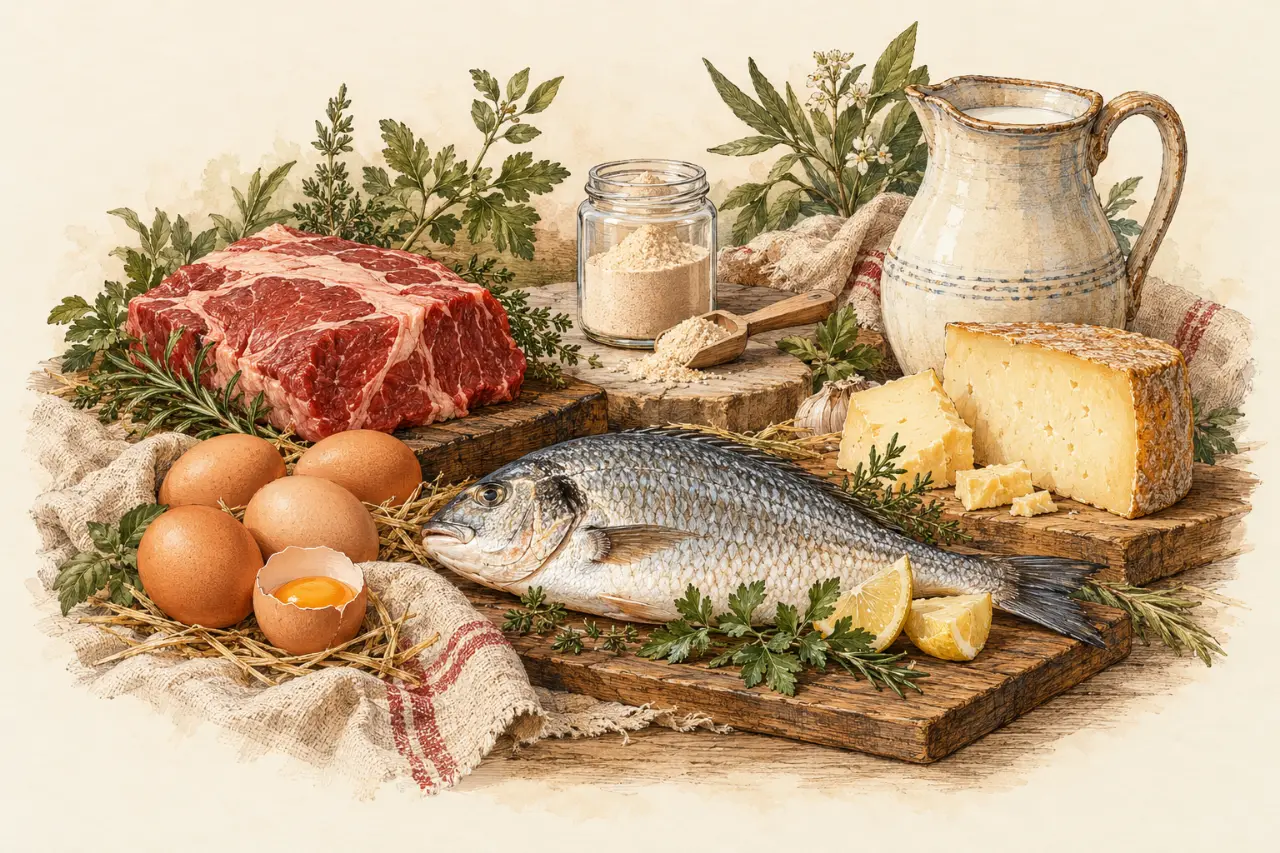
A good way to work this out is to think of protein foods as blocks of about 25 grams of protein each. In round numbers, each of these provides one block:
- 1 serving of meat, liver, poultry or fish (about 100 g);
- 1 serving of cheese (about 80 g);
- 4 eggs;
- 3 cups of milk (about 720 ml).
Women meet their needs with two to three blocks. One serving of meat, one of cheese, two eggs and about half a liter of milk provide around 75 grams of protein.
Men need up to four blocks. Two servings of meat, one of cheese and four eggs or three cups of milk provide about 100 grams.
And what about the bodybuilder or triathlete who needs up to 160 grams a day? If he eats meat at all three meals, plus a serving of cheese, four eggs and about 1 liter of milk (raw, of course), his needs will be more than met. It may sound like a lot of food for an ordinary person, but athletes do eat a lot. And it is real food, which the body knows how to digest and which comes with its own full set of vitamins, minerals and cofactors. If you miss your shake, you can blend one with real ingredients, as in the banana and egg smoothie or the banana shake made with raw milk; to find raw milk, eggs and meat directly from the people who produce them, use the producers map.
A Lot of Protein Calls for a Lot of Vitamin A
With so much protein, athletes need to make sure they get enough vitamin A to make use of it. Masterjohn sounds the alarm: bodybuilders and other athletes who want to gain muscle are interested in raising testosterone and other growth factors and in getting the most out of their protein. Typical recommendations include very high amounts of protein but leave out foods rich in vitamin A, such as liver, and low-fat diets all but ban vitamin A by cutting out foods like whole milk.
In his view, combining a high-protein diet, which depletes vitamin A, with a low-fat diet, which does not replenish it, is a sure recipe for deficiency of this vital nutrient. Exercises that demand a lot of testosterone, such as squats and deadlifts, are often recommended for building muscle, but without vitamin A the body cannot meet that demand.
Masterjohn concludes that it is time for athletes to forget modern mantras and remember the food wisdom of the past, building a lean, muscular physique with traditional foods such as liver (see how to prepare liver for people who don't like it), egg yolks, as in the creamy egg yolks, whole milk, butter from grass-fed cows and cod liver oil.
Excess Protein Does Not Build Muscle
In fact, studies show that excess protein does not increase muscle mass. What builds muscle in healthy athletes is strength training. One blogger summed it up like this: Tom wants to increase the size and strength of his upper body (to impress women, of course). He goes to a health food store, where he is told to drink protein shakes at every meal. Then he goes to a sports doctor and a sports nutritionist, who recommend a moderate amount of protein, swimming three times a week and upper-body weight training three other times. Which of the two pieces of advice do you think will work?
And the author leaves a message for the young men: an athletic career does not last forever. When it ends, you will want to have the health to enjoy what you have achieved, have healthy children and live well into old age. That is only ensured by eating real food, including organ meats and animal fat.
Other Protein Powders
- Rice protein: this is the latest darling of the natural products world, advertised as non-allergenic, easy to digest and "totally vegan." Most brands still use caustic chemicals and high heat, although a few advertise a "raw" enzymatic technique. Even the manufacturers who trumpet the natural process admit that the powder tastes bitter, even "repulsive," and has to be masked with other ingredients, meaning sweeteners. Like all plant protein powders, it offers incomplete protein that needs to be complemented with some legume. Eating meat is a better alternative.
- Egg white powder: it is spray-dried at very high temperatures and tends to be highly allergenic.
- Cranberry protein: seriously? It is made from the skins of the berries that were squeezed for juice, yet another industry leftover. Advertised as rich in antioxidants and omega-3, it hardly contains good-quality protein, and it will still need plenty of sweetener to hide the bitterness.
- Artichoke protein: what will they come up with next? Advertised as rich in inulin, a very hard-to-digest carbohydrate made of fructose molecules, it is likely to cause gas and, on top of that, overload the liver.
- Bone broth protein powder: it is probably a significant source of glyphosate, unless it is made with organic products from pasture-raised animals (the foundation covers the topic in Glyphosate in Collagen). The best option is to make your own bone broth with bones from pasture-raised animals.
What Else Comes in the Tub
Very few protein powders come without a range of added ingredients. Among them:
- Sweeteners: they are needed because these powders tend to be very bitter. Among the caloric ones are sugar and high-fructose corn syrup. The most common artificial sweetener is sucralose. Acesulfame potassium, considered by some to be the most dangerous sweetener there is, shows up on many labels. And there is maltodextrin, a sweetener made from corn.
- Amino acids: the most common is L-glutamine, which according to the author is probably neurotoxic and terrible news for anyone who is allergic to free glutamates. Many products contain a range of free amino acids, compounds that can have drug-like effects and should only be used under the guidance of a qualified professional.
- Vegetable oils: such as sunflower and soybean oil, the same ones the foundation points to in Omega-6: The Danger of Vegetable Oils. One label even claims (illegally) that soybean oil protects against heart disease!
- Additives: natural and artificial flavorings, colorings, carrageenan, cellulose gum, xanthan gum and mono- and diglycerides.
- Cookie pieces: this is no joke, one product contains "cookie pieces."
- Cocoa and chocolate: gym enthusiasts seem to love chocolate, which shows up in many of these products.
Read also
On Nu&Cru
- Liver: The Most Nutritious Food There Is
- How to Prepare Liver for People Who Don't Like It
- Is UHT Milk Bad for You? The Truth About the Carton
- Bone Broth: Benefits and How to Make It
- Grass-Fed Beef: Why It Costs More
- Recipes rich in real protein: liver with onions, eggs with bacon, milk kefir and beef heart
- 181 Receitas Ancestrais (181 Ancestral Recipes), the Nu&Cru recipe book
On the Weston A. Price Foundation (in English)
- Vitamin A, The Forgotten Bodybuilding Nutrient
- Protein: Building Blocks of the Body
- Splendid Specimens: The History of Nutrition in Bodybuilding
- Proliferating Protein Supplements
- Myths & Truths About Soy
References
- Rouja PM, Dewailly E, Blanchet C et al. Fat, fishing patterns, and health among the Bardi people of North Western Australia. Lipids, 2003;38(4):399-405.
- Stefansson, Vilhjalmur. The Fat of the Land. New York: Macmillan, 1956.
- How does protein denaturation work? Biology Stack Exchange.
- Masterjohn, Chris. Vitamin A, The Forgotten Bodybuilding Nutrient. Wise Traditions, Fall 2004.
- Protein. Caryn's page, Rice University.
This article is an adaptation of "The Problem With Protein Powders" by Sally Fallon Morell, published in the Weston A. Price Foundation's magazine Wise Traditions in Food, Farming and the Healing Arts, in Winter 2016. Read the original in English.
As informações têm caráter educativo e não substituem avaliação individual de profissional de saúde habilitado.