Blogfrom the farm to the table · meats and organ meats · Weston A. Price
Why Grass-Fed Beef Costs More (and Why Feedlot Beef Only Looks Cheap)
Grass-fed beef looks expensive, but feedlot beef only looks cheap. See the hidden costs of industrial cattle farming and what really goes into the price you pay.
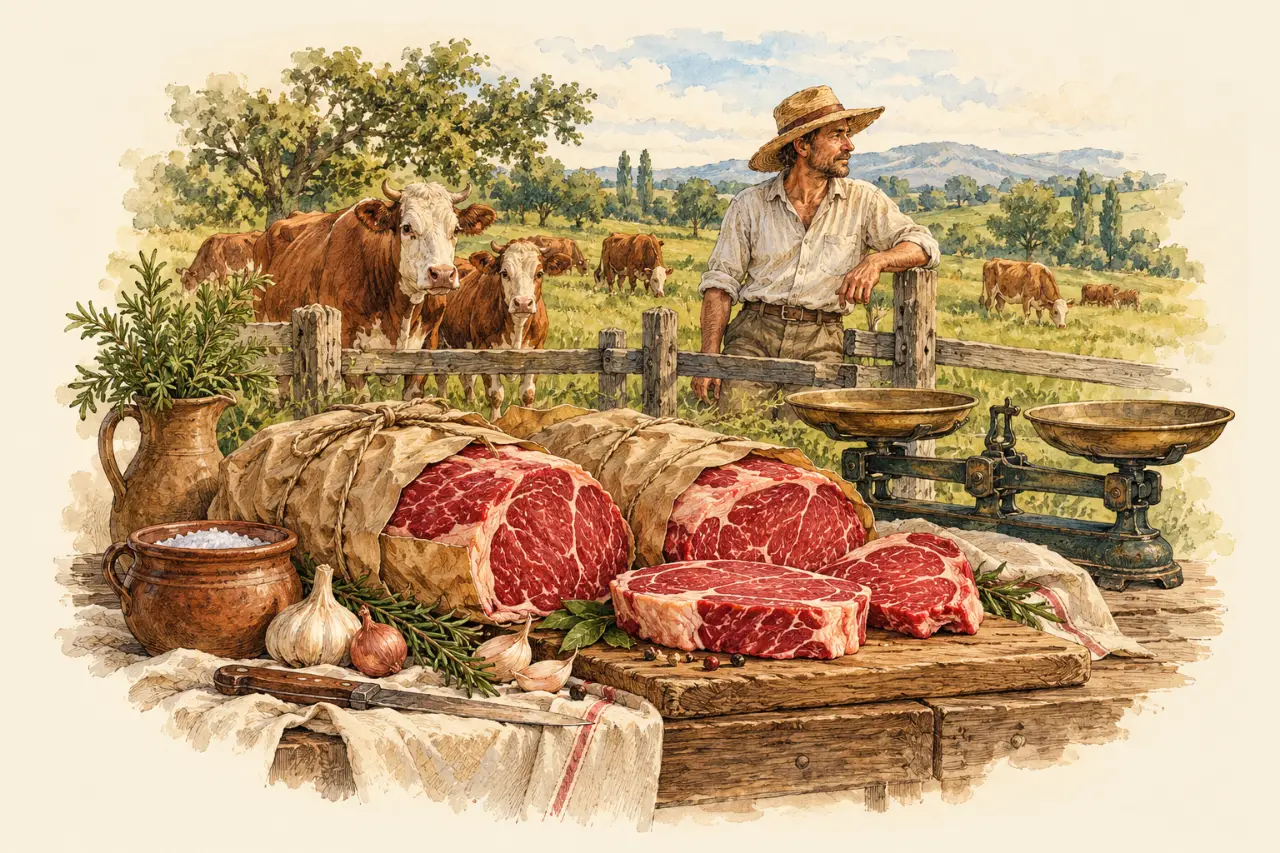
For anyone just starting out, it seems logical that grass-fed beef should cost less than regular beef. After all, a rancher who raises cattle on grass doesn't have the expense of grain, antibiotics, feedlot sheds and all the machinery of modern livestock farming. So why is beef from animals raised on pasture more expensive?
The answer comes from veterinarian Will Winter, in an article published in the journal of the Weston A. Price Foundation. And his answer turns the question on its head: grass-fed beef isn't expensive; industrial beef only looks cheap.
The True Cost of Beef
The first thing to consider is that the price of honest grass-fed beef reflects more accurately what it really costs to raise cattle for food. "Cheap" beef only seems to cost less because factory and feedlot production carries hidden costs that almost never get paid by the producer.
Over the past seventy years, reductionist science has handed the conventional rancher many tools for cutting the cost of producing beef and chicken: performance-enhancing drugs, artificial feed and extreme confinement. The industrial producer is incredibly efficient, but the unintended consequences of that efficiency fall on the consumer and the environment.
More Time, Less Weight
The efficiency shows up in the time it takes to raise the animal, the amount produced and the cost of production. Here is the comparison the author makes:
- Grain-fed steer: can be slaughtered at 16 months, weighing about 590 kg.
- Grass-fed steer: is usually slaughtered at 23 months, weighing about 500 kg.
- Industrial chicken: is slaughtered at five and a half weeks, weighing 1.8 to 2.3 kg, at a production cost of about 1 dollar per pound (roughly 2.20 dollars per kilo).
- Pasture-raised chicken: is usually slaughtered at 12 weeks, weighing 1.4 to 1.8 kg, and the production cost can reach 4 dollars per pound (about 8.80 dollars per kilo).
In other words, an animal raised on pasture takes longer to be ready and weighs less on the scale. That is true for cattle, and it is true for free-range birds, like the one in our galinha caipira recipe (free-range chicken).
The Feedlot Assembly Line
Feedlots work, essentially, like a factory assembly line: young cattle are driven in through the front door and, a few months later, driven out the back door, straight onto trucks bound for huge slaughterhouses.
During their stay, the animals are shoveled cheap genetically modified grain, along with other things that get called food: bakery leftovers, rejects from candy factories and waste from ethanol plants, which are subsidized and protected by the American government. Along with the artificial feed come growth hormones, appetite-stimulating substances and antibiotics at sub-therapeutic doses.
By the end of this regime, according to the author, the cattle are so poisoned by the wrong diet and by the drugs that they would probably die if they stayed much longer. Meanwhile, the manure, which under the right conditions would be a valuable natural fertilizer, becomes a toxic and dangerous waste, impossible to dispose of in an environmentally responsible way.
Consumers who have come to value animal welfare and regenerative agriculture practices ask producers to give up the tools that reductionist science offers for lowering costs. The result is a higher production cost for those who raise the animals.
The Scale of the Corporations
Practically all feedlot beef belongs to large corporations, and the scale is gigantic. The difference in labor costs is enormous: on a grass-fed farm, a herd of 700 cows takes three ranch hands to look after. In an industrial feedlot, the so-called CAFO, three workers handle 50,000 head of cattle.
On corporate farms, profit margins can be razor-thin, but the owners still reap huge dividends. And they often enjoy enormous tax breaks.
Processing the meat in the plants relies on immense machines. Machines need few people and have no need whatsoever for communities or small towns. They thrive, the author writes, on newly arrived immigrants, who work for next to nothing, are housed in dormitories and are discarded very quickly.
The Henry Ford Effect
It all comes down to scale. Everyone knows what Henry Ford did to the cost of building a car. Commodity beef packing plants operate on such a vast scale that watching them at work is a horrible, unforgettable sight.
In these gigantic, noisy, frightening facilities, a whole steer, from the moment it walks in alive until it becomes boxes of frozen meat on its way to the trucks, is processed with only two hours of human labor per animal. A small slaughterhouse spends more than eight hours of labor per steer.
That short time comes from automation, looser rules on how workers are treated, and other shortcuts. Problems like repetitive strain injuries, poorly paid immigrants, pollution from excess waste, and inhumane conditions for people and animals don't show up in the price of "cheap food."
The Costs Nobody Pays
The hidden costs of cheap food from the big producers include massive erosion and the yearly loss of fertile topsoil caused by grain production; pollution of air, water and soil; and the disappearance of farm families, rural communities and small towns all across the American heartland. It was this loss of the possibility of making a living from the land in a simple and honest way that inspired the writer Wendell Berry to write the essay "What Are People For?"
Grass-fed beef producers, on the other hand, are almost all small family businesses, family farming in the most literal sense. These small operations don't benefit from the efficiency of scale. Often the whole family gets involved in caring for the cattle, the land and the survival of the farm.
And they can't survive without a steady income, which can't come from just a few well-raised head of cattle. When they are profitable, these small farms are good for rural communities and small towns. To find people who raise pasture-fed animals near you, check the Nu&Cru producer map.
Commodities: Who Sets the Price
Another reason commercial beef stays cheaper than grass-fed beef is that it has been turned into a commodity. When a product, in this case an agricultural one, becomes a commodity, the producer stops setting the price and starts accepting the price imposed on them.
Here is the difference between commodity beef and niche beef: anyone can produce "grass-fed beef," but only Seu João can produce "Seu João's grass-fed beef." Anyone can find the day's quote in the newspaper or on the radio (in Brazil, the famous arroba price of fattened cattle), but only Seu João decides the price of Seu João's beef. That is the free market. It is up to him to tell his story and explain to customers why his beef is the best option and worth the higher price.
When a product becomes a commodity, the producer receives only the profit margin the market dictates. If that price falls below the cost of production, there are two ways out: take a loss (until the money runs out) or cut corners to make a cheaper product. We have already seen both happen.
Subsidies: The Help That Makes Grain Cheap
Even worse, the American government was pressured by lobbyists into creating what the author calls real "welfare checks" for commodity grain producers. Using taxpayers' money, these farmers receive an amount above the market price. They are paid when a crop fails or another disaster strikes, and often they are paid not to plant when there is a grain surplus.
This "free" grain, financed by the government through agricultural subsidies such as those in the Farm Bill, goes to feedlots to produce cheap beef.
The Cost to Your Health
According to the author, contamination by pathogenic bacteria is low or nonexistent in the meat of grass-fed animals, while pathogens are almost always present in feedlot beef. The health of the people who eat this meat therefore becomes one more item in the real cost. Nobody wants to add up the medical expenses of all the cases of food poisoning caused by industrial food, with illnesses that require hospitalization and cost tens of thousands of dollars every year, as well as thousands of food-related deaths annually. The foundation also addressed the subject in the press release Buy Local Meat to Ensure Food Safety.
In addition, all the chemicals the animals receive end up in the meat, more specifically in the fat (and what the animal eats changes its fat, as shown in the article Is Bacon Bad for You?). Antibiotic resistance is real, and the antibiotics routinely given to feedlot cattle are contributing to the problem.
The Supermarket Marketing
Finally, much of what determines the price consumers pay is decided at the retail end. Big supermarkets bring in meat on 16-meter refrigerated trailers and set up enormous displays of commodity meat. They like to create the illusion of being the cheapest option in town, so many everyday products, precisely the ones shoppers compare most, become "loss leaders": they are sold at minimal profit, while prices go up on other items that almost nobody compares.
The author has also seen butcher-counter managers put a nearly doubled markup on grass-fed beef, arguing that it is harder to sell and takes more time to explain how to cook it. Because butchers were trained on feedlot meat, they prefer to sell it and often discourage customers from buying the grass-fed kind. In many cases, the result is more unsold, expired meat thrown away.
If you buy directly from the producer, the foundation offers a guide on how to succeed in the kitchen with grass-fed beef, and at Nu&Cru you will find recipes for slow-cooked cuts, such as carne de panela (pot roast), roasted beef ribs and ossobuco (braised veal or beef shank).
Is Grass-Fed Beef Expensive? The Right Question
In the end, grass-fed beef producers believe it is essential to reframe the question. Once you know the reality of the meat industry, nobody needs to ask why grass-fed beef costs more. It doesn't.
The right question is a different one: why does feedlot beef look so cheap? A little digging shows clearly that, in general, cheap food is the most expensive food of all, an idea the foundation also explores in The Real Cost of Real Food, the account of a small producer who sharpened his pencil and worked out what it costs to produce real food.
Further Reading
On Nu&Cru
- Is Bacon Bad for You? How to Choose the Real Thing
- Whole Chicken: How to Use the Entire Bird
- Backyard Chickens: Pasture-Raised Eggs at Home
- Liver: The Most Nutritious Food There Is
- Bone Marrow: Benefits and How to Prepare It
- Bone Broth: Benefits and How to Make It
- Recipes to make the most of grass-fed beef: carne de panela (pot roast), rabada (braised oxtail), roasted beef ribs, hamburger and beef heart
- Producer map for buying meat directly from those who raise their animals on pasture
On the Weston A. Price Foundation (in English)
- The Real Cost of Real Food
- Achieving Culinary Success With Grass-Fed Beef
- Rolling Back The Meat Monopoly
- Buy Local Meat to Ensure Food Safety
- Princípios Atemporais de Dietas Tradicionais Saudáveis (in Portuguese)
This article is an adaptation of "Why Is Meat from Grass-Fed Animals So Expensive?" by Will Winter, DVM, published in the journal Wise Traditions in Food, Farming and the Healing Arts of the Weston A. Price Foundation, in Winter 2016. Read the original in English.
As informações têm caráter educativo e não substituem avaliação individual de profissional de saúde habilitado.