Blogreal food · from the farm to the table · Weston A. Price
Is UHT Milk Bad for You? The Truth About Boxed Milk
UHT milk is heated to nearly 150 °C and stays shelf-stable for months without refrigeration. Here is what that process does to milk's proteins, enzymes and nutrients.
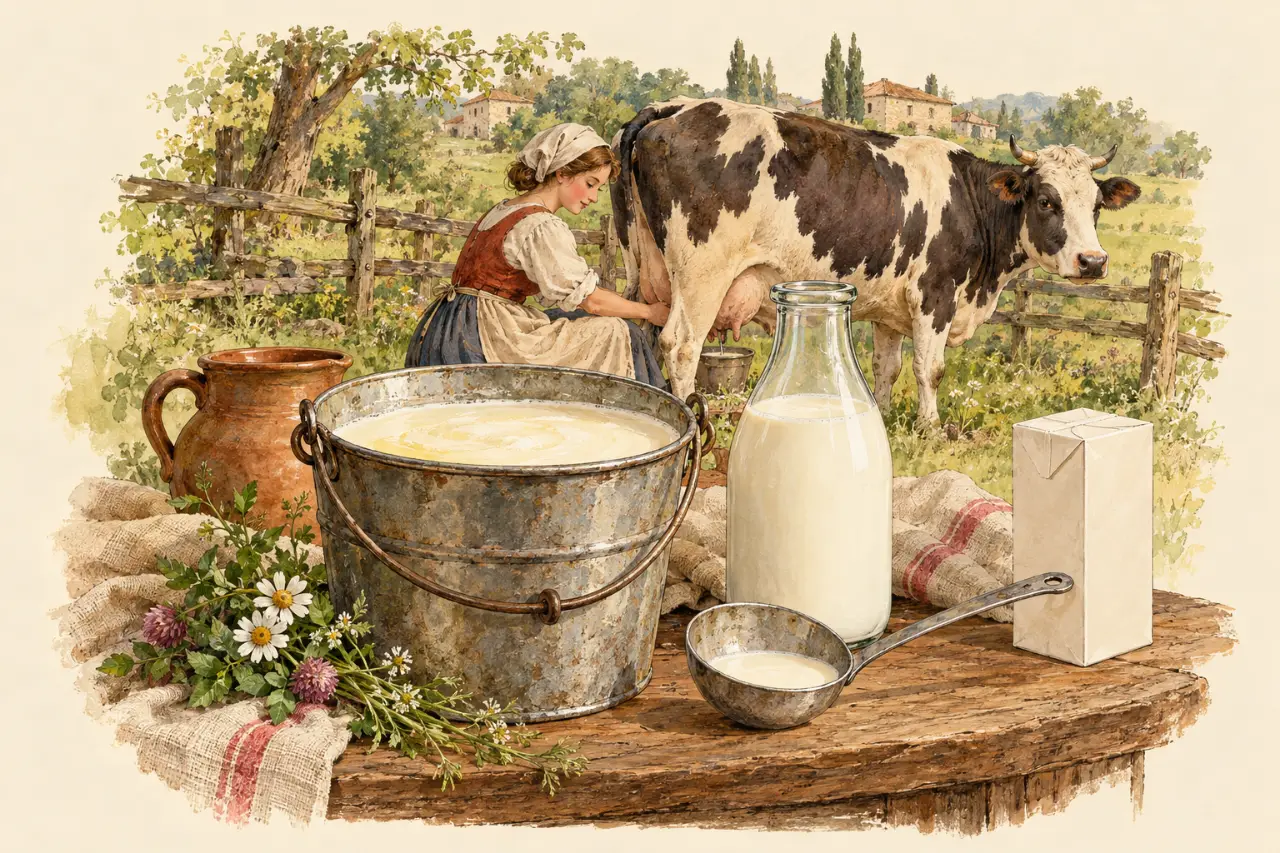
The UHT process, which heats milk to extremely high temperatures so it can sit on a shelf for months, has taken over much of the world. In Brazil it is known as leite longa vida (long-life milk), the famous boxed milk (leite de caixinha), and it is the best-selling milk in supermarkets. But what does this treatment do to milk? For the Weston A. Price Foundation, the answer is in the title the foundation's magazine gave to the article adapted here: "Ultrapasteurized Milk, an Ultra-Bad Idea."
From "Got Milk?" to Organic Milk
In the early 1990s, the famous Got Milk? ad campaign, which became a pop culture phenomenon in the United States, tried to reverse falling milk consumption by using celebrities to give the product a certain charm. Sales of conventional milk kept dropping, because more and more consumers, most often mothers, realized that the industry's product was not the healthy food the billboards promised.
The most attentive mothers took their families straight to raw milk, and they still do. Many others switched to pasteurized organic milk. In 2007, the Reuters news agency reported that demand for organic milk was growing 25% a year.
What Organic Gets Right
At first glance, organic milk is appealing. The selling points include more vitamins (because the cows graze), more humane treatment of the animals, and no pesticides, antibiotics or bovine growth hormone, which are still present in conventional milk.
A 2019 study gave organic milk even more support: researchers found detectable levels of several pesticides in 26% to 60% of the conventional milk samples bought at retail in the United States, "but in none of the organic samples" (Public Health Nutrition, 2019). In the same study, three out of every five conventional samples (and none of the organic ones) had antibiotic residues, some above the limits set by the FDA, the American agency that regulates food and drugs. And because of the synthetic growth hormone used in conventional production, median levels of this hormone were 20 times higher in conventional milk. The only exception was three "legacy pesticides," which persist for a long time in the soil and showed up in almost all samples, both conventional and organic.
Why Organic Milk Is Also UHT
The 2019 study seemed to point the way to organic milk, but pasteurized organic milk deserves a closer look. Besides the fact that the big producers usually operate on the industrial farm model, which contradicts the friendly image of the organic label, most of them share another malign practice: 80% of the organic milk sold in American supermarkets is UHT (ultra-high temperature).
Sometimes called simply ultrapasteurized milk, UHT is heated to a temperature between 138 °C and 149 °C for two to six seconds, far above milk's boiling point of 100 °C. To compare the methods of pasteurization:
- Slow pasteurization (vat or batch): the original method heats the milk to 63 °C for 30 minutes.
- Fast pasteurization (HTST, high temperature short time): heats the milk to 72 °C for at least 15 seconds.
- UHT: from 138 °C to 149 °C, for two to six seconds.
The War Against All Bacteria
Dairy experts justify every form of heat treatment in the context of a "hundred-year war waged indiscriminately against all bacteria," fueled by historical circumstances that no longer exist, as the article 15 Things That Milk Pasteurization Kills, from the real milk campaign of the foundation, reminds us. As one blogger observed, when the public is indoctrinated to fear raw milk and embrace pasteurization, people tend to think: "if pasteurized is good, ultra-pasteurized must be even better, right?" But in the case of UHT, dairy scientists themselves admit that a commercial consideration, shelf life, is one of the main reasons for its spread.
When the industry uses slow or fast pasteurization (which already destroy valuable enzymes and denature some proteins), the final product lasts about a week. UHT's kamikaze approach goes much further: it indiscriminately kills or denatures nutrients, enzymes and proteins, but, and this is the main appeal for producers, it extends the shelf life of the sealed product, unrefrigerated, to an impressive six to nine months.
The Tetra Pak Pitch
The multinational Tetra Pak, a packaging giant and also a major supplier of UHT equipment, enthusiastically explains that, since UHT milk needs no refrigeration and is easy to store and transport, it is no surprise that many producers see it as a great choice for organic milk. With the same twisted logic, the company has the audacity to describe UHT as "fresh milk without preservatives" and says that most organic milk goes through the process "because organic farms are not in every region of the country" and the product has to travel farther to reach many markets.
What Tetra Pak doesn't mention in its ads is that UHT favors big agribusiness. Milky Day, an equipment supplier whose main customers are small dairy farms and people who keep a few cows, sheep or goats, explains that ultra-pasteurized milk is not a viable option for most small producers because of the high cost of the equipment. And when large dairies have the resources not only to buy UHT equipment but also to ship their almost-infinite-shelf-life product over long distances, they gain one more tool for pushing small producers out of the market and cutting milk off from local communities. It is the opposite of what the Nu&Cru producers map proposes, which connects buyers with the people who milk the animals, including raw milk producers and cheesemakers.
Boxed Milk Has Conquered the World
Outside the United States, the trend is the same, and UHT, without even the veneer of an organic label, has "more or less taken over the milk market in many parts of the world." Consumption is growing in Asia-Pacific, Australia, Eastern Europe, Latin America, the Middle East and Africa. Worldwide, about a third (34%) of the liquid milk consumed is UHT, and in some regions, such as South Africa, UHT already holds more than half (53%) of the market.
A marketing professional in the sector, who describes the technology as "a God-sent innovation," celebrates that where electricity is unreliable or homes have no refrigerator, people are being "encouraged" to switch to UHT. The finishing touch, according to him, is that the technology allows milk, a highly perishable product, to be consumed in places as remote as the village of Kalukwakerith, in the far north of Kenya.
American resistance
When UHT arrived in the United States in the early 1990s, producers found that its biggest selling point abroad, the ability to sit unopened at room temperature without refrigeration, made Americans suspicious, since they prefer their milk cold. So, as the Food Renegade blog tells it, "dairy producers got creative" and began selling long-life milk in regular packaging in the refrigerated section, getting around consumer resistance.
The American belief that milk belongs in the fridge drew criticism in the press. Reader's Digest declared, with disdain, that Americans rejected UHT because of their "obsession with refrigeration." In an article for food tourists that praises UHT as a "modern marvel," another journalist poked fun at Americans' alarm at the rows of milk cartons sitting outside the fridge in supermarkets in countries like France: were they left there by mistake? Has something gone terribly wrong? Don't worry, she wrote, that's exactly where they're supposed to be. For Brazilians, the scene is nothing strange: here, too, cartons of long-life milk (leite longa vida) are stacked on shelves at room temperature.
Is Boxed Milk "Dead" Milk?
For consumers who look at UHT more closely, the "shock" is indeed a common reaction, but not for the reasons the journalist imagined. One blogger who looked into her options for pasteurized milk describes how she realized that neither conventional nor organic UHT was healthy: either she filled her children's glasses with synthetic growth hormones and antibiotics, or she served a "milk" so dead that the quotation marks were justified.
Other observers, consumers and researchers agree with describing UHT as "dead" milk. In somewhat more diplomatic but still expressive words, a 2017 BBC report described the effects of UHT's "brief, intense heat" as "strange qualities":
- the whey proteins unfold and turn into "floppy strands";
- the enzymes fall apart, and UHT milk is no good for fermentation, as in cheesemaking;
- a burnt taste appears, the result of a chemical reaction between the milk's proteins and sugars, the Maillard reaction;
- sulfur compounds created in the process give the milk an "eggy smell" or a "cooked taste" (Critical Reviews in Food Science and Nutrition, 2012).
It is no coincidence that Nu&Cru's recipes for plain coalhada (a traditional Brazilian soured milk, similar to a thick yogurt), plain yogurt and milk kefir call for raw milk, preferably.
Plasmin: the enzyme that doesn't die
In the language of dairy scientists, the "undesirable effects" produced by processing and long storage include browning, emulsion instability, off-flavors and loss of nutrients. Some of these effects occur because, although UHT kills the milk's "working" enzymes, at least one, plasmin, resists heat and does not break down. Plasmin causes proteins to break apart, a process called proteolysis (Journal of Dairy Science, 2010).
According to the BBC, plasmin goes around "slicing up various proteins," freeing them from what they were doing and letting them stick to one another. In UHT milk, this can create gelatinous clumps in an irreversible process called age gelation. The viscosity increases, and the ultra-pasteurized milk can become hard to pour.
Cabbage taste, then bitterness
In 2004, Linda Joyce Forristal gathered some of the research on UHT milk for the foundation in her article Ultra-Pasteurized Milk, and she described the timeline of some of these "strange qualities," which were already well documented at the time. She observed that the sulfur compounds formed during heating give the milk a strong cabbage flavor, most noticeable right after processing. These compounds dissipate, but about a month later UHT milk starts to deteriorate and is described by the industry as "stale," eventually becoming not only gelatinous but bitter.
Forristal's ironic conclusion: the ideal moment to drink UHT milk with any pleasure, if that is even possible, is limited to the window between the disappearance of the cabbage taste and the arrival of the stale flavor, the bitterness and the gelatinous texture. Milky Day, for its part, suggests that practically any other kind of milk, raw or even pasteurized by other methods, "will taste better than UHT."
The Brazilian study and the stabilizers
In 2017, Brazilian scientists analyzed samples of whole UHT milk from six large dairy companies that sell in Brazil and in other South American countries (Food Science and Technology, 2017). They were concerned to find that all of the samples had "significant potential to cause toxicity at the cellular level," as well as genotoxic and mutagenic effects.
The researchers also raised the possibility that manufacturers were adding "microingredients" to UHT milk to keep its sensory properties pleasant, and they noted the "great concern of health professionals and health surveillance agencies" about the addition of chemical compounds not permitted by law. In the 2004 article, Forristal had already wondered whether the industry might be quietly adding "flavorings or other chemicals" to disguise the bad taste. Curiously, in 2018, Nestlé admitted that it had been adding "stabilizers" to the UHT milk sold in Brazil (even though long shelf life is precisely the product's great virtue) and committed to removing them, promising to go back to "only simple, recognizable ingredients on the labels."
Is UHT milk hard to digest?
The strange taste and gelatinous texture are far from the only problems with UHT milk. Besides killing the "good" bacteria, which help keep the "bad" ones in check, ultra-pasteurization denatures casein and the whey proteins, the main proteins in milk. The extra heat breaks some of the bonds that give the protein its structure and makes it unfold, which changes how it behaves in the body and makes the milk extremely hard to digest.
The blog Food Renegade sums up the issue well in the post Just Say No to UHT Milk. The components of raw milk are extremely fragile. Milk proteins are complex, three-dimensional structures, made to be broken down during digestion by special enzymes that fit them like pieces of a puzzle. When milk is heated rapidly, the proteins denature and flatten out, and the enzymes cannot do their job. In other words, milk protein becomes much harder to digest. No wonder, says the blog, that more and more people consider themselves casein intolerant: pasteurization and UHT kill the milk enzymes needed to digest casein and also alter the casein to the point of making it indigestible.
Milk Allergy and Esophagitis
In 2021, Austrian researchers admitted that "little is known about the effect of UHT processing in the context of allergy," but agreed that heat processing can change the three-dimensional structure of proteins in ways that matter for allergenic potential (Foods, 2021). Cow's milk allergy is the most common allergy among American babies (World Allergy Organization Journal, 2022).
A 2020 case report described eosinophilic esophagitis, an allergic condition of the esophagus, in a nine-year-old boy with prior allergies and asthma who switched from "regular pasteurized" milk to ultra-pasteurized milk (Cureus, 2020). The condition showed up as episodes of abdominal pain, intermittent nausea, occasional vomiting and coughing after meals. The authors note that the mass commercial adoption of ultra-pasteurized and UHT dairy in the United States roughly coincides with the period when eosinophilic esophagitis emerged as a medical problem, and they ask whether the new milk processing methods might be behind the disease, by changing the structure of proteins and their allergenic potential.
What About the Nutrients?
Tetra Pak's claim that the nutritional difference between ultra-pasteurized milk and "other" milks is "minimal, if not entirely negligible" is hard to swallow. Even simple boiling significantly reduces the nutritional value of milk, including the B vitamins, by up to 36%, according to the health website WebMD. As far back as 1982, researchers had found that the protein denaturation caused by regular pasteurization reduced the absorption of folate, a B vitamin (Journal of Nutrition, 1982). WebMD plays down quick pasteurization, saying that pasteurized milk is usually fortified with vitamins and minerals to replace the few lost in heating, but it doesn't even discuss the impact of ultra-pasteurization temperatures, which are far above those of quick pasteurization and boiling.
In a study published in 2021, researchers from France and New Zealand lamented the scarcity of studies measuring protein and fat metabolism in humans after they consume heat-treated milk (Frontiers in Nutrition, 2021). Even so, the little data available suggests an association between consuming heat-treated milk and lower nutrient absorption, which in turn is associated with gastrointestinal disorders and inflammatory bowel disease.
Dormant Spores and Heat-Resistant Enzymes
Sally Fallon Morell, president of the foundation, has described how the listeriosis outbreaks caused by pasteurized milk in the mid-1980s (New England Journal of Medicine, 1985) showed that the pasteurization techniques of the time did not fulfill their stated purpose of preventing such outbreaks. In 1987, scientists from the US Centers for Disease Control and Prevention (CDC) reported that a single dairy plant, which produced two brands of pasteurized milk with 2% fat, was responsible for nearly 200,000 cases of antibiotic-resistant salmonellosis in Illinois, and concluded that the bacteria had "repeatedly contaminated the milk after pasteurization" (JAMA, 1987). Morell observes that the unfortunate lesson the industry took from these episodes was not to work more cleanly, but with more heat: UHT.
The spores that survive
Not even ultra-pasteurization solves the problem, as research on endospores shows. These are resistant structures that allow certain bacteria, such as the hardy species of the genus Bacillus (not to be confused with Lactobacillus), to stay dormant for long periods, "up to centuries," according to Wikipedia, and to become active again under favorable conditions.
Ultra-pasteurization is said to kill "most" bacterial spores, but dairy experts acknowledge that some of the remaining spores can activate and cause problems, especially when the milk is stored in warmer places. A Tunisian study that tracked the occurrence of spore-forming bacteria along the UHT milk production line in winter, spring and summer found that they had "high heat resistance," especially in spring and summer (Journal of Dairy Science, 2017). And according to a 2022 study on Bacillus cereus, heat treatment of milk can actually "act as an activator of spore germination" (Foods, 2022).
Enzymes that spoil milk
Studies also show that psychrotrophic bacteria, which can grow below 7 °C, can multiply and contribute to the spoilage of UHT milk, because they produce heat-resistant "spoilage enzymes" that withstand everything from pasteurization to UHT temperatures. In 2017, European and Brazilian researchers observed that the residual activity of these enzymes after heat treatment can cause "technological problems," such as sedimentation, gelation and rancidity during the shelf life of milk and dairy products, in addition to the flavor defects already described (Frontiers in Microbiology, 2017).
The same researchers acknowledge that reducing the activity or secretion of these enzymes is "a scientific challenge" and that reducing it with heat "seems to be very difficult." They conclude that the problem "is of growing importance because of the large worldwide trade in liquid milk and milk powder."
The future of milk: UHT or real milk?
Researchers who recognize the high nutritional value of raw milk marvel at its "wide microbial biodiversity, with more than 150 species identified," and remind us that this diversity is the foundation of the richness of traditional dairy products in every region of the world. They also note that "a large part of the milk microbiota is still unexplored": almost one in five microorganisms isolated from raw milk (18%) belongs to "previously unknown species." It is this living community that gives rise to raw-milk cheeses such as brie and parmesan.
Instead of admiring the impressive complexity of "nature's perfect food," the conventional dairy industry seems determined to keep steamrolling over it. Tetra Pak's latest marketing bet is the "revolutionary" OneStep technology, which combines separation, standardization, mixing and heat treatment in a single step, starting from raw milk or milk powder. According to the company, OneStep cuts processing time from a few days to "just a few hours."
Raw milk made to be drunk raw
The Weston A. Price Foundation and other organizations, such as the Raw Milk Institute, have long pointed out the difference between two kinds of raw milk. On one side is high-risk raw milk "intended for pasteurization," mixed from several confinement dairies and "produced under conditions in which animal health is compromised," with "a correspondingly high rate of pathogens." On the other is the low-risk raw milk that so many Americans can now get, "produced with care and intention for direct human consumption," as explained in the Raw Milk Institute's letter to health professionals.
In the author's view, anyone who takes the trouble to learn the basic facts about the many advantages of raw milk, for consumers and producers alike, will probably see through the false promises of UHT technology and keep UHT dairy, organic or not, off the family table. With real milk, the kitchen gets back recipes like sour cream, raw ice cream and banana smoothie.
Sidebar: the "endless possibilities" of UHT
In October 2023, a promotional article published on the Dairy Reporter website, with paid content supplied by Tetra Pak, celebrated the "evolution" of UHT milk and the endless possibilities for creating loyal customers. According to the text, UHT milk is "naturally nutritious" but "can easily be transformed to meet consumers' specific desires for functional benefits." Tetra Pak suggests that UHT can serve a number of market niches:
- UHT milk fortified with synthetic vitamin D or zinc, for post-Covid-19 consumers who "look for elements that strengthen immunity";
- UHT milk with chamomile, for people who suffer from insomnia linked to mental health;
- flavored UHT milk products, for people who want to cut back on sugar;
- protein-enriched drinks for "health and fitness enthusiasts," who appreciate how convenient UHT is to take anywhere (the foundation has a lot to say about this trend, as shown in the article Is Protein Powder Bad for You?).
Besides "exploring new flavors, adding functionality and even incorporating particles" (the company does not explain what it means by "particles"), Tetra Pak promises a "wide range of packaging solutions" that make it possible to create distinctive packaging that stands out on the shelf and "engages" the consumer.
Food scientists are also studying probiotics for dairy products that can survive UHT. One businessman explains that, after going through heat treatment, "the probiotics keep their viability and are stable at room temperature for a typical storage period of 10 to 12 months." The supposed double benefit is that this "simplifies the manufacturing process and improves safety": "from a food safety standpoint, you can rest easy knowing that everything added to the product has been heat treated."
Further reading
On Nu&Cru
- Is Butter Bad for You? Why It's the Better Choice
- Is Protein Powder Bad for You? The Problem With Whey
- Lacto-Fermentation: What It Is and How to Do It
- Weston A. Price: What Traditional Peoples Can Teach Us About Eating
- Recipes with real milk: natural coalhada (Brazilian-style soured milk), milk kefir, cream cheese and golden milk
- Producer map for buying raw milk and cheeses straight from the people who make them
At the Weston A. Price Foundation (in English)
- Ultra-Pasteurized Milk
- Facts About Raw Milk
- Microphotography of Raw and Processed Milk
- The Untold Story of Milk, by Ron Schmid
- 15 Things That Milk Pasteurization Kills, from A Campaign for Real Milk
References
- Stewart H, Kuchler F. Fluid milk consumption continues downward trend, proving difficult to reverse. Amber Waves, Economic Research Service, U.S. Department of Agriculture, June 2022.
- Daddona M. Got Milk? How the iconic campaign came to be, 25 years ago. Fast Company, June 13, 2018.
- Organic milk seen flooding U.S. market. Reuters, August 9, 2007.
- U.S. organic dairy market: statistics & facts. Statista, December 14, 2023.
- Welsh JA, Braun H, Brown N et al. Production-related contaminants (pesticides, antibiotics and hormones) in organic and conventionally produced milk samples sold in the USA. Public Health Nutrition, 2019;22(16):2972-2980.
- Michaelis K. Just say no to UHT milk. Food Renegade, June 4, 2020.
- McDowell J. Shelf-stable (aseptic) milk: everything you need to know. Dairy MAX, January 1, 2022.
- What is vat pasteurization? Zwirner Equipment.
- High-temperature short-time pasteurization. National Agricultural Library Thesaurus, U.S. Department of Agriculture.
- McAfee M. The 15 things that milk pasteurization kills. A Campaign for Real Milk, August 3, 2010.
- Ashley. Ultra-pasteurized milk: who knew? Brood Farm, April 14, 2012.
- Sunds AV, Rauh VM, Sørensen J et al. Maillard reaction progress in UHT milk during storage at different temperature levels and cycles. International Dairy Journal, 2018;77:56-64.
- How long does UHT (long life) milk last once opened? Dairy Australia.
- Tetra Pak. UHT milk: separating the truth from the myths. n.d.
- Tetra Pak. UHT milk FAQ. n.d.
- Milky Day. About us.
- Milky Day. Ultra pasteurized milk: is it bad? How is it made? November 18, 2019.
- Forristal LJ. Ultra-pasteurized milk. Weston A. Price Foundation, May 23, 2004.
- Greenwood V. The milk that lasts for months. BBC, March 27, 2017.
- Ndeda A. UHT milk continues to evolve to meet changing consumer tastes and preferences. Food Business Africa, November/December 2022.
- Alexander BN. This is the reason why Americans refrigerate milk and Europeans don't. Reader's Digest, updated March 17, 2021.
- Rickman C. The reason aseptic milk isn't sold in the refrigerated section. Tasting Table, updated February 16, 2023.
- Zabbia A, Buys EM, De Kock HL. Undesirable sulphur and carbonyl flavor compounds in UHT milk: a review. Critical Reviews in Food Science and Nutrition, 2012;52(1):21-30.
- Ismail B, Nielsen SS. Invited review: plasmin protease in milk: current knowledge and relevance to dairy industry. Journal of Dairy Science, 2010;93(11):4999-5009.
- Rauh VM, Sundgren A, Bakman M et al. Plasmin activity as a possible cause for age gelation in UHT milk produced by direct steam infusion. International Dairy Journal, 2014;38(2):199-207.
- Carvalho BdL, Sales IMS, Peron AP. Cytotoxic, genotoxic and mutagenic potential of UHT whole milk. Food Science and Technology (Campinas), 2017;37(2):275-279.
- Cornall J. Nestlé eliminates stabilizers from its UHT milks in Brazil. Dairy Reporter, September 19, 2018.
- Haas R. Loss of nutritional value in ultra-pasteurized vs. pasteurized milk. LiveStrong.com, n.d.
- Geiselhart S, Podzhilkova A, Hoffmann-Sommergruber K. Cow's milk processing: friend or foe in food allergy? Foods, 2021;10(3):572.
- Warren CM, Agrawal A, Gandhi D et al. The US population-level burden of cow's milk allergy. World Allergy Organization Journal, 2022;15(4):100644.
- Manadan A, Edigin E, Attar B. Eosinophilic esophagitis occurring after switching to ultra-pasteurized milk: coincidence or unrecognized etiologic trigger? Cureus, 2020;12(8):e9828.
- WebMD Editorial Contributors. What to know about boiling milk. WebMD, reviewed February 12, 2024.
- Gregory JF 3rd. Denaturation of the folacin-binding protein in pasteurized milk products. Journal of Nutrition, 1982;112(7):1329-1338.
- Fatih M, Barnett MPG, Gillies NA et al. Heat treatment of milk: a rapid review of the impacts on postprandial protein and lipid kinetics in human adults. Frontiers in Nutrition, 2021;8:643350.
- Fleming DW, Cochi SL, MacDonald KL et al. Pasteurized milk as a vehicle of infection in an outbreak of listeriosis. New England Journal of Medicine, 1985;312(7):404-407.
- Ryan CA, Nickels MK, Hargrett-Bean NT et al. Massive outbreak of antimicrobial-resistant salmonellosis traced to pasteurized milk. JAMA, 1987;258(22):3269-3274.
- Morell SF. The curse of ultra-pasteurization. The Epoch Times, February 15, 2024.
- Endospore. Wikipedia (in English).
- Kmiha S, Aouadhi C, Klibi A et al. Seasonal and regional occurrence of heat-resistant spore-forming bacteria in the course of ultra-high temperature milk production in Tunisia. Journal of Dairy Science, 2017;100(8):6090-6099.
- Tirloni E, Stella S, Celandroni F et al. Bacillus cereus in dairy products and production plants. Foods, 2022;11(17):2572.
- Machado SG, Baglinière F, Marchand S et al. The biodiversity of the microbiota producing heat-resistant enzymes responsible for spoilage in processed bovine milk and dairy products. Frontiers in Microbiology, 2017;8:302.
- Tetra Pak. The UHT milk evolution: discovering new possibilities in a long-lasting favourite. Dairy Reporter, October 30, 2023.
- Smith S. Letter to medical professionals about raw milk. Raw Milk Institute, December 3, 2019.
- Lyubomirova T. Probiotics-enriched ambient dairy "three to six months out," says AnaBio. Dairy Reporter, March 21, 2023, updated January 11, 2024.
This article is an adaptation of "Ultra-Pasteurized Milk: An Ultra-Bad Idea" (published on the website as "Is Ultra-Pasteurized Milk Bad"), by Merinda Teller, which appeared in the Weston A. Price Foundation's magazine Wise Traditions in Food, Farming and the Healing Arts in spring 2024. Read the original in English.
As informações têm caráter educativo e não substituem avaliação individual de profissional de saúde habilitado.