Blogfats · from the farm to the table · real food
How to Choose Lard, Tallow and Butter: Labels and Origin
Lard, beef tallow, butter or ghee: what the name on the label guarantees, what the way the animal was raised changes in the fat, and what to ask the producer before you buy.
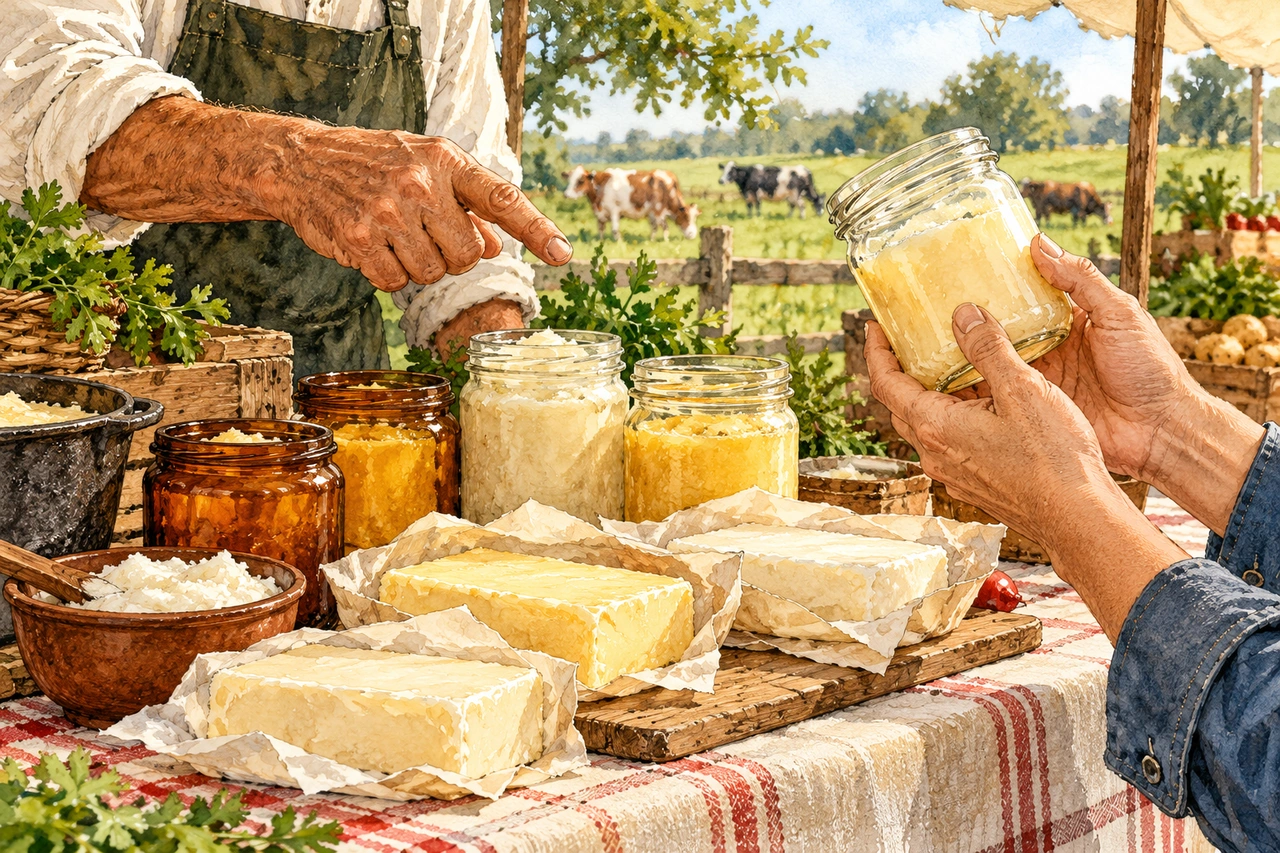
To choose an animal fat well, ask three questions, in this order: what animal and what part of it does the fat come from, how was that animal raised, and what happened to the fat after slaughter? The label answers the first and the third, if you know how to read it. The second almost always means talking to whoever produces it. The honest answer about how the animal was raised is also less dramatic than social media tends to make it sound: in Brazil, most cattle already live on pasture, and there is a difference in the fat's composition, but it is modest.
First, the name: what each product is by definition
On the shelf, lard, vegetable shortening and "pork fat" sit side by side, and the packages look alike. The product's official name is the first filter, because Brazilian law defines what can be called what.
- Lard (banha). The regulation on inspecting animal-origin products, the RIISPOA (Decree 9.013/2017), defines banha as the product obtained "by melting fresh adipose tissue from swine." It is rendered pork fat. Supermarket lard is usually refined, white and odorless; a small producer's lard tends to have a light aroma of torresmo (fried pork rinds). Both are lard. What sets them apart is the ingredient list: real lard has only one ingredient.
- Beef tallow (sebo). This is beef fat that has been rendered and strained. In the kitchen, the part most used is the fat surrounding the kidneys and the loin, which is firmer and cleaner of meat. In Brazil, the word "sebo" is often associated with industrial use; culinary tallow is the same product made with the care of a food. The article beef tallow: what it is and how to use it explains the difference unhurriedly.
- Butter (manteiga). Under the same RIISPOA, the fat in butter must be "exclusively milk fat," and the technical regulation on identity and quality (Portaria MAPA 146/1996, copy kept by UFRRJ) requires at least 82% fat, or 80% for salted butter. If the package says "cream," "blend" or lists vegetable oil among the ingredients, it is not butter, however much the color and the tub resemble it.
- Manteiga de garrafa (Brazilian clarified butter, sold in bottles). It has its own regulation. MAPA's Instrução Normativa 30/2001 requires at least 98.5 g of fat per 100 g: it is practically just milk fat, once the water has been removed.
- Ghee. We did not find a specific Brazilian standard for the name "ghee." The closest product in the law is the "anhydrous milk fat or butter oil" in the RIISPOA. In practice, read the ingredients: there should be only butter or cream.
- Hydrogenated vegetable fat. It is not animal fat, even though it shares the shelf with lard. Since January 1, 2023, Anvisa has banned partially hydrogenated oils and fats, the main source of industrial trans fat (RDC 632/2022). Fully hydrogenated and interesterified fats are still allowed, as Anvisa's own questions and answers document explains. If your recipe calls for lard, vegetable shortening is not the same thing.
One detail worth noting: Anvisa does not restrict the small amount of natural trans fat in beef and dairy, because it is produced by biohydrogenation in the rumen. It is a different substance, with a different origin, and the rule treats it differently.
Next, the Composition: Why Each Fat Behaves Differently
Animal fats are not all alike. The USDA table, the most widely used reference for food composition, gives these numbers per 100 g of product:
- Beef tallow: 49.8 g saturated, 41.8 g monounsaturated and 4.0 g polyunsaturated (USDA FoodData Central, tallow).
- Lard: 39.2 g saturated, 45.1 g monounsaturated and 11.2 g polyunsaturated (USDA, lard).
- Unsalted butter: 50.5 g saturated, 23.4 g monounsaturated and 3.0 g polyunsaturated; the rest of the weight is mostly water and milk solids (USDA, butter).
- Anhydrous milk fat, the type that ghee is: 61.9 g saturated, 28.7 g monounsaturated and 3.7 g polyunsaturated (USDA, butter oil).
These numbers explain what you see in the kitchen. Tallow is the firmest at room temperature; lard is softer; butter burns sooner than the others because it carries milk solids, which brown early; ghee, without those solids, holds up to more heat.
They also explain stability under heat. A classic review on the chemistry of frying concludes that high temperature, reuse and more unsaturated fatty acids reduce the stability of the oil (Choe and Min, 2007). For comparison: in soybean oil, unsaturated fatty acids add up to about 86% of the total, and linoleic acid, a polyunsaturated fat, is close to 54%, according to Embrapa Soja, which also notes the lower oxidation stability of this profile. That is why Nu&Cru prefers animal fat over refined oil for frying and searing.
What composition doesn't settle
Saturated fat is the point where official guidelines and Nu&Cru's view part ways, and it is worth saying so clearly. The World Health Organization recommends that, from age 2 onward, no more than 10% of dietary energy come from saturated fat, and suggests replacing it with polyunsaturated fats, plant-based monounsaturated fats or carbohydrates from fiber-rich foods. The Dietary Guidelines for the Brazilian Population put oils, butter and lard in the same group, culinary ingredients, and ask that they be used "in small amounts when seasoning and cooking foods."
Nu&Cru defends animal fat in place of refined oil, within a kitchen built on real food. This is not a license to use it without measure, and anyone with specific medical guidance about fat should follow it.
Origin: What the Animal's Upbringing Really Changes
This is where the topic is most exaggerated. It helps to separate pork from beef, because they work in different ways.
Pork: The Fat Reflects the Feed
Pigs are monogastric, like us. Part of the fat a pig eats goes straight into its body fat, especially the polyunsaturated fats. Embrapa Suínos e Aves (the Brazilian agricultural research corporation's swine and poultry unit) describes this in a technical bulletin: "the fatty acid profile of the diet is partly reflected in body fat." In practice, a pig fed a ration rich in soybean or corn oil tends to give a softer lard with more linoleic acid, which oxidizes faster. With less vegetable oil in the diet, the lard tends to come out firmer. The tendency is clear; how big the difference is depends on how much goes into the trough, and what.
So, when it comes to lard, what the pig ate is the most useful question to ask the producer.
Cattle: The Rumen Buffers the Diet
In cattle, the bacteria in the rumen transform much of the unsaturated fat in grass before it reaches the meat. This is the same biohydrogenation process that Anvisa (the Brazilian health regulatory agency) mentions. The result: diet changes the fat of cattle less than it changes the fat of pigs, and Brazilian studies show real but small differences.
- At Embrapa Pecuária Sudeste, a study of crossbred cattle finished on pasture or in a feedlot found no difference in CLA content, contrary to what was expected. Pasture gave more omega-3 and a lower omega-6 to omega-3 ratio, between 2.85 and 3.31, against 4.32 to 5.35 in the feedlot (Embrapa, 2011).
- At the Universidade Federal de Santa Maria, Devon steers finished on winter pasture, in a temperate climate, had meat with more CLA and more omega-3 than the feedlot animals. Those finished on tropical pasture fell in between, with no statistical difference from either group (Menezes and colleagues, 2014).
Both studies measured the fat in the meat, not the cover fat that tallow comes from, and the amount of omega-3 in beef fat is small in any system. The honest conclusion: raising cattle on pasture improves the balance between fats, without turning tallow into an important source of omega-3. Anyone who promises that is exaggerating.
"Grass-Fed" in Brazil Means Something Different
Most of the content about grass-fed fat comes from the United States, where the typical steer is finished in a feedlot eating grain. Here, the reality is different. According to Embrapa, about 86% of cattle production, from calf rearing to fattening, is done with grazing animals (Boletim CiCarne 33). Feedlots come in mainly at the final stage for part of the herd, and in the dry season it is common to supplement cattle on pasture with mineral salt, protein supplements or semi-feedlot feed (Embrapa, animal nutrition chapter).
So for Brazilian beef fat, "pasture-raised" is the rule, not the exception. The question that sets one producer apart from another is more precise: did the animal stay on pasture until the end? Did it get grain during finishing, and how much? We found no official standard defining "a pasto" or "grass-fed" on beef labels in Brazil; what exists is the general ban on information that misleads the consumer (art. 446 of the RIISPOA, the federal regulation on inspection of animal products). The producer's word and your own visit are worth more than a loose phrase on the packaging.
To find someone who can answer these questions, the Nu&Cru producer map brings together small farmers of meat, organ meats and animal fats in several states. It is free, the team checks the contact and the production method before publishing, and the purchase is arranged directly with the producer.
The Process: Inspection, Rendering and Storage
Lard, tallow and butter are animal products. To be sold, they must come from a registered, inspected establishment: under the SIF (federal inspection service) if sold to other states, or under the state (SIE) or municipal (SIM) service if sold within the state or the municipality, as set out in Law 1,283/1950. Establishments with SIE or SIM that are part of the Sisbi-POA can also sell to other states. The inspection stamp on the label is the bare minimum. We explain the three seals in more detail in our guide to buying beef directly from the producer.
After inspection, look at the process:
- Raw material. Tallow from the fat around the kidneys or from the tenderloin gives a cleaner, lighter fat. Mixed trimmings give a stronger flavor, which can be good for frying meat and bad for sweet dishes.
- Rendering. Fat melted slowly, over low heat for hours, and carefully strained ends up light in color and mild in smell. Heat that is too high darkens it and leaves a burnt taste. Some people render it dry and others start with a little water; both ways work as long as the heat is low. The step-by-step is in how to make lard and tallow at home.
- Packaging. Glass is what Nu&Cru prefers for fat, which is stored for months and sometimes jarred while still warm.
- Batch and expiry date. Well-made fat keeps well, but it oxidizes with light, heat and air. Buy what you will use within a reasonable time.
How to Recognize Good Fat at Home
You don't need a laboratory to tell the essentials. When cold, well-made beef fat is white or cream-colored and firm; lard is white and softer. Melted, both are clear and limpid, with no residue at the bottom. The smell is clean: a slight meaty aroma in tallow, almost nothing in refined lard. A smell of paint, old cardboard or rancidity indicates oxidized fat, which makes food bitter. If that happens, throw it away. The article on how to store and reuse cooking fat shows how to keep this from happening with the fat you already have.
Before You Buy: The Short List
At the store:
- Is the product called "banha" (lard), "manteiga" (butter) or "manteiga de garrafa" (clarified butter)? Or is it "gordura vegetal" (vegetable fat), "creme" (cream), "composto" (compound) or "mistura" (blend)?
- Does the ingredient list have only one item? If another oil or fat shows up, you already know what you are buying.
- Is there an inspection stamp (SIF, SIE or SIM), a batch number and an expiry date?
- Does the packaging protect from light and air?
With the producer, add:
- Which part of the animal does the fat come from?
- What did the animal eat, especially in its last months? For pigs, was there feed with oil in it? For cattle, was grain used in finishing?
- Where was the animal slaughtered, and under what inspection?
- How is the fat melted, strained and jarred?
If the answer comes quickly and in concrete terms, that's a good sign. People who raise animals with care usually enjoy telling you how they do it.
Which Fat for Which Dish
Choosing by origin settles quality; choosing by use settles flavor. Tallow for frying and searing meat and potatoes, lard for pie dough and for sautéing beans, butter for anything that goes into the oven for sweet baking and for finishing a dish. The full comparison, dish by dish, is in lard, tallow or butter: which to use for each dish. To see the fats in action, kabocha squash fried in animal fat (abóbora cabotiá) is a good place to start.
Where to Find Good Fat
The most direct route is to buy from the person who raises the animals, and the map of producers, mentioned above, was made for exactly that. It's worth asking the pig or cattle farmer whether they sell raw fat along with the meat: rendered at home, it becomes lard or tallow of known origin.
For those who would rather not render it at home, there is the Nu&Cru Beef Tallow: a single ingredient, beef fat from 100% grass-fed cattle from the pampas of Rio Grande do Sul, made in small artisanal batches and packed in glass. The current batch is sold out. On the Beef Tallow page you can see the composition and reserve the next batch via WhatsApp.
On your next shopping trip, take the short list with you and ask at least the question about what the animal ate. The answer tells you more about the fat than any packaging.
As informações têm caráter educativo e não substituem avaliação individual de profissional de saúde habilitado.