Blogbabies and children · introducing solid foods · kitchen organization
How to Freeze Baby Food: How Long It Lasts and How to Thaw It Safely
How long baby food keeps in the fridge and freezer, how to portion, thaw and reheat it, with the most conservative time limits and the reason behind each rule.
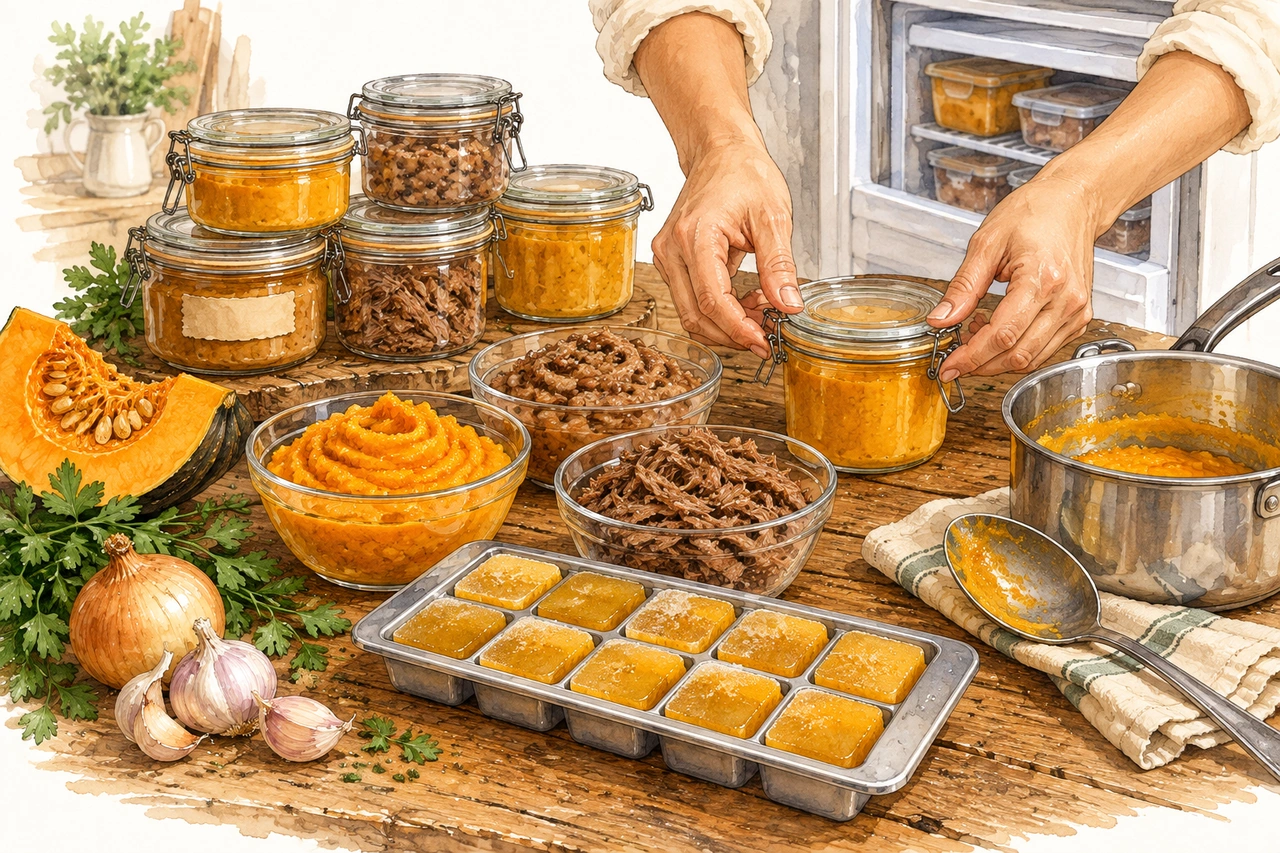
Once it's made, baby food, whether mashed or in pieces, keeps for up to 3 days in the fridge, up to 10 days in the freezer compartment of a single-door fridge, and up to 30 days in a real freezer. Cooked fish keeps only 1 day in the fridge. To thaw, use the fridge or take the frozen portion straight to the stove. Never leave it on the counter, and never refreeze what has already thawed.
These are the timeframes from the Guia Alimentar para Crianças Brasileiras Menores de 2 Anos (Dietary Guidelines for Brazilian Children Under 2), from the Ministry of Health (p. 169 and p. 186). Online, you'll find 2 months, 3 months, even up to 8 months of freezer time. We chose the shortest timeframes on purpose, and the reason comes right below. After that comes the step-by-step: how to batch cook, portion, store and reheat.
The timeframes at a glance
In the fridge
- Raw meats (beef, pork, chicken, fish): 3 days.
- Raw meats that are already seasoned: 1 day.
- Cooked fish: 1 day.
- Other cooked meats and ready-made food: 3 days.
In the freezer compartment of a single-door fridge
- Ready-made homemade food: 10 days.
In the freezer (the one in a two-door fridge or a stand-alone freezer, which gets much colder)
- Ready-made homemade food: 30 days.
- Raw meats: 30 days.
The Ministry adds that the storage temperature for each frozen or refrigerated product follows what the manufacturer indicates on the label (p. 169). The timeframes above apply to food made at home.
Why sources give such different timeframes
Three reasons explain the confusion.
Freezing pauses, it doesn't sterilize. In the cold, the microorganisms already in the food stop multiplying, but many survive and start growing again when the temperature rises, as this technical article from Nutritotal explains. Freezing preserves whatever was in good shape when it went into the freezer. That's why hygiene during preparation and speed in storing the food matter as much as the timeframe.
Safety limits and quality limits get mixed up. The long timeframes usually assume a very cold freezer that stays stable all the time. Even in those conditions, food loses quality over the weeks: it dries out, picks up a freezer taste, and the same Nutritotal article notes a gradual loss of vitamins when the temperature stays above −18 °C.
Not every "freezer" is equally cold. The Ministry separates the freezer compartment of a single-door fridge, which is less cold, from the freezer, and gives different timeframes for each. At home, almost no one measures the temperature, and the door is opened several times a day.
For a baby's food, it makes sense to use the wider safety margin. And there's a kitchen argument too: the texture of the food changes within a few weeks. The mashed purée of the 6th month gives way to the soft little pieces of the 9th. A 30-day stock keeps up with the stage; a three-month stock falls behind.
Batch cooking: a morning routine
The Guia da Introdução Alimentar Ancestral (Ancestral Guide to Introducing Solid Foods), by the nutritionists Laura Valentim and Dalyla Peçanha, organizes the week in blocks rather than in separate meals: one day for the broth, one for vegetables and roots, one for fruit purées with fat, one for fermented foods and one for checking the freezer. At the start of introducing solid foods, one morning a week is usually enough:
- Put the broth on the stove first. Meat and bone broth is the foundation of the first months in the ancestral guide, and it cooks on its own while you do the rest. The step-by-step is in bone broth.
- Cook the meat in the broth until it falls apart. Shred it very fine for a baby who is just starting, or into soft flakes for one who already picks food up by hand.
- Cook the vegetables separately, steamed or in a little water, until soft: pumpkin, chuchu (chayote), zucchini. No salt.
- From 7 months, cook the fruits that the ancestral guide uses in the first year (apple, pear, banana), already mixed with the fat.
- Don't let it cool on the counter. The Ministry advises putting food in the fridge without waiting for it to cool (p. 187). To speed things up, spread it out in shallow containers.
- Portion and label, as explained in the next section.
If the family eats from the same pot, set aside the baby's portion before adding salt and strong seasonings, and only then freeze it. The Ministry does this with beans: it separates and freezes portions before seasoning the household pot (p. 174). The complete single-pot routine is in baby at the family table.
In the guide, the chapter "Organização da rotina" (Organizing your routine) details this planning by blocks, and the five weeks of menus show what to freeze for each stage. Discover the Guia da Introdução Alimentar Ancestral.
How to Portion
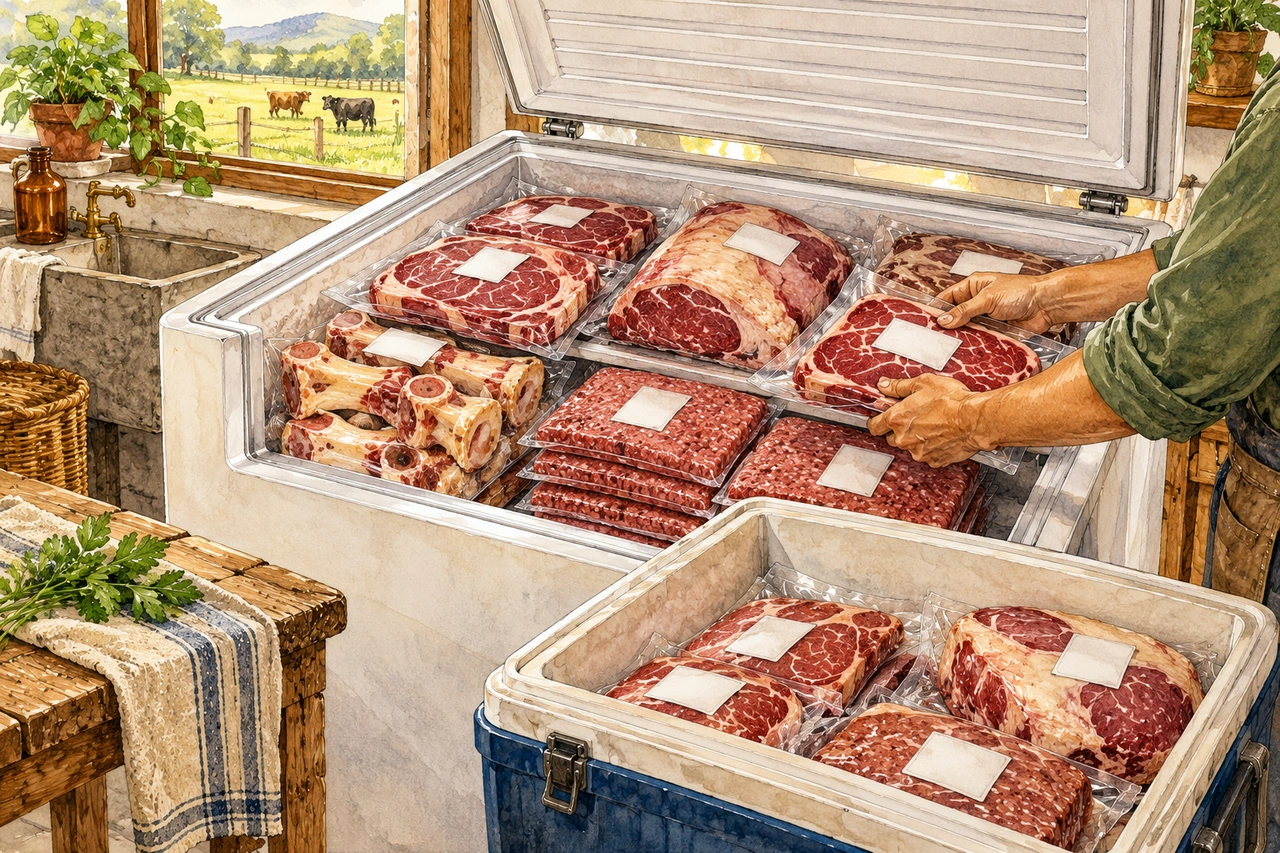
One portion per meal. The Ministry of Health recommends small jars, preferably glass, already filled with the amount that goes to the baby (p. 186), and says to thaw only what will be eaten. Meal-sized portions mean no thawed leftovers.
Each food in its own jar. Meat in one, pumpkin in another, chayote (a mild green squash) in another. On the plate, they go side by side, not mixed, as the Ministry advises, so the baby learns the flavor of each one. In the freezer, the ancestral guide suggests setting aside one space for broths, another for meats, another for vegetables, another for fruits with fat.
Broth in cubes. Freeze the broth in a stainless steel ice cube tray or in small containers and, once it is solid, move the cubes to a lidded glass jar. That way you take out only what you will use to moisten the day's meal.
Glass, with room to spare. Use a glass jar made for the freezer and leave about a finger's width of empty space, because liquid expands as it freezes. Do not take the jar from the freezer straight to the stove or to boiling water: the temperature shock can crack the glass.
Name and date on everything. A strip of masking tape with the food and the day it was made. Three weeks later, no one remembers which orange jar was pumpkin and which was carrot.
A disagreement about broth
The ancestral guide suggests freezing broth in portions that last about 3 days, moving each portion from the freezer to the fridge, and using it within 3 days. The Ministry of Health is stricter and advises thawing only what will be eaten at that meal (p. 186). Here we follow the Ministry's rule, because it is the most conservative and because it costs nothing: with broth in cubes, you thaw the exact amount, and the rest stays frozen.
Thawing and Reheating
- In the fridge, the night before. Move the next day's portion from the freezer to the fridge in the evening.
- Or straight onto the heat. The Ministry also accepts taking the food from frozen directly to reheating (p. 186). A small covered pot with a spoonful of broth or water does the job.
- Never on the counter. Thawing at room temperature is not recommended (p. 186).
- Heat evenly and stir. The food needs to be piping hot in the middle, not just at the edge. In the microwave, which heats unevenly, stir and wait a little before serving, and use a glass plate or jar, with no plastic wrap (p. 186).
- Wait for it to cool to lukewarm and taste it with a different spoon, never the baby's, and do not blow on it to cool it down (p. 106).
- Do not refreeze. What has been thawed does not go back into the freezer. The Ministry's exception applies to raw food: thawed raw meat can be cooked and, once cooked, frozen again (p. 186).
What Is Left on the Plate Gets Thrown Out
The Ministry distinguishes between sobra (food left over in the pot) and resto (food left on the plate). Leftovers are what stayed in the pot or jar without going onto the plate: they go in the fridge and follow the storage times. Scraps are what was left on the baby's plate: even if the baby never touched it, it is not offered again at another meal (p. 187). In practice, serve on the plate the amount the baby usually eats and add more if they ask for it. Do not feed the baby straight from the storage jar with a spoon that has been in their mouth.
Some foods change a lot in texture in the freezer. Hard-boiled egg turns rubbery and raw leaves wilt. These are worth making fresh.
When someone else is feeding the baby
Grandma, a nanny, a dad home alone: whoever didn't do the cooking needs simple instructions. The ancestral guide recommends leaving the meal already assembled in its little jar, explaining how to heat it, and saying what can and cannot be mixed. If the baby takes a prescribed supplement, it does not go on the stove together with the food. A note on the fridge door with the three steps (take it out of the freezer the night before, heat it until piping hot, wait for it to cool to lukewarm and taste it with a different spoon) removes any doubt in the moment.
The Bebê Ancestral app was made for this part of the routine: it builds the week's plan with menus by stage, generates the shopping list and lets you invite grandma, the nanny or the daycare to see what the baby eats and record how it went. The complete guide comes with it.
The first prep morning
Pick a day this week for your first prep morning. The day before, set aside six or eight small glass jars, a tray for the broth and some masking tape with a pen. If your baby hasn't started eating yet, the roadmap for the first weeks is in baby's first foods. For the adults' food, the same logic of bases that combine is in base cooking for the week.
If your baby is already in the middle of introducing solid foods, the Guia da Introdução Alimentar Ancestral lets you go straight to their stage: what comes in at each age, the recipes for each stage, from broths to pâtés, and what is worth preparing ahead. It is a digital book, with printing allowed for those who buy it.
Educational content; it does not replace an individual assessment by a health professional.
As informações têm caráter educativo e não substituem avaliação individual de profissional de saúde habilitado.