Blogbabies and children · starting solids · kitchen
Baby Feeding Essentials for Starting Solids: What to Actually Buy
A high chair, a small spoon, an open cup, a fork for mashing and glass containers: the short list for starting solids, with criteria for materials and what you can skip.
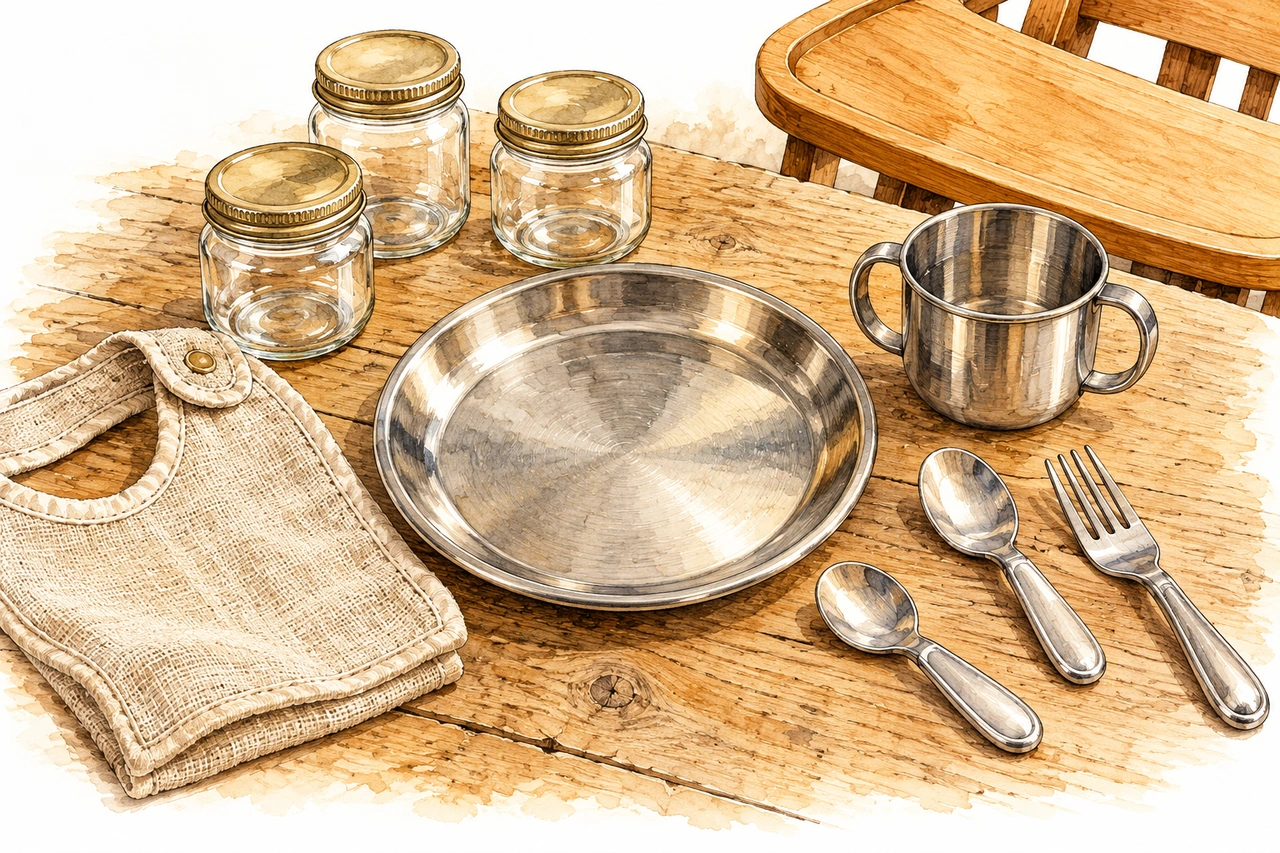
The real list is short. To start solid foods, a baby needs a place to sit upright and safely, a small spoon, an open cup and someone sitting facing them. In the kitchen, a fork for mashing, a small pot and a few glass containers cover the rest. Brazil's Ministry of Health says as much in its Dietary Guidelines for Brazilian Children Under 2: there is no need to buy special utensils for the child (p. 105).
Baby registry lists suggest otherwise: colorful sets, suction plates, blenders, spouted cups, food warmers. This article separates what changes safety and routine from what just takes up drawer space, and explains the material criteria Nu&Cru uses for everything that touches hot food.
The short list, item by item
1. A chair where the baby sits upright
This is the item that matters most, because posture affects swallowing. The Ministry describes the right position: seated, with an upright posture, not leaning back, with no risk of falling and with arms free to move. Whoever is feeding sits facing the baby, at the same height, so the baby doesn't have to turn their head or lift their chin to eat (p. 106).
When choosing one, this translates into a few practical criteria:
- an upright backrest, without the recline of a bouncer or infant car seat;
- a stable base that doesn't wobble when the baby stretches;
- a harness or strap, so the baby can't slide down or stand up;
- a height that fits the family table, or a tray in front;
- a footrest, which helps the baby avoid sliding on the seat and keep their trunk upright; it's a practical criterion, worth checking with your pediatrician if your baby has any muscle tone or posture issues.
Solid wood lasts for years and gets passed from one child to the next. But any chair that meets these points will do. Laps, strollers and infant car seats are off-limits at mealtime: in them the baby is reclined or moving around, and the Ministry advises against feeding a child while they walk or play around the house (p. 97).
2. A small spoon
The spoon should fit in the baby's mouth (p. 105). A shallow spoon, stainless steel or wooden, does the job. Soon the baby will want to hold their own: the Ministry recommends letting them use their hands to grab the spoon, even if clumsily (p. 107). It's worth having two, one for you and one for them.
3. An open cup
Water and other liquids go in a cup, not a bottle (p. 105). A bottle gets in the way of the child regulating their appetite, can confuse a breastfed baby and, even after age 1, hinders the development of swallowing, chewing and speech (p. 105 and 106). If you're buying a cup, the Ministry suggests avoiding ones with straws or lots of details, because they're hard to clean, and choosing smooth, straight ones. A small stainless steel cup or a short glass, with you holding it together, works from the very beginning.
4. A simple plate or bowl
The Ministry recommends serving foods separately on the plate, not mixed, so the baby gets to know each flavor (p. 102). A small shallow plate or a bowl made of stainless steel, wood or bamboo works fine. A divided plate isn't necessary. A suction base helps once the baby starts pulling everything, but it's a convenience, not a safety feature.
5. A bib that can handle washing
Cotton or linen, ideally with sleeves for the phase when they dig their hands into the food. Two or three are enough for the week. The mess is part of it: the Ministry reminds us that the mess of this phase passes and that the child will soon be eating on their own (p. 107).
In the kitchen, what actually changes the routine
The difference in your routine doesn't come from a colorful plate. It comes from five kitchen items, most of which you already have at home.
- A fork for mashing. Baby food is mashed with a fork, not blended or strained (p. 116). That makes a stick blender unnecessary.
- A small stainless steel or cast iron pot. For warming a portion without dirtying the big pot. If you want to understand the materials, see pots and pans for the home kitchen.
- A steamer basket or cuscuzeira (a Brazilian stovetop steamer). The Ministry suggests steaming the baby's foods separately on days when the family meal isn't suitable for them (p. 181).
- A separate cutting board for raw meat. The Ancestral Guide to Starting Solids recommends solid wood boards, one for meat and another for vegetables and bread, dried well after washing.
- Small glass containers with lids. For storing and freezing portions. The Ministry recommends small containers, preferably glass, already portioned to the amount to be served (p. 186). Storage times and how to thaw are covered in how to prepare and freeze baby food.
The material criterion: what touches hot food
Nu&Cru chooses utensils by the same criterion it applies in its own kitchen: stainless steel, glass, cast iron, clay, wood and bamboo for anything that goes on the heat, stores or serves food. Plastic, silicone, nonstick and aluminum stay out of anything that comes into contact with hot food.
Part of this criterion has direct official backing. The Ministry recommends heating the baby's food in the microwave on a glass plate or in a glass container, instead of plastic containers, and says PVC plastic wrap should not be exposed to heat (p. 186). The Ancestral Guide to Starting Solids goes further and advises, for feeding the baby, little plates of stainless steel, wood or bamboo, stainless steel or wooden cutlery and stainless steel cups, avoiding plastics and silicones.
The rest is a choice made for precaution and durability, and it's worth saying so clearly: this isn't an emergency, and nobody needs to throw out what they have. If your set is plastic, use it to serve food that's already lukewarm and leave the heating to glass or the pot. Next time you buy, switch to the material that lasts longer.
The chapter "Choosing your equipment" in the Ancestral Guide to Starting Solids details this criterion for pots, boards, baking pans, storage containers and baby utensils.
What you can skip
- A stick blender, food processor or blender for baby food. The guidance is to mash with a fork (p. 116). In the family kitchen they're still useful, for example for a pâté.
- Spouted cups or straw cups. They're hard to clean and don't teach the baby to drink from a cup (p. 105).
- A bottle for water or juice. Water goes in a cup, and juice isn't necessary.
- Disposable cutlery. It can break and cause injuries (p. 105).
- An electric baby food warmer. A small pot or a water bath does the same thing.
- Complete sets. Buying piece by piece, as the need arises, is cheaper and avoids piling up things you don't use.
Safety matters more than any utensil
No object replaces an adult sitting across from the baby, watching. A few of the Ministry's rules apply in any kitchen:
- test the temperature on the plate with a different spoon from the baby's and, if it needs cooling, stir instead of blowing (p. 106);
- wash your hands and the baby's before eating (p. 106);
- turn off the TV and keep your phone away from the table (p. 97);
- offer foods in a texture and cut that are safe for their age: the roadmap is in baby's first foods.
It's also worth learning infant choking first aid before you start, in an in-person first aid course, because it takes practice. Gagging, grimacing and strong coughing are the baby protecting themselves: if they cough or cry, let them cough and don't put your finger in their mouth to look for the piece. If they can't cough, cry or breathe, it's an emergency: call 192 (Brazil's emergency medical number; use speakerphone if you're alone), and the SAMU doctor will guide you through the maneuver over the phone until the team arrives, as explained in the SAMU Belo Horizonte guidance. If your baby chokes often or has trouble swallowing, talk to your pediatrician.
Before you buy, open the drawer
Before buying anything, look at what you already have at home. Set aside a small spoon, a fork, a short cup and three or four glass containers. Then take a look at the chair: posture depends on it. Whatever is missing, buy one item at a time.
Nu&Cru is finishing a curated selection of Brazilian brands chosen for their raw materials and origin, with utensils for starting solids, glass containers and stainless steel and cast iron pots. The selection isn't open yet: join the waitlist for the curated selection to be notified when it opens.
And to know what goes on the plate, stage by stage, the Ancestral Guide to Starting Solids covers the progression by age, meal plans and more than 80 recipes, written by nutritionists Laura Valentim and Dalyla Peçanha.
Educational content; it does not replace an individual assessment by a health professional.
As informações têm caráter educativo e não substituem avaliação individual de profissional de saúde habilitado.