Blogfermentation · recipes · Weston A. Price
Sauerkraut Benefits and How to Make It at Home
Sauerkraut starts with just cabbage and salt, fermented by bacteria from the air. Here is the science, the benefits and its cousins around the world, from kimchi to curtido.
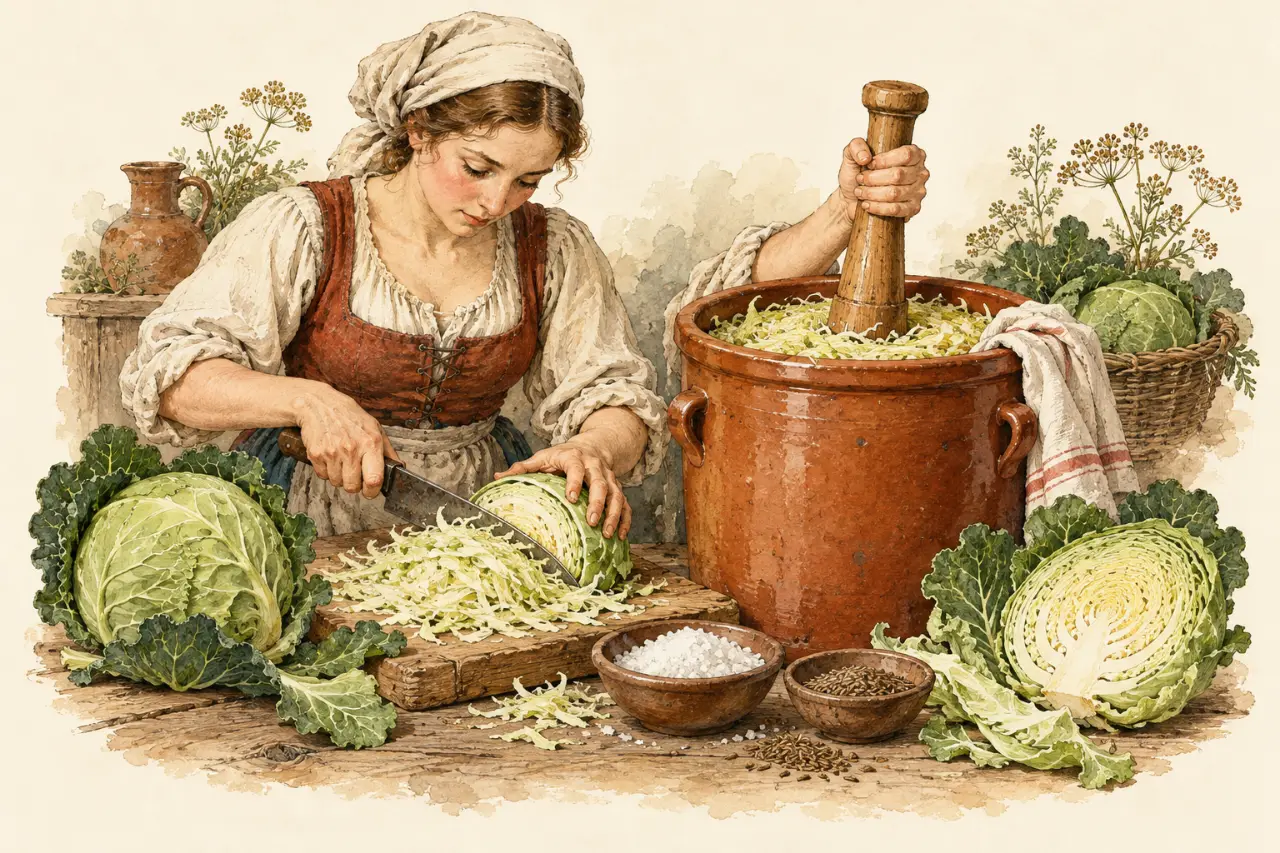
With winter on its way, cooking expert Linda Joyce Forristal decided it was the right time to talk about sauerkraut, one of humanity's most ingenious ways of making the most of the garden's abundance in months when there is no fresh fruit or vegetables. The piece ran in her cooking column in the magazine of the Weston A. Price Foundation.
For her, the miracle of sauerkraut is that the brine does not need to be inoculated with bacteria for the process to work. The best sauerkraut is made with just sliced cabbage and salt, and the bacteria that come from the air do the rest, as if by magic.
The Science of Sauerkraut: How Fermentation Happens
According to food science writer Harold McGee, author of On Food and Cooking: The Science and Lore of the Kitchen, the ideal salinity for sauerkraut brine is 2.25%, at a temperature between 18 and 21 °C. These conditions create the best environment for the bacterium Leuconostoc mesenteroides to multiply and produce lactic acid.
When the acidity of the brine reaches about 1%, another bacterium, Lactobacillus plantarum, steps in and finishes the job. The result is tangy, crunchy little pieces of cabbage, perfect for topping a sandwich, such as a choripán (Argentine sausage sandwich), or for balancing a heavy meal.
How to Make Sauerkraut at Home
In practice, the lesson from McGee and the author comes down to three points:
- Just cabbage and salt. There is no need to add a starter or a bacterial culture: the right bacteria arrive on their own.
- The right amount of salt. The ideal brine has about 2.25% salt, the point at which lactic acid bacteria work best.
- Mild temperature. Between 18 and 21 °C, fermentation goes down the right path. In Eastern Europe, as we'll see later, the barrels sit on the porch in early autumn and move down to the cellar when it gets cold.
The full step-by-step is in our sauerkraut recipe. The technique behind it, which works for many other vegetables, is the subject of Lacto-Fermentation: What It Is and How to Do It, adapted from the foundation's article Lacto-Fermentation.
A Whole Book About Sauerkraut
The passion for sauerkraut has even inspired a book. A Passion for Sauerkraut: The Humble Vegetable for Good Health, by Sam Hofer, published in 2001 by Hofer Publishers of Saskatoon, Canada, is full of curious stories about sauerkraut and fascinating recipes, including a chocolate cake made with sauerkraut.
Whole-Head Sauerkraut, Eastern European Style
In much of Eastern Europe, sauerkraut isn't made only with sliced cabbage, but with the whole head of cabbage. The author says she has seen huge barrels full of whole cabbages fermenting in brine.
In early autumn, when the temperature sits between 18 and 21 °C, the preparation can happen on the porch. When the weather turns cold, everything moves to the basement or cellar. When sauerkraut is on the menu, someone simply fishes a head of cabbage out of the barrel and chops it.
In many Eastern European countries, whole leaves of fermented cabbage are stuffed with meat, rice and vegetables, in a family of dishes that includes our cabbage rolls.
Sauerkraut's Cousins Around the World
European sauerkraut has many cousins around the world. Three of them are among the author's favorites.
Kimchi, Korean Sauerkraut
One of her favorites is Korean sauerkraut, kimchi. In the old days, Korean housewives fermented cabbage in autumn and early winter and kept the kimchi in clay pots buried in the ground, just below the layer of soil that freezes in winter. Besides cabbage and salt, the mixture included chili pepper, garlic and ginger, and everything stayed covered, fermenting for weeks.
In Korea, kimchi goes with almost every meal. Before it was easy to find in the United States, immigrants brought theirs across the ocean. The author heard the story of a Korean woman going through US customs with her jars of kimchi when one of them broke on the conveyor belt. It was chaos: nobody knew what that pungent, foul-smelling thing could be. To make your own at home, see our kimchi recipe.
Curtido, Latin American Sauerkraut
Another favorite is curtido (or cortido), popular throughout Latin America. The basic formula calls for sliced cabbage and carrot, chili pepper to taste, salt and seasonings such as oregano and cumin.
Each of the author's Salvadoran friends makes theirs a little differently, and differently every time. Curtido is always served alongside rich, fatty foods, and sometimes piled on top of them, like pupusas, cheese-filled tortillas typical of El Salvador.
Hum choy, Chinese Sauerkraut
Chinese sauerkraut is called hum choy. To make it, leaves of Chinese cabbage (what Brazilian farmers' markets call acelga) are covered in salt and left to wilt in the sun. Then they go into clay vessels and are covered with rice water, the liquid left over from rinsing rice before cooking.
The jars are sealed so as to eliminate all air bubbles and kept in a cool corner of the house. Fermentation takes about four days, and the leaves turn soft and a yellowish green.
Sauerkraut Benefits
Many sources claim that raw fermented foods are good for the digestive system, because they increase healthy gut flora or create the environment for it to thrive. According to the author:
- Gut. Sauerkraut and its juice are traditional folk remedies for constipation.
- More nutrients. Fermentation increases the nutritional value of cabbage, especially its vitamin C content.
- Protein. Fermented foods are said to make it easier to break down and assimilate protein.
- Nervous system. They are also said to have a calming effect on the nervous system.
Winter's vitamin C
Before refrigeration, sauerkraut was the only source of vitamin C during the winter in northern climates. It was also taken along on long sea voyages to prevent scurvy.
During the American Civil War, some enlightened doctors gave sauerkraut to prisoners of war and, according to the author, the death rate from smallpox dropped from 90% to 5%. Writing in 2001, she noted that this was worth paying attention to, given the concern at the time about the use of the smallpox virus as a biological weapon.
Nu&Cru's Ancestral Complementary Feeding Guide includes sauerkraut among the fermented foods offered to babies from 6 months of age.
Sauerkraut with Fatty Meats: the Perfect Pairing
Best of all, according to the author, sauerkraut forms a synergistic combination with heavy, fatty, cooked foods, such as sausages and cooked meats, precisely the kind of food that nourishes us in winter.
And since it aids digestion, all you need to do is put sauerkraut on the plate as a side dish to eat these meals without feeling sleepy afterward. This is the logic behind classics like pork knuckle with sauerkraut.
Read also
On Nu&Cru
- Lacto-fermentation: what it is and how to do it
- Natural sourdough bread: the Swiss lesson
- Oatmeal porridge: how to make it more nutritious
- Fermented food recipes: sauerkraut, kimchi, pickled cucumbers, fermented hot pepper, fermented mustard and fermented ketchup
- To serve with sauerkraut: pork knuckle with sauerkraut, sausage and cabbage rolls
- Ancestral Complementary Feeding Guide, with fermented foods for babies from 6 months
- 181 Receitas Ancestrais, Nu&Cru's recipe book (181 Ancestral Recipes)
At the Weston A. Price Foundation (in English)
- Lacto-Fermentation
- FAQ-Fermented Foods
- Purple Sauerkraut with Fennel Seeds
- Fermented Vegetables, by Kirsten and Christopher Shockey
- Princípios Atemporais de Dietas Tradicionais Saudáveis (Timeless Principles of Healthy Traditional Diets) (in Portuguese)
This article is an adaptation of "Sauerkraut: The Miracle Cabbage," by Linda Joyce Forristal, published in the Weston A. Price Foundation's magazine Wise Traditions in Food, Farming and the Healing Arts in winter 2001. Read the original in English.
As informações têm caráter educativo e não substituem avaliação individual de profissional de saúde habilitado.