Blogbabies and children · family routine
Picky Eating in Children: Just a Phase or a Red Flag?
When food refusal is just a phase, what to track in your routine for one week, what helps at the table, and the signs that call for a pediatrician, dietitian or speech-language pathologist.
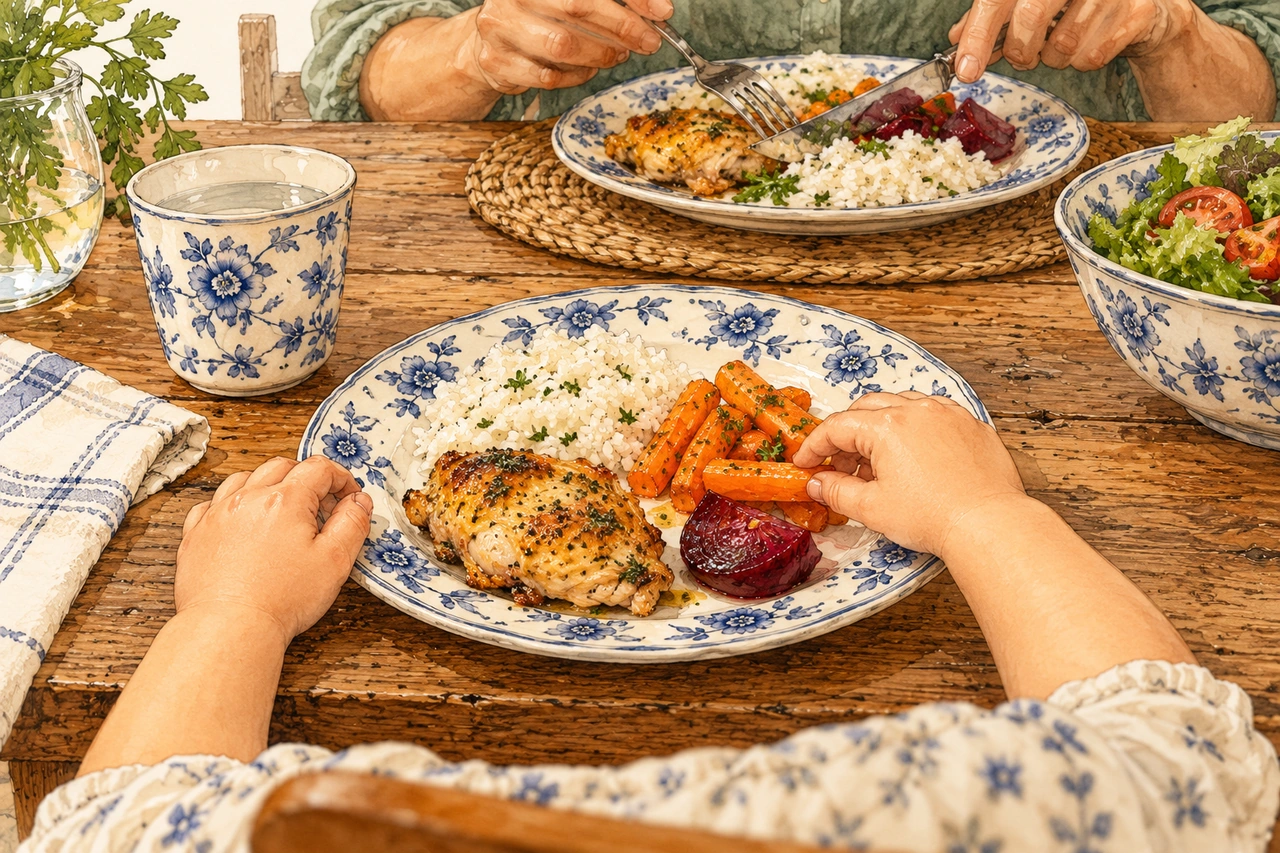
In most homes, the child who "won't eat anything" is going through an expected phase. After the first year, growth slows down and appetite drops with it. Between the end of the first year and age 2, wariness of new foods, called neophobia, reaches its peak. The Guia de Dificuldades Alimentares (Feeding Difficulties Guide) from the Sociedade Brasileira de Pediatria places this peak between 18 and 24 months and says that, when handled well, neophobia resolves on its own (p. 28). What makes the difference is offering the food again, without pressure, for weeks.
Refusal that comes with stalled or falling weight, gagging and frequent vomiting while eating, a list of accepted foods that shrinks month after month, or mealtimes that have turned into a daily fight for more than a month is something else. In these cases, the family should not wait for the phase to pass: the first step is the pediatrician. The full list of warning signs is further below, along with who to see in each situation.
This text helps you tell one situation from the other and organize your routine. It does not diagnose. Educational content; it does not replace an individual assessment by a health professional.
What to expect at each age
Picky eating changes its face with age, and a lot of worry comes from comparing the child with what they ate a few months earlier.
From 6 to 12 months: a grimace is not a refusal
A baby who wrinkles their nose at the first bite of pumpkin is getting to know a flavor that is different from milk. The Guia Alimentar para Crianças Brasileiras Menores de 2 Anos (Dietary Guide for Brazilian Children Under 2), from the Ministry of Health, says that grimaces do not mean the child disliked the food and that some children need to try a food more than eight times before accepting it (p. 107). If the refusal continues, the advice is to wait a few days and change how it is prepared: the carrot that came back mashed may be accepted in pieces the baby can pick up by hand (p. 116). For those just starting out, the roadmap for the first weeks is in baby's first foods.
From 1 to 2 years: less hunger, more opinions
In the first year, a child usually triples their weight; in the second, they gain between 2.5 kg and 3 kg over the whole year, and it is natural for them to eat less. They are also walking, talking, asking for things and getting distracted by everything. The Ministry's guide notes that at this stage the child may resist new foods or refuse some they used to like, that this is not permanent, and that acceptance improves with repeated offering and with other ways of preparing the food (p. 124).
After age 2: independence at the table
From age 2, the child starts to negotiate. The same guide points out that children who used to eat everything may start refusing leafy greens and vegetables at this age, and it advises continuing to put these foods on the plate at lunch and dinner, without pressure, letting the child choose among the options in the meal (p. 131).
When picky eating is more than a phase
Among feeding difficulties, the SBP guide (the Brazilian Society of Pediatrics) describes three patterns that are often mistaken for a phase (pp. 28 to 30). Mild selectivity, the "fussy eaters," who eat less variety than average even with frequent exposure, but grow and develop well. Highly selective eating, an intense and persistent refusal of foods with a certain taste, texture, smell or appearance, often with sensory sensitivity in other areas (the child avoids touching play dough, sand or grass), accepting only the same color, the same brand or the same preparation, and sometimes gagging when forced; the SBP notes that this pattern is common in children on the autism spectrum. And food phobia, a fear of eating that appears after choking, vomiting or painful feeding.
In searches you will also come across the acronym ARFID (avoidant/restrictive food intake disorder). It is a diagnosis from the psychiatric manual DSM-5 for people who cannot meet their own energy or nutrient needs for reasons other than a wish to lose weight, with medical or psychological consequences. This diagnosis is made by the health care team, not by the family or the internet.
Observe the routine for a week before changing the menu
Refusal almost never lives on the plate alone. Before inventing new recipes, spend seven days writing down what happens around mealtimes. It is what a professional will ask you at the appointment, and often the answer shows up in the notebook itself.
For each day, write down:
- The time of each meal and each snack. Include the piece of bread on the way to school and the biscuit from grandma.
- What was offered and what was eaten, in household measures: "three spoonfuls of rice, none of the meat."
- Everything the child drank between meals: milk, juice, bottle, water. For children under 2, also note the breastfeeds.
- Where and with whom they ate: at the table with the family, alone, on someone's lap, on the sofa.
- Whether a screen was on and how long the meal lasted.
- Sleep and mood: napped in the afternoon, arrived tired, was teething, had just been scolded.
- Texture and form of the refused food: cooked, raw, mashed, in pieces, mixed.
- Bowels and complaints: pain, constipation, vomiting, coughing or choking during the meal.
At the end of the week, look for patterns. The most common ones are simple to fix:
- A short interval between snack and lunch. The SBP recommends 4 to 6 meals and snacks a day, with only water in between (Table 2, p. 34). A child who nibbles at 10:30 a.m. arrives at lunch without hunger.
- Milk or juice close to the meal. The Ministry of Health guide notes that juice drunk close to mealtime leaves the child full and reduces the intake of other foods (p. 85). For children under 1 year, juice is not recommended.
- The refused meal replaced by a snack. When the refused lunch turns into yogurt or biscuits half an hour later, the child learns that refusing brings something else. The Ministry advises waiting a little and, if the child is hungry, offering a plate with the same food again, or waiting for the next meal (pp. 198 and 200).
- Tiredness. The 8 p.m. dinner of a child who woke up at 6 a.m. tends to end in tears, and the broccoli is not to blame.
Take the notebook to the appointment, whether with the pediatrician or the nutritionist. It saves time and keeps the conversation from depending on the memory of a difficult week.
What helps at the table
Everyone has their own role
The Ministry's guide sums up the division: adults choose the appropriate foods, and the child chooses from among them (p. 63). In practice, you decide what goes on the table, at what time and where the meal happens. The child decides how much to eat of what was served. This division takes away the pressure of convincing them with every forkful.
A routine that opens the appetite
Table 2 of the SBP guide has recommendations that apply to all children (p. 34):
- meals without distractions, with a neutral and pleasant attitude;
- limited duration, 20 to 30 minutes;
- 4 to 6 meals and snacks a day, with only water in between;
- food appropriate for the child's age;
- new foods offered systematically, up to 8 to 15 times;
- encouragement for the child to eat on their own, and tolerance for the mess that comes with the age.
The same food, prepared differently
Repeating doesn't mean serving the same thing the same way until the child gives up. It means offering the food again in different forms. Carrot can be cooked in the beans, roasted as sticks with fat, grated raw with olive oil, mashed, or mixed into little fritters. Egg can be boiled, scrambled or turned into pancakes. Put a small portion of the new food next to a food the child already accepts, and don't comment on it. Eating together, with enjoyment and praising the food, encourages the child, according to the Ministry's guide (p. 96).
For babies, moist preparations tend to be better accepted: the guide suggests adding a little of the cooking liquid from the vegetables, beans or meat when the food is dry (p. 116). A homemade bone broth does this job, with no salt in the baby's portion.
The child in the kitchen
Involving the child in choosing foods and preparing meals is a recommendation of the Ministry's own guide (p. 63) and an old habit in many homes: picking out fruit at the street market, washing vegetables, tearing leaves, stirring the dough. Often, a child who helped make the food tastes it with more curiosity. Leaving the week's menu in sight, on a sheet on the fridge, also takes away the surprise of dishes the child usually refuses.
Sweets are not a prize
If dessert becomes a reward for "eating everything", dinner turns into just the road to the sweet. The Ministry's guide advises against rewarding a child for eating what they don't like, because it creates a relationship of dependence between food and reward (p. 97). Strict restriction doesn't help either: in a study of 192 girls followed from ages 5 to 7, restricted access to foods, as reported by parents at age 5, predicted that the girls would eat snacks without being hungry at age 7 (Fisher and Birch, 2002).
For children over 2 years old, the approach that works in many homes is to take sweets off their pedestal: a homemade sweet shows up now and then, with the meal or after it, with no negotiation and no drama. Before age 2, the Ministry's guidance is not to offer sugar or honey, and honey never before 1 year of age (p. 104).
What tends to make refusal worse
- Pressure to eat. In an experiment with preschoolers, the children ate more and made far fewer negative comments when they were not pressured to finish their food (Galloway and colleagues, 2006). The SBP describes the cycle of "pressure to eat, refusal, more pressure, more refusal" (p. 32).
- "Cleaning your plate". The Ministry warns that forcing a child to eat everything harms their ability to regulate their appetite (p. 96).
- Hiding the food they refuse. The guide advises against hiding foods on the plate under other foods (p. 97). Blending liver into the family's sauce is a cooking choice; using it as a trick to fool a child who refuses it tends to undermine trust. Show what is on the plate.
- Screens. With a phone or TV on, the child eats automatically, without paying attention to the food (p. 97).
- Threats and punishments. Hitting, scolding or not letting the child leave the table are practices the guide asks us to avoid (p. 197).
- Restaurant-style menus. Preparing a different dish for each person is the style the SBP calls permissive, associated with a poorer diet (p. 32). Make one meal for everyone, with at least one item the child accepts.
When to seek professional help
The signs below call for a visit to the pediatrician, without waiting for the phase to pass:
- weight loss or stalled growth, which you can see on the growth curves in the Caderneta da Criança (Brazil's child health booklet); the Ministry of Health guide says that if weight gain is not good, it is a warning sign (p. 199);
- frequent gagging, coughing or vomiting while eating, pain when swallowing, or retching when certain textures touch the mouth;
- fear of eating after choking or after an illness that caused pain when eating;
- difficulty moving from purées and liquids to foods with pieces, dragging on longer than expected for the child's age;
- a list of accepted foods that keeps getting shorter, to the point that entire food groups disappear from the plate;
- refusal lasting more than a month, with long, stressful meals, the criteria the SBP (Brazilian Society of Pediatrics) uses to tell a feeding difficulty apart from parental worry (p. 26);
- apathy, meaning little interest in food and in the surroundings at the same time.
The pediatrician assesses growth, development and possible medical causes. The SBP recommends that children with feeding difficulties be followed together with a dietitian and a psychologist, and that a dentist, a speech-language therapist and a physical therapist join in when there is a problem with chewing, swallowing, or coordinating swallowing and breathing (p. 64). If the question is whether a nutrient is lacking, that assessment also belongs to the pediatrician and the dietitian, with lab tests when needed.
Without a warning sign, the help may be of a different kind. When the child is growing well but the household routine is hard, individualized nutritional guidance helps set up the menu, the mealtimes and the way food is offered. For babies who are starting solid foods and children up to around 2 years old, the complementary feeding consultation includes a full assessment and a personalized meal plan. For older children and the whole household, the Nu&Cru family consultation works with the same dietitians on topics such as breakfast and snacks, family meals and busy days. Neither replaces the pediatrician when there is a warning sign.
In the kitchen: how to build the plate for a child who accepts little
Choose an anchor food, something the child eats without resistance (rice, beans, potato, egg), and build the plate around it. Next to it, put a small portion of the food you would like them to get to know, with no comment. The food is the family's: the same pot, with the child's portion set aside before adding salt when they are small, as we explain in baby at the family table.
If you cook for a baby and get frustrated throwing food away after every refusal, portioning and freezing helps you offer the same food several times without waste. The safe step-by-step, with storage times and thawing, is in how to prepare and freeze baby food.
The Guia da Introdução Alimentar Ancestral (Ancestral Complementary Feeding Guide), written by Laura Valentim and Dalyla Peçanha and edited by Nu&Cru, covers the progression by stage, meal plans, more than 80 recipes and a chapter on organizing the routine. It is material to study at home; it does not replace follow-up with a professional.
Start with the notebook
Start the seven-day notebook today, at dinner. Next week, you'll know whether the refusal has a time of day, a drink or tiredness behind it, or whether there is a sign that calls for the pediatrician. If there is, take the notebook to the appointment. If there isn't and mealtimes are still hard, the notebook is the starting point for one of the consultations described above: it's what lets the nutritionist see the routine of your home.
Sources consulted
- Ministério da Saúde (Brazilian Ministry of Health). Guia Alimentar para Crianças Brasileiras Menores de 2 Anos. Brasília, 2019.
- Sociedade Brasileira de Pediatria (Brazilian Society of Pediatrics), Departamento Científico de Nutrologia. Guia de Orientações: Dificuldades Alimentares. São Paulo, 2022.
- Fisher JO, Birch LL. Eating in the absence of hunger and overweight in girls from 5 to 7 y of age. Am J Clin Nutr, 2002.
- Galloway AT et al. 'Finish your soup': counterproductive effects of pressuring children to eat on intake and affect. Appetite, 2006.
- Norris ML, Spettigue WJ, Katzman DK. Update on eating disorders: current perspectives on avoidant/restrictive food intake disorder in children and youth. Neuropsychiatr Dis Treat, 2016.
Part of this text is based on an article by Jen Allbritton published by the Weston A. Price Foundation.
As informações têm caráter educativo e não substituem avaliação individual de profissional de saúde habilitado.