Blogskin · tallow · cosmetics
Tallow Lip Balm: A Natural Lip Balm Without Petroleum Jelly
Tallow lip balm is beef tallow (rendered beef fat) with beeswax, and no petroleum jelly. See how it differs from standard lip balms, how to use it in cold weather and sun, and when to see a doctor.
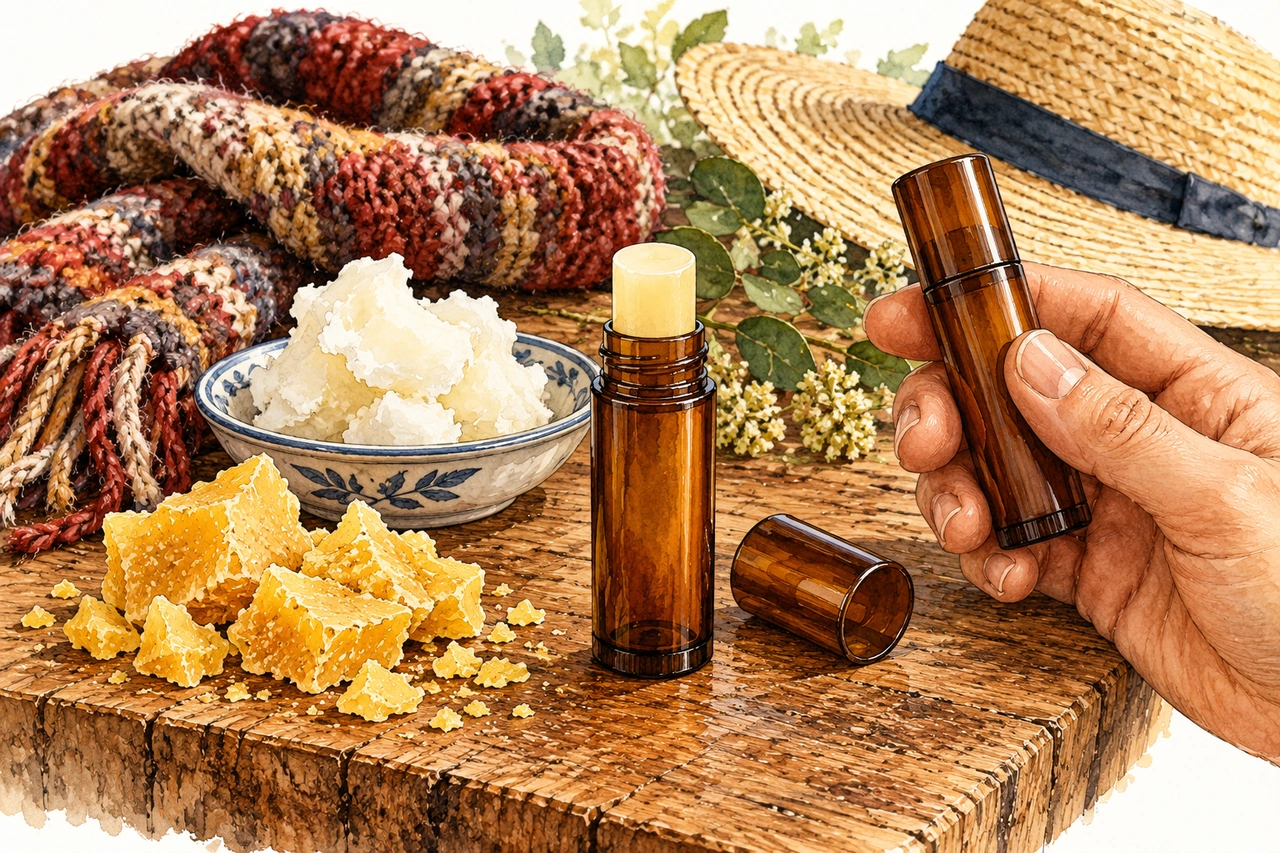
Beef tallow (rendered beef fat) and beeswax: in its simplest formula, a tallow lip balm needs nothing else. The tallow provides the soft part, which melts with the warmth of your mouth, and the wax adds firmness and forms the film that stays on the lip. With no water, petroleum jelly, fragrance or menthol, it is an ointment for everyday use, in the cold, in the wind and before bed. It has no sunscreen and does not treat sores, cold sores or cracks that won't close.
Two ingredients, two functions
Tallow. This is beef fat that has been melted and filtered, the same fat that goes into the cooking pot (the article what is beef tallow covers that side). Oleic, palmitic and stearic fatty acids predominate in tallow, according to a 2024 review on tallow on the skin. It is firm at room temperature and softens with body heat.
Beeswax. This is the wax bees produce to build their honeycombs. On cosmetics labels it appears as Cera Alba. It is harder than tallow and gives the balm body, so that it stays firm in the jar and doesn't run on the lip.
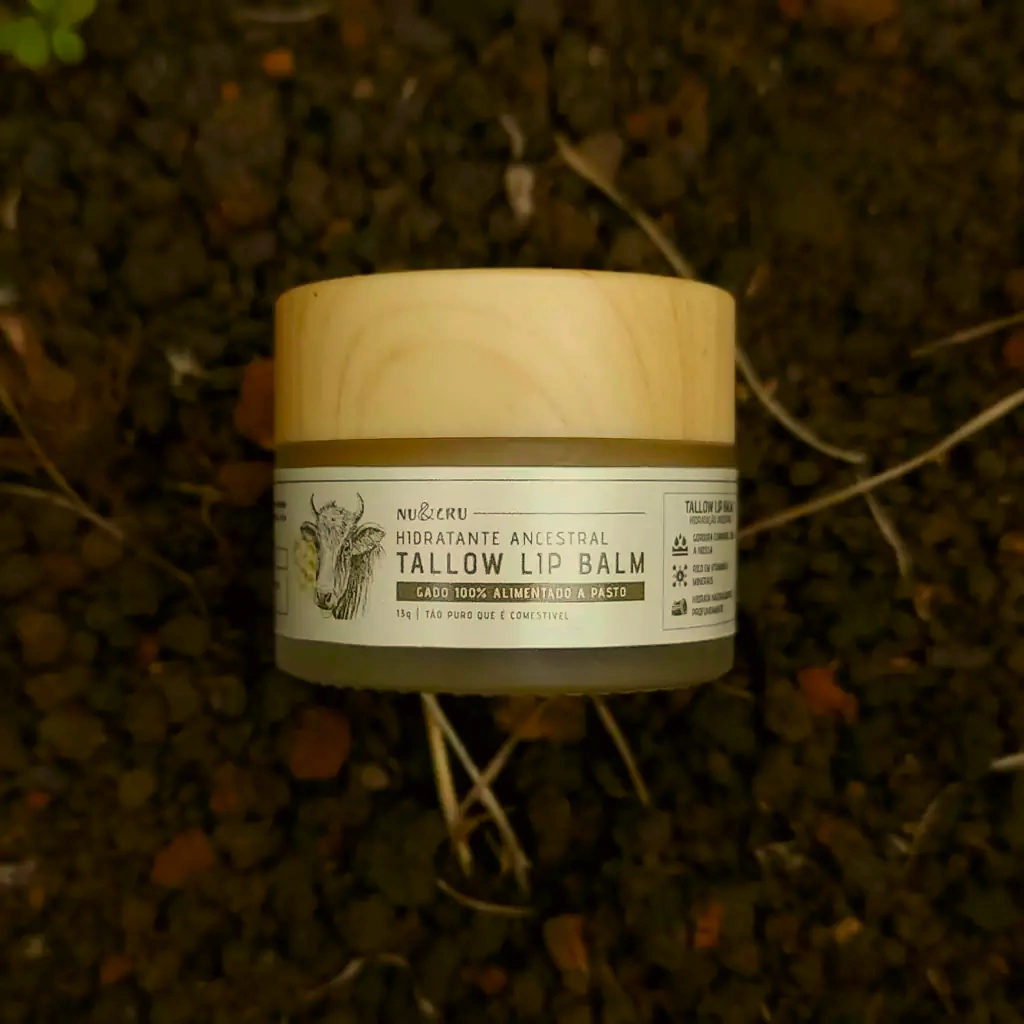
In the Nu&Cru lip balm, there are only these two: 100% grass-fed beef tallow and pure beeswax from small producers, with no petroleum jelly and no preservatives. The product page uses the phrase "so pure it's edible" and explains what it means: it is about the simplicity of the composition. The balm is meant for the lips, not for eating. The current batch is sold out, and you can reserve the next one through WhatsApp, on the same page.
Tallow with wax or petroleum jelly: what changes
Most drugstore lip balms use petrolatum (petroleum jelly, or "vaselina" in Brazil), a mixture of hydrocarbons derived from petroleum refining, often with fragrance, flavor and sunscreen added. It is worth saying clearly: petrolatum works. The American Academy of Dermatology (AAD) includes it among the ingredients that help dry lips, alongside shea butter, ceramides, castor oil and others.
The difference between the two formulas lies elsewhere.
Tallow and wax lip balm:
- animal-based raw material, which lets you know which cattle and which apiary it comes from, when the brand discloses it;
- two ingredients, which you can read and understand;
- firm texture, which softens with heat;
- no sunscreen.
Petrolatum lip balm:
- mineral-based raw material, industrially refined;
- a formula that varies widely from brand to brand, from a single ingredient to dozens;
- a more slippery, greasy texture, which usually leaves a shine;
- sunscreen versions exist.
Nu&Cru's choice of tallow and wax comes from a house criterion: raw materials of known origin, few ingredients, and no petrolatum, synthetic fragrance or synthetic preservatives in cosmetics. It is a preference about origin and formula, not a promise that tallow lip balm moisturizes more. We have not found a study comparing the two on human lips.
What helps and what makes dry lips worse
Before you reach for any product, look at your habits. The AAD summarizes dermatologists' recommendations.
What helps:
- applying lip balm several times a day and before bed;
- a humidifier in the bedroom, especially if you sleep with your mouth open;
- lip balm with SPF 30 or higher in the sun, reapplied every two hours.
What makes it worse:
- licking your lips: saliva evaporates and takes moisture with it;
- biting or pulling off loose skin;
- ingredients that irritate already dry lips, according to the AAD: camphor, eucalyptus, menthol, phenol, salicylic acid, fragrance and lanolin;
- cinnamon, citrus, peppermint and mint flavors.
In winter, the Brazilian Society of Dermatology recommends moisturizers made specifically for the lips to prevent cracking. The article dry skin in winter lays out the full routine, covering bath, hands, feet and lips.
How to use it day to day
- In the morning, after brushing your teeth, apply a thin layer. If you'll be in the sun, use a lip balm with sunscreen over it or instead of it.
- In cold and wind, reapply whenever your lips feel tight. A lip balm with no added flavor doesn't invite licking.
- Before bed, apply a more generous layer. This is when your lips go the longest without being licked, bitten or exposed to wind.
- To apply, use a clean, dry fingertip. If the balm is firm, hold your finger on it for a moment to soften it.
For the jar, the tip is the same as for any product without preservatives: dry finger. Water in the jar is exactly what the formula was designed to avoid.
Sun: lip balm without a sun filter doesn't protect you
A tallow and beeswax lip balm moisturizes, but it doesn't protect you from the sun. Anvisa itself separates the categories: under RDC 752/2022, "lip balm without sun filter" is a grade 1 cosmetic, while "lip balm with sun filter" is grade 2, which requires proof of efficacy. At the beach, in the countryside or on a day of strong sun, use a lip balm with SPF. Keep the tallow one for the rest of the time.
Who should be careful
Beeswax allergy exists, but it is rare. A 2026 review on propolis and beeswax in cosmetics concluded that reactions to beeswax in people allergic to propolis can't be ruled out, but seem uncommon and show up mainly as inflammation of the lips. A 2023 case report describes severe lip inflammation associated with the wax and other fats in lip balms. If you have a known allergy to propolis or bee products, talk to a dermatologist first.
For everyone, the test is simple: use it for two days on just one part of your lips and watch. Burning, itching, swelling or redness that spreads to the surrounding skin are reasons to stop.
Nu&Cru's lip balm is made for adults. The company does not recommend it for babies and children, and under Anvisa's rules, children's lipstick and lip gloss fall into grade 2, with their own requirements.
How to store it
The Nu&Cru lip balm label says to keep the jar out of the sun, in a cool place, with no need for the fridge, and to use it within about six months of opening. In a car or a bag in the sun, it can soften or melt. If that happens, let it firm up again in the shade. A rancid smell, similar to old oil, is a sign it has gone past its best.
When dry lips are not a job for a moisturizer
The AAD notes that chapped lips usually improve within two to three weeks of care. See a dermatologist when:
- they don't improve in that time, even with good habits;
- the lip becomes rough, whitish and flaky, always in the same spot: the AAD points out that actinic cheilitis, caused by the sun, is a precancerous lesion that leaves the lip dry and scaly;
- there are cracks at the corners of the mouth that don't close, sores or blisters;
- the lip swells or itches after a new product.
Lip balm takes care of dry lips. Sores, herpes and inflammation call for a diagnosis.
What to do from today
Choose a lip balm with no menthol, no fragrance and no flavor, apply it several times a day and before bed, and stop licking your lips. If the short formula of tallow and wax makes sense to you, the tallow lip balm page shows the composition and the origin of both ingredients. It is sold out, and you can reserve from the next batch via WhatsApp. For hands, elbows and body, the same logic is behind the Tallow Balm, also available by reservation, and the article tallow balm: what it is, who it's for and how to use it explains who it is not recommended for.
Educational content; it does not replace an individual evaluation by a dermatologist.
As informações têm caráter educativo e não substituem avaliação individual de profissional de saúde habilitado.