Blogskin · tallow · cosmetics
Tallow Balm: What It Is, What It's For, and How to Use It on Your Skin
Tallow balm is a beef tallow balm for dry skin. Learn what's in it, who should avoid it, and how to patch test, apply, store it and read the label before you buy.
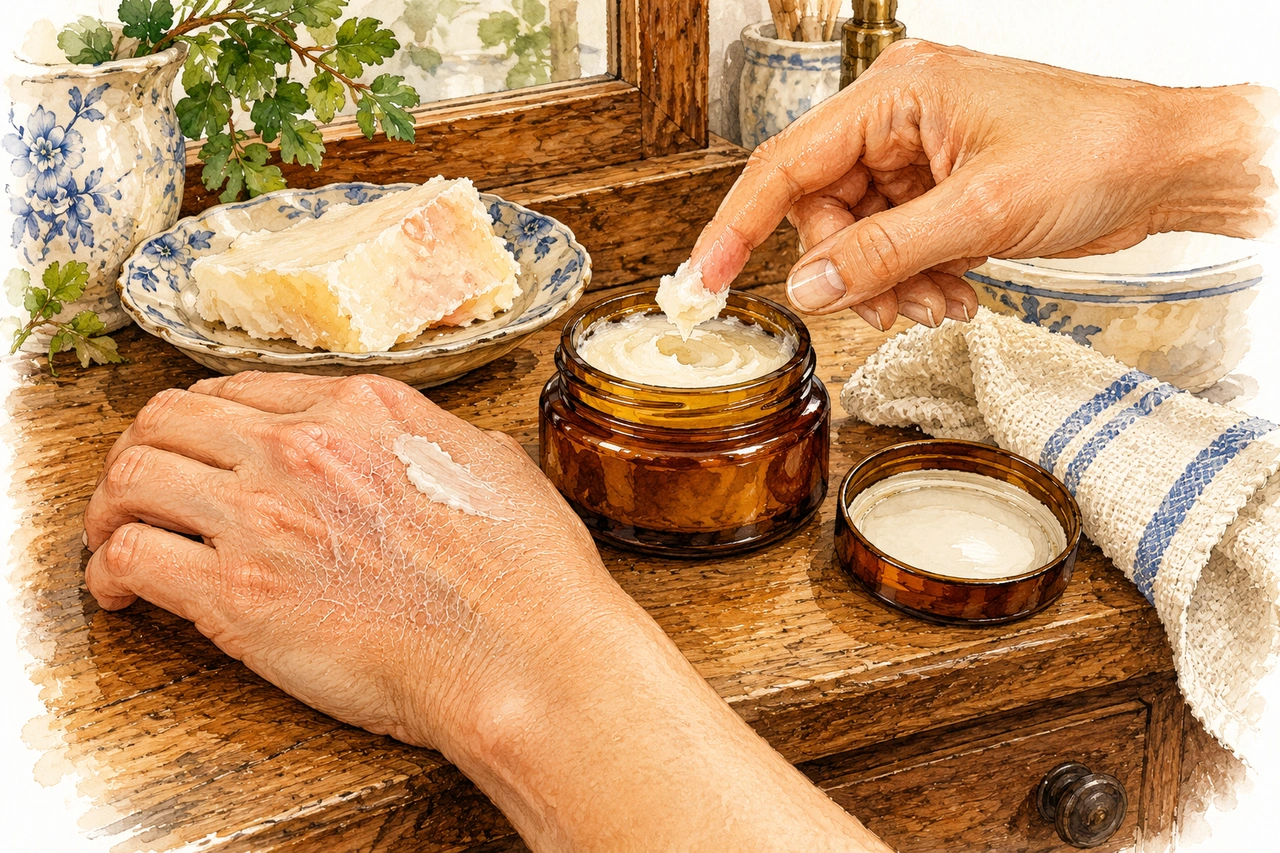
Tallow balm is a balm made from melted, purified beef tallow, sometimes with essential oils, used to moisturize and protect dry skin. It contains no water, so it isn't a cream: it's a firm fat that softens with the warmth of your fingers and leaves a thin layer on the skin. It makes sense for dry skin, hands worn out by dishwashing, elbows and areas exposed to the cold. For acne-prone or oily skin, dermatologists advise caution, and the claims circulating on social media that it treats acne, eczema or psoriasis have no studies to back them up.
What tallow balm is
Tallow is the English word for the fat of cattle and other ruminants (in Portuguese, sebo). In the kitchen, it's a fat for frying, roasting and sautéing (the article what beef tallow is and how to cook with it covers that side). For the skin, the tallow is melted, strained and, at many brands, whipped once it cools until it takes on a lighter texture. The result is an ointment: pure fat, no water.
For Anvisa, Brazil's health regulator, a balm like this is a cosmetic. RDC 752/2022, the regulation that governs the sector, defines cosmetics as preparations for external use made to clean, perfume, change the appearance of, protect or keep in good condition the skin and other parts of the body. A cream or balm for the face, hands or body "for the sole purpose of moisturizing" and without sunscreen falls under grade 1, the category of products with basic properties. A product for acne-prone skin is already on the grade 2 list, the one for products with a specific indication, which require proof of safety and/or efficacy. In practice, a cosmetic moisturizer moisturizes. Treating skin disease is the job of a medicine, which follows a different set of rules.
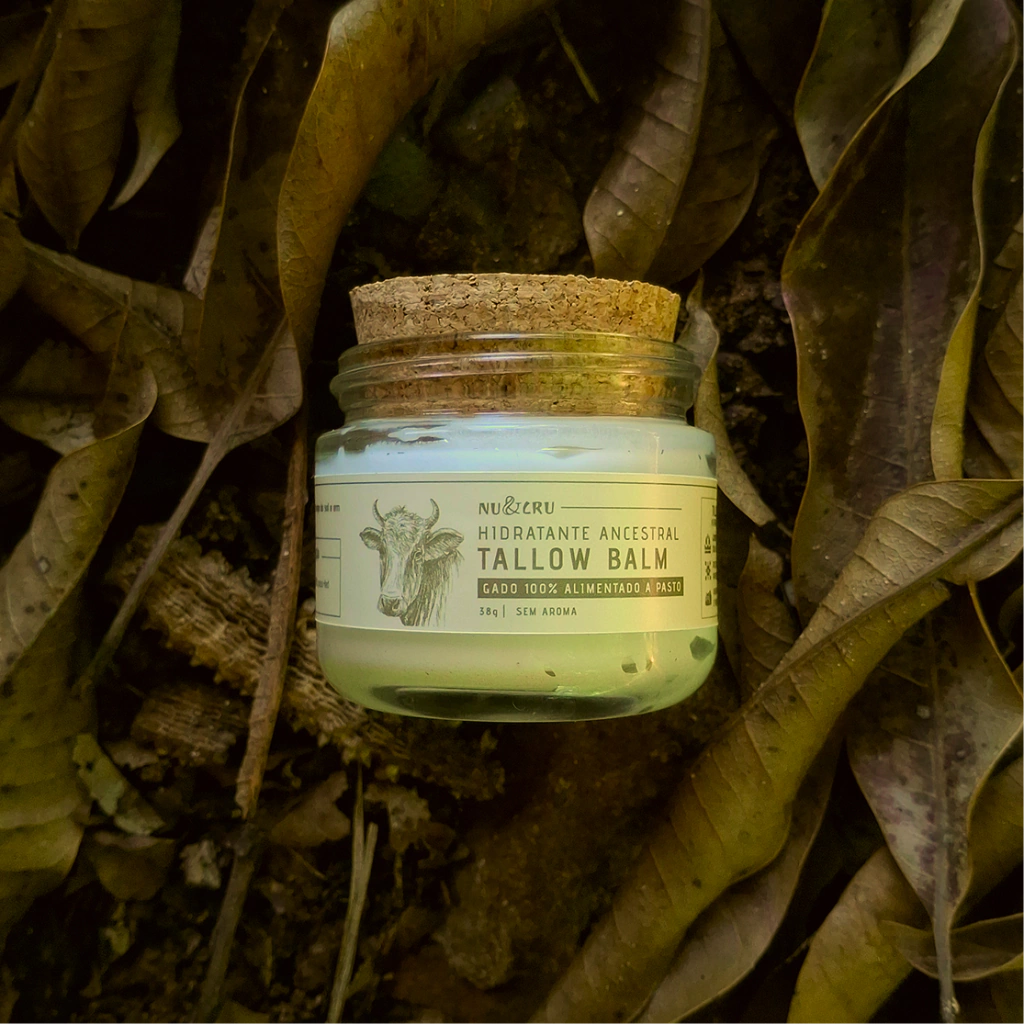
Nu&Cru's Tallow Balm is this kind of product: tallow from 100% grass-fed cattle, plain or with essential oils, with no preservatives, emulsifiers or artificial fragrances, in a glass jar. The current batch has sold out; the page shows what goes into each version and takes reservations for the next one via WhatsApp.
What's inside the jar
The tallow
Fat is made mostly of triglycerides, glycerol molecules attached to three fatty acids. What sets one fat apart from another is the proportion of those acids. Beef tallow is dominated by oleic, palmitic and stearic acids, according to a scoping review published in 2024 on the use of tallow on the skin. The saturated portion is large, which is why tallow stays firm in the jar and only softens when warmed between your fingers.
Almost every tallow balm package repeats that it's "just like your skin's own oil." The phrase holds a grain of truth and an exaggeration. The grain of truth: fatty acids such as oleic and palmitic acid are also part of the skin's lipids, and dermatologist E. Victor Ross, of the Scripps health system, points out that tallow is made mostly of fatty acids found in the skin's natural barrier. The exaggeration: human sebum has its own composition, different from that of other species, with components such as squalene and wax esters that appear nowhere else in the body, according to a review of sebaceous gland lipids. Chemical kinship, then, is not identity. And kinship doesn't prove an effect either: only a study in people could show that.
The essential oils
Many brands scent their balm with essential oils. At Nu&Cru, there are three scented versions besides the plain one: lavender with tea tree (melaleuca), lemongrass, and orange. Essential oils add fragrance and make the balm a pleasure to use, but they're also the part of the formula most likely to cause an allergy. A 2016 review of contact allergy to essential oils counted nearly 80 oils that had been involved in cases of dermatitis. Among those patch tested in series on patients with suspected allergy, orange and tea tree oils were among those with more than 2% positive tests. The same review notes that most reactions come from undiluted or highly concentrated oil and that cross-reactions with other oils and with the fragrance mix used in allergy testing are common.
The practical takeaway is simple. Sensitive skin or a history of fragrance allergy calls for the unscented version.
What's left out
With no water in the formula, the balm doesn't need an emulsifier, the ingredient that turns water and oil into a cream. The absence of water also explains why the formula can do without preservatives: microorganisms need available water to grow, and lowering water activity is one of the strategies for preventing contamination in cosmetics. That doesn't make the balm last forever. Fat oxidizes with time, heat and light, and a wet finger in the jar brings in exactly what the formula was designed to keep out.
What the research says, and what it doesn't yet
There are two recent papers worth knowing about before you buy any tallow balm.
The first is the 2024 scoping review, which searched for studies on the use of tallow on the skin and found 19 that fit, including comparative, laboratory and animal studies. The authors concluded that the literature supports the composition and possible benefits for the skin, but the evidence they gathered comes from comparisons, lab work and animals, and they call for research on tallow as a cosmetic in humans. Side effects were the point on which the sources disagreed most.
The second is a 2025 analysis of posts about tallow on YouTube, Instagram and TikTok, published in the Journal of Cosmetic Dermatology. Claims that it works against acne, atopic dermatitis and psoriasis were common and almost never came with evidence. Most of the posts showed a commercial interest and came from people with no health training. The authors conclude that the evidence is still insufficient to support those claims.
The Scripps dermatologist sums up the in-office advice: on very dry skin with no history of breakouts, a small amount may be well tolerated; tallow can clog pores in some people; and it's a poor choice for acne-prone or oily skin.
Nu&Cru's position fits within these findings. Tallow balm is a short-ingredient moisturizer for people who want to know exactly what they're putting on their skin. It isn't a treatment, and anyone with a skin condition needs a dermatologist, not a new jar.
Who it makes sense for, and who it doesn't
It makes sense for:
- dry skin on the body, especially in the colder months;
- hands that wash dishes and laundry and get rough;
- elbows, knees and heels;
- a dry face with no tendency toward blackheads and pimples, in a very thin layer;
- anyone who prefers a short formula, with no petrolatum and no synthetic fragrance.
Best avoided, or tested very carefully:
- acne-prone or oily skin: the Brazilian Society of Dermatology advises avoiding cosmetics that increase oiliness and lists contact with greasy products among the factors that make acne worse;
- people allergic to fragrance or essential oils: choose the plain version;
- skin with a wound, an infection or an eczema flare: in these cases, the first step is a doctor;
- babies: Nu&Cru does not recommend the balm for babies, and under RDC 752 itself, children's cosmetics are grade 2 products, with stricter requirements.
If you're here because of the cold, you'll find a complete routine, covering bathing, hands, feet and lips, in the article dry skin in winter: a simple routine for hands, feet and lips.
Patch test a small area before using it
The patch test is the step most people skip, and the one the Scripps dermatologist calls essential: apply a small amount to one spot on the skin for a day or two and stop if there's any irritation.
- Choose the inner forearm. If you plan to use it on your face, also test a small spot near the jawline.
- Apply a thin layer to the same spot once or twice a day for two days.
- Watch. The SBD explains that an allergic contact reaction usually appears 24 to 48 hours after exposure, with redness and sometimes swelling and small blisters. Burning, itching or redness are reasons to stop.
- On the face, keep watching for longer. If new blackheads or pimples appear over the following weeks, stop using it.
A home test is no substitute for patch testing done by a dermatologist, who applies dozens of substances to the back for 48 hours. Anyone who has had an allergy to cosmetics should talk to one before trying new formulas.
How to apply it
- Amount. Less than you'd think. The Tallow Balm page says a small amount is usually enough; start with a little and add more if your skin asks for it. If your skin is still shiny and greasy a few minutes later, you used too much.
- Warm it first. Scoop up the balm with a fingertip, warm it between your hands until it softens, and spread it with light pressure. When it's firm, it spreads poorly and you end up using more product than you need.
- Best time. Right after a shower or bath, while the skin is still damp. The SBD recommends moisturizing while you're still in the bathroom, and the American Academy of Dermatology gives the same advice, adding that ointments and creams moisturize more than lotions. The balm acts as the layer that holds in the water your skin has just taken up.
- Face. A very thin layer, ideally at night. During the day, the balm does not replace sunscreen, which the SBD recommends every day, in winter too.
- Hands. After washing dishes or your hands, once the skin has been patted dry with a towel. If you wash a lot of dishes, gloves help more than any moisturizer.
How to store it
- Dry fingers or a clean spatula. Water in the jar is exactly what a preservative-free product doesn't want.
- Jar closed, away from sun and heat. In the Brazilian summer, the balm can soften or melt. If that happens, let it firm up again in a cool place. The texture may change and become less whipped.
- Signs it's time to toss it: a rancid smell, like old frying oil, a change in color, or any spot of mold.
- Shelf life. Follow the expiration date on the label. The label on Nu&Cru's lip balm, for example, says to use it within about six months of opening, kept away from the sun in a cool place, with no need to refrigerate.
How to choose by the label
The Brazilian tallow balm market is new, and a lot of products arrive without a clear origin. RDC 752 spells out what a cosmetic label must include. Use this list as a filter for any brand.
- Full ingredient list, using the names from the International Nomenclature of Cosmetic Ingredients (INCI). Tallow appears as Tallow, beeswax as Cera Alba, and shea butter as Butyrospermum Parkii Butter. If you only see Parfum or Fragrance, there's a perfume blend whose components the label doesn't disclose, synthetic or not. If you want to avoid synthetic fragrance, choose a label that names each essential oil.
- Batch number, expiration date and manufacturer details: legal company name, CNPJ (Brazilian company registration number), customer service contact and the Anvisa registration process number.
- Origin of the tallow. "Grass-fed" with nothing else says little. Look for where the cattle come from and who makes the product.
- Claims. "Treats acne," "cures eczema" and "anti-inflammatory" have no place on a cosmetic moisturizer, by Anvisa's own definition. A brand that writes this is promising what the category can't promise.
- Packaging. Glass with a tight-sealing lid protects the fat from air. Protection from light is the cupboard's job.
The balm is the version for the body. For lips, Nu&Cru makes a two-ingredient balm, tallow and beeswax, and the article tallow lip balm: what it is and how to use it compares that formula with petrolatum-based lip balms.
Next step
If your skin is dry and not prone to breakouts, choose the unscented version, do the forearm test for two days and use a little, right after your shower. If your skin is acne-prone, oily or flaring up, the way forward is a dermatologist.
Nu&Cru's Tallow Balm is sold out. On the Tallow Balm page you can see what goes into each version (plain, lavender and tea tree, lemongrass, and orange) and reserve the next batch via WhatsApp. The tallow and beeswax lip balm is also available for reservation.
Educational content; not a substitute for an individual assessment by a dermatologist.
As informações têm caráter educativo e não substituem avaliação individual de profissional de saúde habilitado.